Editor’s Note: The following is a book excerpt from the new edited volume: From the Outrageous to the Scandalous: Re-imagining Christian Thinking and Scholarship in an Age of Tribalism and Ideological Resentment, eds. Robert H. Woods Jr. and Mark Allan Steiner.
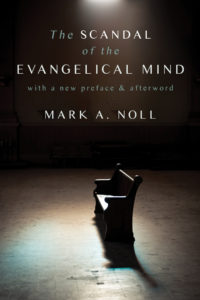
The assignment that I’ve been given is to attempt an assessment, now more than a generation after the publication of The Scandal of the Evangelical Mind1, about how I look upon the current situation for Christian learning and Christian activity in the American academic world. I was certainly no more than one of many voices at the time appealing for a healthy combination of, on the one side, rooted, stable, serious Christian faith, but also on the other side, open, dedicated, and discerning commitment to intellectual pursuits.
For today, I have a simple outline of two sets of two observations, so there are four points, none of them radical or dramatic. All of them are things that I’m sure you have talked about. First, the picture is brighter than it was. But second, the landscape is treacherous. Third, there are real problems in the Christian world. But four, there exist many ways forward.
The Picture is Brighter than it Was
When I was recently asked to prepare a new preface and afterward for a reprinting of the Scandal of the Evangelical Mind, I pointed out that compared to the situation 30 or 40 years ago, there are now many Christian voices actively publishing, actively contributing in many of our main academic disciplines. The book contains quite a few examples. Among the publications, I have been most impressed by works in serious Christian theology and Christian apologetics produced by philosophers—most of that work coming from university presses, especially Oxford University Press and Cornell University Press. Then there are the discipline-specific groups that have provided viable organizations to promote academic and extra-academic encouragement for believers.
It is also noteworthy that the 180 or so members of the Council for Christian Colleges and Universities include many institutions that are trying to do more than just protect their students from the outside world but are also trying to engage that world with Christian values and Christian thinking. On another front, the Veritas Forum has enlisted a stellar lineup of outstanding scholars willing to be identified as believers and is coordinating a major new initiative to bring training and mentorship in Christian learning to new generations of younger scholars.
I’m also struck by the Christian studies centers that have been established on many pluralistic campuses and with the national organization that now links these centers. It has been my privilege to visit or at least know something about such centers. They are usually funded and supported by local church groups but are doing a relatively new thing in maintaining an understated but genuine Christian presence on the campuses of pluralistic universities. Having such an organization sometimes reveals how much Christian activity is present in the academic realm of the institutions where they exist.
In sum, it is certainly not the case that we are living in a golden age of Christian learning. It is also certain that Christian scholars do not dominate either the intellectual realm or loom especially large in the public sphere. But it is a reasonable judgment to say that there is now more scholarship by individuals willing to be identified as believers, more scholarship with observable Christian meaning disseminated in pluralistic venues, more intentional Christian thinking about pedagogy, and more American academics regarding their work as a calling from God than ever before in the nation’s history.
The Landscape is Treacherous
For the humanities, which are the areas that traditionally have invited the most direct Christian thinking, declining enrollments mean declining job opportunities for aspiring scholars. We also live in a world in which experts on social media—those who really know how to use the internet, those who make video presentations attractive—dominate public discourse, and with a very large influence in the academic sphere as well. And this is not to speak of the ideological factors that are common knowledge. Political partisanship affects almost all academic domains. Cancel culture and politically driven interventions in public education make the academic life, which many people got into because it promised space and relaxation, precarious. Identity politics, the United States’s fraught racial history, the fact that most college and university environments favor progressive certainties concerning families, sexuality, race, and economic inequality—all of these realities can make it very difficult for religious believers who question the certainties that seem to dominate the university world of our day.
These difficulties are widespread in pluralistic academic settings, but sometimes also in institutions identified as Christian. Examples of slights, bullying, and discrimination against those who wish to express their faith even in appropriate ways are not uncommon. These difficulties are real. Thus, alongside what might be called, from some perspectives, the best of times for Christian intellectual life, we can also talk about the worst of times for the academic environment.
Real Problems in the Christian World
Third, there are real problems in the Christian world. For the life of the mind, I would identify the most serious problem as the disconnect between the academic world and the churches. Paul Miller is a well-regarded political theorist at Georgetown University who has published several well-received university press books. Recently he brought out The Religion of American Greatness: What Is Wrong with Christian Nationalism? from InterVarsity Press, with this sobering judgment: “We do not lack for good academic political theology [he lists several books from Christian and university presses], but that theology is not getting to the pews because pastors are not transmitting it.”2 The books he listed do not necessarily agree, but all show how to be a serious-minded Christian studying political life and the values that are influencing America’s political culture. Yet the solid Christian reasoning of that kind is not reaching the pews because pastors are not transmitting it. I would amend Miller’s conclusion only to say that this is a weakness lying at the feet of professors as well as pastors.
We do live in a world where the masters of social media tend to be partisan, populist, conspiracy mongers for whom scholarship, particularly disinterested scholarship, is a dirty word. My sense when working on the Scandal of the Evangelical Mind and still today is that that most academics want to do the kind of good quality work that will be recognized by their peers. But the churches mostly exist in a world where attitudes, outlooks, impressions, presuppositions, are dominated by what comes through social media and popular communications. It has taken me quite a while to realize that the American context constrains what academics can accomplish among academics, but even more in the world at large. There may be good quality thinking in the churches and by Christians in the academy. But that good quality work will not have the kind of impact it could have if there is not also attention to the means of propagation, the means of publicity, the means of presentation of solid work in the world. Although there are some healthy signs, it seems to me that Christian academics, along with scholars in general, have been slow to realize how important it is to think about communicating in the broader realm.
Many Ways Forward
After I published the Scandal of the Evangelical Mind, I heard from quite a few people who said in one way or another, “I feel that in my academic life, I can’t tell people that I’m a serious church member. I feel at church that I can’t tell people I’m committed to the academic life.” That situation is still with us, but there are now more opportunities in more different Christian churches for those who have a calling as academics to share that calling with the church, even as they are being strengthened in their personal Christian lives in the church.
. . .
Going further toward the goals of Christian learning is possible. And it’s appropriate at the end of this brief presentation, to repeat what seems to me to be the goals of all who are involved in the enterprise of Christian learning. One goal is clarity, seeing more clearly what God has made possible for those who are concerned about the world. But then another goal is charity, acting always with the understanding that all humans are made in the image of God, and all are called to redemption in Christ.