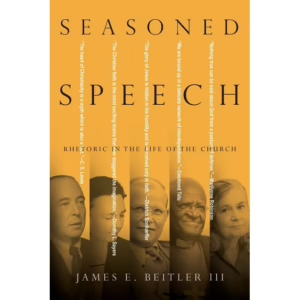
Seasoned Speech: Rhetoric in the Life of the Church

Losing Our Religion: An Altar Call for Evangelical America
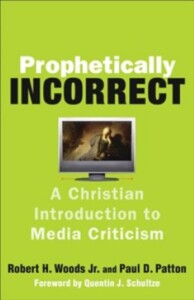
Prophetically Incorrect: A Christian Introduction to Media Criticism
At first glance, or even third, one might have difficulty seeing the connection between these three books. However, each makes a significant argument for the life of the church in this divisive age. How can Christians with divergent beliefs and markedly different political positions communicate with one another? How can the fractured church communicate to the many outside the church, sharing with them the Good News? Because the arguments among Christians are so extreme, the work of the church in reaching non-Christians is at risk. Because the arguments among Christians are so severe, the church often seems unable to encourage, edify, and unify its own members. Major Protestant denominations are losing membership, and painful tales of church fractures are growing. For example, In Losing Our Religion, Russell Moore, minister and editor of Christianity Today, relates his bitter journey out of the Southern Baptist Convention where he had been a member since childhood.[1] What to do? At least one possible aid may lie in the study of rhetoric. The new book addressed in this essay, When Politics Becomes Heresy, a finalist in the politics and public life section of the 2025 Christianity Today Book Awards, offers deep insights into our present conflicted trends. The two older books help us to recognize the role of rhetoric in those trends.
Rhetoric, not just or mere rhetoric, as people often encounter it, need not be lies, baloney, or propaganda. Rhetoric is an ancient discipline with its roots among the Greeks and Romans, and it figured as a major part of the early university curriculum. Although both the field and its definitions have often proved contentious, Aristotle’s definition is most commonly accepted—“the faculty of discovering in the particular case what are the available means of persuasion.”[2] James Beitler in Seasoned Speech: Rhetoric in the Life of the Church analyzes the rhetoric of five diverse Christian writers: C. S. Lewis, Dorothy Sayers, Dietrich Bonhoeffer, Desmond Tutu, and Marilynne Robinson. Demonstrating deep knowledge of both the history and concepts of rhetoric, Beitler makes a convincing argument for the value of rhetoric study in the life of the church.
Many Christian scholars over the years have considered rhetoric positively; Beitler lists Augustine and Erasmus, and Hugh Blair, George Campbell, and Richard Whately, ministers who advocated the use of rhetoric in schools and seminaries during the late eighteenth and early nineteenth centuries, along with modern scholars (12). Indeed, St. Paul advises in Colossians 4: 6, “Let your conversation be always full of grace, seasoned with salt, so that you may know how to answer everyone.”[3] In Acts 17 Paul himself demonstrated rhetorical skills in his speech at Athens. Christians need to reflect on their communicating, both in service of effective witnessing and in service of self-reflection.
The influence of C. S. Lewis (1898–1963) on Christian thinking has been considerable, as through Mere Christianity (1952), his apology for Christianity for modern believers. Through his rhetorical analysis of Lewis’s God in the Dock: Essays on Theology and Ethics (1970), Beitler maintains that ethos is particularly demonstrated by Lewis. Ethos is one of the three major appeals a rhetor should consider in creating an argument, according to Aristotle. Ethos is an appeal from character; what is thought about the speaker/writer. Lewis demonstrated respect and concern for his audience; he did not dismiss anyone, and he did not come across as self-righteous. Beitler summarizes that the nature of the ethos of Lewis was shown in “his willingness to address his audiences on their own terms, his forthright yet humble stance, and his attempts to cultivate communities characterized by goodwill” (37). Lewis made it a point to talk about the beliefs that unite Christians, rather than separate them. Moreover, Beitler commends “Lewis’s willingness to dialogue openly with non-Christians about matters of faith” (48).
Dorothy Sayers (1893–1957) is known for her popular mystery series about Lord Peter Wimsey and her essays on such matters as Christian education. Beitler contends that Sayers in her play, The Zeal of Thy House (1937), and other writings presented the importance of Christian creeds and doctrines in a winning way. Sayers’s rhetorical method in her plays is a technique advocated by Roman rhetorician, Quintilian, enargeia. Enargeia “involves depicting an event so vividly . . . that one’s audience feel[s] as they would if they were really there” (66). Sayers artfully and imaginatively represented the creed by “dramatizing dogma” (64). To achieve this end, Sayers, according to Beitler, used visualization to move the story. She also insisted on using “contemporary, everyday language—a rhetorical choice that helps the dramatist to move audience members” (73). In addition, Sayers used vivid realism “not only to move her audience but also to confront and disturb them” (74). The basic beliefs of the church, like the Christmas story, are not hidden in language but revealed in their power in Sayers’s work, from plays to novels to essays.
Dietrich Bonhoeffer (1906–1945), German pastor, theologian, and martyr at the hands of the Nazis, and Desmond Tutu (1931–2021), South African minister, activist, and winner of the Nobel Peace Prize, were both rhetors involved in politics. Beitler uses the rhetorical concept introduced by rhetoric scholar Kenneth Burke, identification, to characterize Bonhoeffer’s rhetoric in various essays, lectures, and writings. Beitler states, “For Burke, identification included all of the ways in which speakers and writers align themselves, or are aligned with, their audiences” (101). Bonhoeffer began to stand against Hitler’s government in 1933 “with rhetorical countermeasures that aimed to re-identify German Christians with those whom Hitler had displaced—Jewish Christians and, along with them, Jesus Christ himself” (104). A humiliated Christ who dies for all people is the Christ Bonhoeffer sought to preach, without flowery language. Bonhoeffer was executed for his beliefs.
Likewise, Desmond Tutu spoke out against the policy of apartheid in South Africa as anti-Gospel, and he worked his entire life, often in dangerous situations, to destroy the policy and bring new life to South Africa. Beitler applies to Tutu the concept of constitutive rhetoric, the idea that “our language that surrounds us influences all aspects of our lives” (138). Thus Tutu’s activist “ministry often involved stationing himself with the marginalized and the suffering, and his willingness to preach and comfort in the midst of charged situations” (131). Tutu worked and spoke for reconciliation and forgiveness while acknowledging the violence and destruction caused by apartheid. Beitler notes that “Desmond Tutu resolutely advanced a constitutive rhetoric that defined personhood in terms of human interdependence . . .” and “time and time again, Tutu positioned South Africans of all backgrounds as dependent upon and responsible for one another’s flourishing as humans” (138–39). Tutu sought to bring South Africa together by engaging in discussion with all South Africans. As a rhetor he was direct and plain, and called on the principles of Christianity to show people how to live with one another.
Finally, Beitler approaches the work of novelist Marilynne Robinson (1943-), author of the Gilead novel series. He brings back the notion of ethos—character. This concept of ethos is expanded here to include context and place. Robinson used lyrical language in portraying her characters sympathetically, both Christian and those struggling with faith. In addition, she portrayed the settings for characters as meaningful and powerful. Beitler notes, “Robinson’s verbal artistry—and her clear desire to describe rural Iowa in beautiful and even majestic ways—explains in part why so many readers want to spend time in her world” (175). Avoiding rejection of this world that God created, Robinson creates a place that “performs that hospitality for its readers by avoiding a didactic stance, and, instead, by dwelling with questions of the Christian faith” (189). Robinson’s rhetoric is inviting, relatable, and moving.
Ultimately, Beitler maintains that there is no one kind of rhetoric that Christians must use to represent Christ in the world, as shown by the diversity among Christian writers examined. Mikhail Bakhtin (1895–1975), literary theorist and philosopher, contributes the notion of heteroglossia, the use of many languages, a notion that Beitler advocates. He concludes, “I simply want to affirm the notion that, if the gospel of Jesus Christ is truly to reach the whole world, the church’s witness must go forth in multiple languages, through a variety of mediums, by the way of different genres and voices, using a host of rhetorics” (212).
Seasoned Speech provides a thought-provoking and well researched argument for the church to attend to rhetoric. The book is not an easy read and will appeal most to those with some background in rhetoric. A key lacuna in the book is that Beitler ignores the place of rhetorical analysis or evaluation—in what ways Christians can not only witness to others but can think critically about their own rhetoric and the rhetoric to which they are exposed. The other two books addressed in this essay will show how this evaluative element is more important than ever.
[1]. Moore’s book, Losing our Religion: An Altar Call for Evangelical America (Sentinel, 2023), tells an agonizing story but not an uncommon one.
[2]. Aristotle, The Rhetoric of Aristotle (Prentice Hall, 1932), 2.
[3]. All biblical citations are from the Concordia Self-Study Bible, NIV (Concordia, 1986).