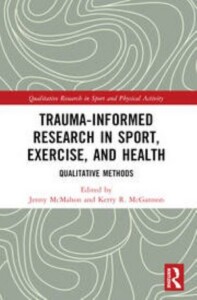
Trauma-Informed Research in Sport, Exercise, and Health: Qualitative Methods
Our review of the literature yielded no publications specifically on a theological and psychological understanding of trauma in sports, aside from an interview with Rachael Denhollander[1] and a book and two articles that touch on trauma-related issues in sports from a Christian perspective (e.g., resilience and identity).[2] There are several publications from the fields of sports psychiatry and clinical sport psychology that explicitly address psychological trauma (PTSD),[3] while none explicitly mention the potential salience of spirituality or religion. This oversight is also true of the text, Trauma-Informed Research in Sport, Exercise and Health. Nonetheless, this book—the first of its kind in the social sciences and sport and exercise sciences—provides an excellent general overview of trauma in sports, and especially the “what,” “why,” and “how” of conducting evidence-based, trauma-informed qualitative research in the domains of sport, exercise, and health. Within contexts such as social work, counselling, and the judicial system, evidence-based, trauma-informed practice is well established, while the editors of this anthology highlight that these practices are only emerging within the sports community generally (as is the case in the church, we would add), and qualitative research theory and practice.
In a quest to address this gap, editors McMahon and McGannon claim that “the book offers evidence-based, trauma-informed research practices, which qualitative researchers can use . . . to prevent causing further harm to participants while maintaining a strength-based approach. . . . It is a valuable resource for anyone working in athlete welfare, sport and exercise psychology, youth sport, sport development, physical activity and health, disability, gender, safeguarding, or social work” (Overview). On the whole, we concur, while recognizing the need for a biblical and theological lens to understand trauma more holistically, as articulated in the subsequent sections of this review. The book is organised into four parts relating to different trauma events: (i) Trauma and Gender-based Violence; (ii) Trauma In and From Sport; (iii) Trauma and Disability, Injury, Chronic, and Life-Threatening Diagnosis; and (iv) Developmental Trauma and Youth Trauma. Given the complex and often overlapping nature of human trauma, the editors and chapter contributors frequently remind readers that trauma origins, and their effects, are virtually always impacted by intersectionality.
The disciplinary and geographic diversity of this book’s contributors makes for an insightful read, which is indicative of trauma studies being typically interdisciplinary and globally relevant, while culturally situated. Trauma is analysed through specific topics and sports in a collection of thirteen generally well-curated chapters. Examples include examination of: various forms of abuse and eating disorders in elite female ballet, swimming, and artistic gymnastics (chapters 2, 3, 7, and 8); the disproportionate levels of trauma experienced by autistic (and non-binary) females in physical education, exercise, and sports settings (chapter 11); two “sport-for-development” interventions for the homeless and socially excluded—the Street Soccer Scotland and Street Soccer USA initiatives which are long-time partners of the Homeless World Cup (chapter 13); researching with young people “in care” within recreational sports and physical activity contexts (chapter 12); trauma and mental health in elite/Olympic athletes (chapter 6), and the transition from able-bodied life-sport to disabled life-sport due to spinal cord injury and limb amputation (chapters 9 and 10). These chapters certainly offer a fascinating, insightful, and at times challenging read.
Of course, in a book focussed on the “what,” “why,” and “how” of conducting evidence-based, trauma-informed qualitative research, methodological reflections comprise the substantive part of each chapter and include the use of diverse methodological approaches, data collection and analysis techniques, and ethical frameworks. Given the aims and embryonic nature of the book, some repetition of ideas and conclusions is understandable. Nevertheless, the second halves of most of the chapters are repetitive with authors rehearsing how they employed the guidance provided via the Substance Abuse and Mental Health Services Administration’s (SAMHSA) concept and guidance of a trauma-informed approach (2014) and practical guidance for implementing a trauma-informed approach (2023). That said, some chapters do discuss important nuances in the application of these widely accepted principles, due to differing participant characteristics, trauma-types, contexts, and the overarching research methodology deployed. For clarity, we will now summarise (from across all chapters) some of the key recommendations regarding conducting evidence-based, trauma-informed qualitative research in sport, exercise and health:
- A good general understanding of trauma is essential for interviewers, as recognizing verbal and non-verbal cues surrounding surfacing trauma allows the researcher to “put the brakes on” if necessary, so to lessen the chance of re-traumatization.
- To so avoid harm and re-traumatization of participants during data collection and other relational interactions (e.g., ethnographies), researchers need to be cognizant of the basic life-trauma-history of each participant, their potential trauma triggers, and related issues surrounding intersectionality meanings (e.g., gender, disability, politics, race, class, culture, sexuality, and religion).
- When designing a research project, draw on the expertise of a person with lived experience of trauma, and/or cultural/contextual insiders, and consider adopting a longitudinal design that allows for trust and vulnerability to develop between researcher and participant(s) over time.
- Adopting approaches such as “narrative inquiry” and “narrative interviewing” allows for storytelling, which empowers the participant (through voice and choice), gives them a sense of agency, and is potentially a cathartic/healing experience.
- Research should always be designed adopting a “strength-based-approach” where participants are afforded opportunities for “post-traumatic growth,” the development of hope and resilience, greater self-understanding, and even a measure of healing—while healing is not the principal aim, it may occur in non-clinical settings, such as research.
- Given that individuals suffering from certain types of abuse (e.g., sexual) and PTSD, as well as those with autism, may find it difficult to talk about their trauma, researchers can use “mind-map” drawings and arts-based ethnographies, for example, using poetry, photography, drama, dance, digital storytelling, theatre performance, painting, craft, and sports, etc. These non-verbal methods can assist in slowly piecing together and expressing the often complex and fragmented trauma histories of individuals.
- Ensuring psychological “relational safety” is paramount both in optimizing participant care and the quality and authenticity of the findings. Examples include: allowing participants control and power in the research process, for example, being able to choose the means (e.g., in-person or virtual interview) and physical location of data collection; adopting “active” consent which allows the data collection process to be paused, stopped, or terminated by the participant at any point; addressing gender power differentials (a potential trigger), especially when interviewing or observing participants who have experienced gender-based violence; and using interviewers that are “cultural insiders” (e.g., retired elite swimmers interviewing elite swimmers), which often helps with establishing trust and increasing vulnerability and sharing by the participant and, if appropriate, the researcher.
- Researcher self-care is vital due to the risk of vicarious trauma, compassion fatigue, and burnout from listening to often horrific stories of abuse. Examples of self-care methods are peer support, mentoring, and debrief; awareness of one’s own trauma, triggers, and inner world; ensuring data collection and analysis points are appropriately spread out over time; and seeking professional help if needed.
- Adopt a posture of “cultural humility” that entails open conversations with participants. Seeking genuine understanding about their context and background is important.
- Participation in sport and exercise—if appropriately framed and led—can be a valuable part of the journey of trauma healing, and an antidote to hopelessness, fear, depression, and anxiety for refugees, the homeless, and those with mental health challenges or addictions (see chapter 13). Many sport-for-development projects in the Middle East, Northern Ireland, and in refugee camps across the globe seek to contribute to trauma healing through the vehicle of sport.[4]
In addition to these recommendations, we suggest that training/mentoring in evidence-based, trauma-informed practice should be compulsory for researchers in universities that conduct empirical research into sports, exercise, and health, and embedded in undergraduate and postgraduate research methods courses. In summary, the editors of this volume set out to “address a significant gap in the market by providing a qualitative research resource that outlines the ‘what,’ ‘why,’ and ‘how’ of trauma-informed practices, in turn suggesting ways forward for those interested in conducting trauma research” (9). For the most part, we believe that they have accomplished their goal and we highly recommend this book. Within the Introduction, the editors also observe that there is a significant evidence base demonstrating that trauma “can impact a person developmentally in three ways: neurologically, physiologically, and psychologically” (1). Again, we agree with this sentiment, while noting that trauma can also impact a person spiritually, and to this end, we turn to Hunsinger’s Spiritual Trauma Care, so to more holistically understand the sports-trauma nexus.
[1]. Paul Putz, “A Conversation with Rachael Denhollander on Sports, Theology, Justice and Identity,” Faith and Sports (blog), Baylor University, August 10, 2020, https://blogs.baylor.edu/faithsports/2020/08/10/a-conversation-with-rachael-denhollander-on-sports-theology-justice-and-identity/.
[2]. Diane M. Wiese-Bjornstal et al., “Exploring Religiosity and Spirituality in Coping with Sport Injuries,” Journal of Clinical Sport Psychology 4, no. 1 (2020): 68–87; Brian Hemmings, Nick J. Watson, and Andrew Parker, eds., Sport, Psychology and Christianity: Welfare, Performance and Consultancy (Routledge, 2019).
[3]. For example, see Donald R. Marks, Andrew T. Wolanain, and Kendhal M. Shortway, eds., The Routledge Handbook of Clinical Sport Psychology (Routledge, 2021); David A. Baron, Claudia L. Reardon, and Steven H. Baron, eds., Clinical Sport Psychiatry: An International Perspective (John Wiley & Sons, 2013).
[4]. Frida Björkman and Örjan Ekblom, “Physical Exercise as Treatment for PTSD: A Systematic Review and Meta-Analysis,” Military Medicine 187, no. 9–10 (2022): 1103–13; Zoe Dean, “Sport as a Way to Heal Trauma for Child Refugees,” Red Sea Executive Search, August 3, 2021, https://www.redseasearch.com/2021/08/03/sport-as-a-way-to-heal-trauma-for-child-refugees/.