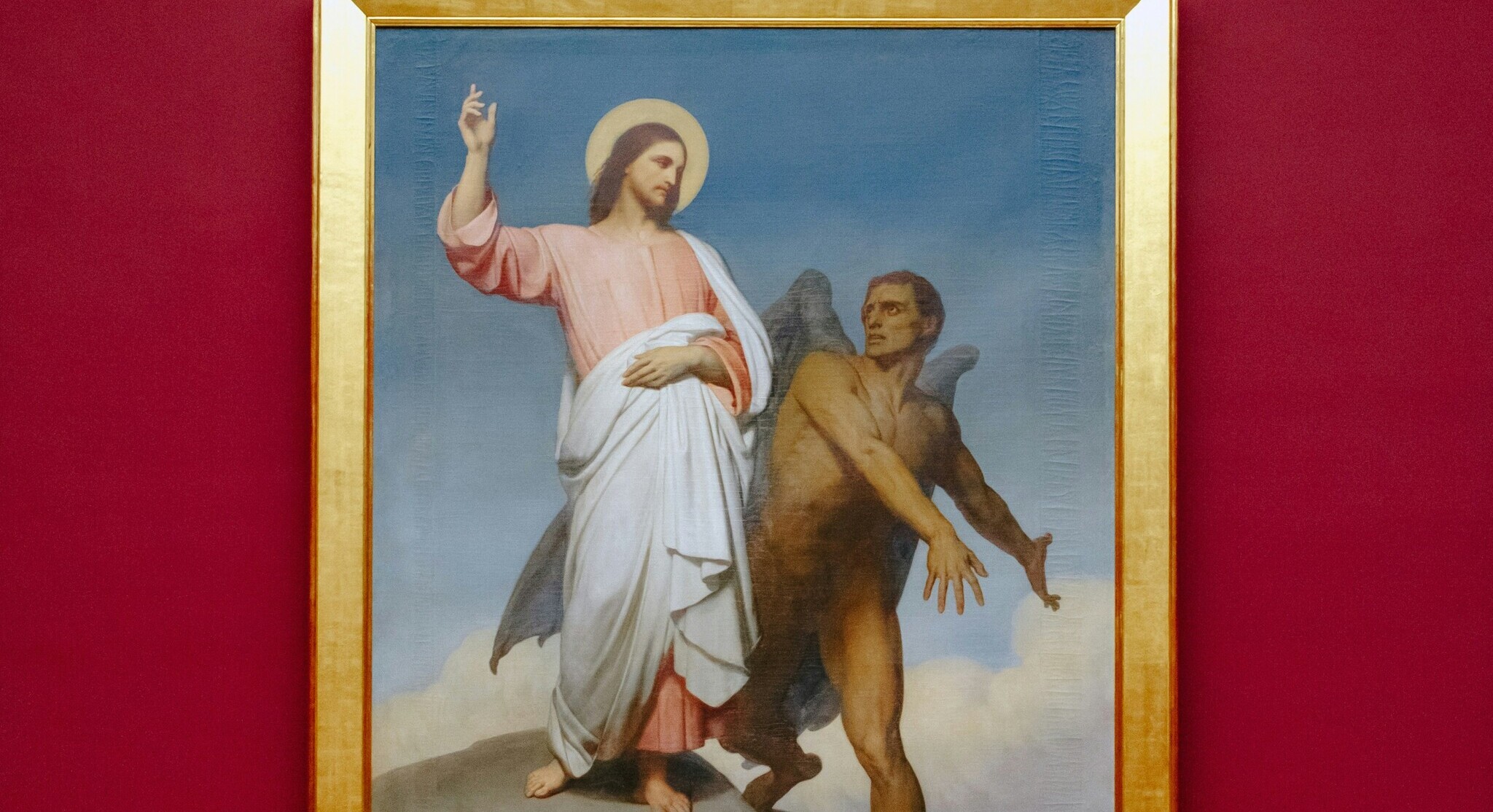
How can Christian intellectual institutions—institutions dedicated to pursuing and understanding the good, the true, and the beautiful in the name of Christ—respond to an age of nihilism? That is the question raised by Dr. Hunter’s address, and it is the question I want to take up.
In some ways, this can seem like a question asked from the margins. There was a conversation earlier about the closing paragraph of Alasdair MacIntyre’s After Virtue, where he called for “another—doubtless very different—St. Benedict.”[1] That passage was interpreted by the writer Rod Dreher in his 2017 book-length treatment, The Benedict Option, which was taken, rightly or wrongly, as calling for retreat—for small, encapsulated communities to withdraw from what Aaron Renn has described as the “negative world.”[2] Just hole up, create a separated institution, a parallel culture, a counterculture; put your head down and wait until the barbarians have settled down in a few centuries.
As Dr. Hunter expressed, I think this moment is one of even greater rupture than that. That strategy will not work, even if you try it. Instead, there seems to be so much disorientation in the wider culture about the solidarity of common ends, common truth, and common ideals of the good, that we have an opportunity as Christian intellectual institutions to speak to the whole wider culture. I can only speak anecdotally. As the editor of Plough Quarterly, recently I have found a remarkable openness, for example in the humanities departments at certain elite universities, to invite in Christian voices in a way that five years ago I would have found unimaginable.
Having said that, I want to focus specifically on what Christian intellectual institutions can do, because if we are not doing it well ourselves, we will not be able to have those conversations or make those contributions.
This year, we mark the 250th anniversary of the United States of America—and we mark it in a time of soberness about where this national project is going. Is the vision of the “city upon a hill” conjured by John Winthrop in 1630 of any relevance to what we are doing in this country today? Does Lincoln’s Second Inaugural Address still speak to our national project going forward? Does the conversion of Sojourner Truth in the Hudson Valley in the late 1820s, about two miles from where I grew up—her conversion to Christ, which inspired her to dedicate her life to the liberation of the enslaved and of women—does that still speak to what we are doing with the United States of America today?
I am not going to answer those questions, but that framing helps us think about our task as Christian institutions today. As we heard from Dr. Hunter, America’s soul, if you want to express it that way, appears sick and at war with itself. I find persuasive Dr. Hunter’s diagnosis of the sickness as an age of nihilism—not of nihilists, but of nihilism. An Age of Nietzsche. A denial of the good, the true, and the beautiful. A denial of the solidarity based on the transcendentals that can bind a nation together. And the temptation to substitute for these the naked will to power.
Dr. Hunter also warned us not to be complacent. This moment, in his assessment, is one of deep rupture. In his book Democracy and Solidarity,[3] he points out that it is probably not enough to say, as a mother might say to her toddler, “Everything’s going to be okay, honey.” Good cultures do die. Anglo-Saxon Christianity disappeared beneath the onslaught of the Norsemen. Seventeenth-century Japanese Christianity did not entirely disappear, but it was largely suppressed by the determined persecution of the Tokugawa shogunate. I lived in Eastern Germany for seven years—the birthplace of the Reformation, the land of Luther, the University of Wittenberg—and in the region where I lived, church leaders told me that only around ten percent of the population believed in Jesus. Communism was very effective at suppressing the faith over three generations.
So perhaps not everything will be okay. But as Dr. Margaret Diddams just told us, we are people of hope because we believe that “crowns and thrones may perish, kingdoms rise and wane, but the Church of Jesus constant will remain.” That is the hope that must inspire us as Christian intellectuals, as Christian humanists. What cure can we offer for nihilism, working through Christian institutions?
I obviously cannot answer that question fully here, but I do want to draw on one moment earlier in history that can offer us three hints, because we are not the first generation to confront an Age of Nietzsche. In 1920s Germany, World War I had just ended. On the left, communists were cloaking their will to power in the language of universal brotherhood. On the right, identitarian movements were making appeals to ethnic solidarities, foregrounding the supposed biological differences between races. Prominent Christian churches had lost credibility with wide swaths of the young. An arrogant scientism combined with social Darwinism rejected the Christian teaching that human beings are made in God’s image—not wholly unlike the eugenic and transhumanist fixations so popular in Silicon Valley. It is not an exact analogy to today, but people have been in a similar age to ours before.
I want to single out one thinker from that time: Eberhard Arnold, a theologian and philosopher who happens to be the founding editor of Plough Quarterly magazine. Just nine years after Nietzsche’s death, Arnold submitted a doctoral dissertation on Nietzsche; he consulted Nietzsche’s sister and did considerable original research. The title of the dissertation—Early Christian and Anti-Christian Elements in the Development of Friedrich Nietzsche—gives you a hint of his argument: that nihilism can serve as a goad for the purification of Christianity.[4] There are three things Arnold does in that dissertation and his subsequent writings on Nietzsche that I want to touch on: the first is to resist ressentiment; the second is to recover roots; and the third is to announce that another life is possible.
Dr. Hunter told us about how victimhood narratives are used today to create solidarity between identitarian groups, and how that has substituted for a wider solidarity of common purpose. A big driver, as he explains in his book, is ressentiment. Nietzsche defines it in The Genealogy of Morals as the affect of “natures that are denied the true reaction, that of deeds, and compensate themselves with an imaginary revenge.”[5] Ressentiment divides people into victims, who define themselves as morally good, and oppressors, whom they define as evil. In recent years, such victim-oppressor narratives have come to sound quite familiar. As Dr. Hunter said, it may be that those narratives are based on genuine grievances. But the dynamic itself is what is problematic.
What is interesting, though, is that when Nietzsche talks about ressentiment, he is not talking about the nineteenth-century equivalent of today’s woke activists or Nick Fuentes fans. He is talking about Christians. For Nietzsche, Christianity was first and foremost the religion of ressentiment—a religion of the weak and undistinguished who compensate themselves with dreams of revenge on the strong and excellent. He had great fun quoting Tertullian’s lurid description of the punishment of unbelievers on the Day of Judgment, for example.
The historian Tom Holland has argued in his book Dominion[6] that Western culture, even after secularization, remains in its nature Christian in its concern for the excluded and marginalized and its belief in equality. Holland, I think, largely means this as a compliment, and in recent years has tiptoed up to the edge of Christian faith himself. But Nietzsche’s ressentiment is the shadow side of Holland’s thesis. Christianity, Nietzsche charges, is to blame for the modern fixation on victim narratives.
Eberhard Arnold, the man who founded the magazine I now edit, argues that Nietzsche is at least partially right—to the extent that Christians have thought of themselves as victims, as the threatened underdog, and have reacted with fantasies of dominance and revenge. Nietzsche is right about us today. There are narratives of Christian victimhood that serve to justify a nihilistic will to power, a determination to win by any means necessary. This reaction, sometimes understandable, can take the form of dreams of Calvinist theocracy, or Catholic integralism, or evangelical political tribalism.
But we cannot criticize others’ victimhood narratives while indulging our own. The fundamental problem with ressentiment, from a Christian perspective, is that it is not Christlike. Christ, the most innocent victim, never sought revenge on those who persecuted and killed him. Instead, he overcame tribalism. He broke down the dividing walls of hostility. He taught us to pray: “Forgive us our trespasses, as we forgive those who trespass against us.”[7]
So if, as MacIntyre tells us, what matters is what story we find ourselves part of, one thing that Christian cultural institutions—colleges, universities, magazines—can do is tell the story of belonging to someone who breaks down the walls of hostility, belonging to the Lord of the universe, the Lord of history, who tells us to forgive.
The second point is to recover roots. Nietzsche understood his own project partly as a ressourcement: he was going back to the classical age and bringing back what he considered the life-affirming Greek ideals of beauty and mastery. The Christian response can be our own ressourcement. We can recover our own roots. I will quote from Arnold’s founding manifesto for Plough Quarterly magazine, because I think it might be of inspiration for those of you teaching in a Christian institution. It is really the same mission:
The mission of our publishing house is to proclaim living renewal, to summon people to deeds in the spirit of Jesus, to spread the “mind of Christ” (1 Corinthians 2:16) in the social distress of the present day, to apply Christianity publicly, and to testify to God’s action in current events. We must get down to the deepest roots of Christianity and demonstrate that they are crucial to solving the urgent problems in contemporary culture. With breadth of vision and energetic daring, our publishing house must steer its course right into the torrent of contemporary thought. Its work in fields that are apparently religiously neutral will lead to new relationships and open new doors.[8]
That same mission could be the mission of your university or college. One response to nihilism is to get back into the lifeblood of Christianity. Go deeper. Recover.
The final response is to announce that another life is possible. Nihilism is life-denying. In our age of nihilism, we see a rise of loneliness, rising mental illness among the young, and social isolation—as Jonathan Haidt has argued, smartphones are not helping, but it goes deeper than that.[9] We see alienation from the natural world in favor of virtual worlds. We see, literally, a life-denying nihilism: the spread of euthanasia, the increasing acceptance of abortion and of political violence. And we see the life-denying nature of today’s nihilism in declining fertility rates.
For Nietzsche, of course, Christianity was the life-denying force. As he writes in The Antichrist: “Christianity has taken the part of all the weak, the low, the botched; it has made an ideal out of antagonism to all the self-preservative instincts of sound life.”[10] Arnold argued that Nietzsche was partly right and turned his argument on its head. It is true that an otherworldly Christianity, fixated only on the afterlife, is life-denying. It can inculcate passive conformity, morbid introspection, a jaundiced view of the beauties of creation, including human beings themselves. But this is not truly Christian. Jesus said, “I came that they may have life and have it abundantly.”[11] It is the task of the Christian humanist—educator, writer—to show the beauty, power, and vitality of this life here on earth as we wait for the age to come.
Another life is possible.
These, then, are three ways that Christian intellectual institutions might respond and offer a cure to the age of nihilism, the Age of Nietzsche: resist ressentiment in our own tribes; go back to the roots of the gospel, the heart of the faith; and show a new generation that another life is possible—that the age of nihilism we see around us is not inevitable, not the only alternative, not the only possible future. Because we believe that Christ will come again in glory, another life is not only possible, but certain.
[1]. Alasdair MacIntyre, After Virtue: A Study in Moral Theory, 3rd. ed. (University of Notre Dame Press, 2007 [1981]), 263.
[2]. Rod Dreher, the Benedict Option: A Strategy for Christians in a Post-Christian Nation (Sentinel, 2017); Aaron M. Renn, Life in the Negative World: Confronting Challenges in an Anti-Christian Culture (Zondervan, 2024).
[3]. James Davison Hunter, Democracy and Solidarity (Yale University Press, 2024).
[4]. Eberhard Arnold, Urchristliches und Antichristliches im Werdegang Friedrich Nietzsches (Bruderhof Historical Archive, 1910), https://www.eberhardarnold.com/archive/2021/04/01/2012630901s.
[5]. Friedrich Nietzsche, On the Genealogy of Morals (C. G. Naumann, 1887).
[6]. Tom Holland, Dominion: The Making of the Western Mind (Basic Books, 2019).
[7]. Matthew 6:12.
[8]. “Plough Mission Statement,” Plough Quarterly, 1920, accessed June 20, 2026, https://www.plough.com/plough-mission-statement.
[9]. Jonathan Haidt, the Anxious Generation: How the Great Rewiring of Childhood is Causing an Epidemic of Mental Illness (Penguin, 2024).
[10]. Friedrich Nietzsche, The Antichrist, trans. H. L. Mencken (Alfred A. Knopf, 1923 [1888]), 45, https://www.gutenberg.org/files/19322/19322-h/19322-h.htm.
[11]. John 10:10