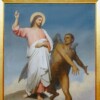
“I did that,” says my memory. “I could not have done that,” says my pride, and remains inexorable. Eventually, memory yields. – Friedrich Nietzsche[1]
The fool hath said in his heart, there is no God. – Psalm 14:1 (KJV)
Reading Psalm 14:1 through the lens of Nietzsche’s aphorism is philosophically suggestive. In Nietzsche, pride refuses a truth that threatens the self-image. In Psalm 14, the “heart” (Hebrew lev) is not merely the seat of emotion but the center of will, intellect, and moral disposition. A theological interpretation might therefore be: The fool does not primarily reason his way to atheism; rather, his heart rejects a reality that would require humility, repentance, and accountability. Jeremiah deepens this insight when he warns that “the heart is deceitful above all things, and desperately sick; who can understand it?” (Jer. 17:9).
This theme runs throughout Augustine’s writings. He argued that the deepest obstacles to recognizing God are often not intellectual but moral and volitional. Central to his doctrine of ordo amoris is the conviction that our loves, desires, and pride shape what we are willing to believe and, consequently, how we perceive reality.
In effect, pride distorts perception. One could almost paraphrase the intersection of Augustine and Nietzsche as what conscience knows, pride refuses to acknowledge.
It is doubtful that Nietzsche would have accepted the Psalmist’s conclusion. Ironically, he often argued the reverse: that religious belief can itself arise from psychological needs and acts of self-protection. Yet his insight about pride’s power to suppress unwelcome truths can be turned back toward the Psalmist’s claim. In that sense, the Psalm’s “heart” and Nietzsche’s “pride” occupy surprisingly similar psychological territory—and what a “deceitful and desperately sick” territory it is.
Jeremiah’s diagnosis of the heart finds a striking illustration in Luke’s Gospel, where Jesus confronts the Pharisees’ craving for social approval and public esteem. “You are those who justify yourselves in the sight of men, but God knows your hearts; for that which is highly esteemed among men is detestable in the sight of God” (Luke 16:15).
This tension between reason and pride, the intellect and the heart, is stark in many academic circles, particularly when acceptance by peers and gatekeepers becomes more important than following evidence wherever it leads.
In Engaging God’s World, Cornelius Plantinga Jr. quotes the late evolutionary biologist and Harvard geneticist Richard C. Lewontin, whose candid remarks about materialism have become widely cited in discussions of religion’s role in science:
Our willingness to accept scientific claims that are against our common sense is the key to understanding the real struggle between science and the supernatural. We take the side of science in spite of the patent absurdity of some of its constructs, in spite of its failure to fulfill many of its extravagant promises of health and life, in spite of the tolerance of the scientific community for unsubstantiated just so stories, because we have a prior commitment to materialism. It is not that the methods and institutions of science somehow compel us to accept a material explanation of the phenomenal world, but, on the contrary, that we are forced by our a priori adherence to material causes to create an apparatus of investigation and a set of concepts that produce material explanations, no matter how counter intuitive, no matter how mystifying to the uninitiated. Moreover, that materialism is absolute, for we cannot allow a Divine Foot in the door.[2]
Against this backdrop, Richard Dawkins’ recent embrace of “cultural Christianity” is particularly striking. In a rare moment of candor, Dawkins said he identifies as a “cultural Christian,” explaining that while he doesn’t believe in Christian doctrines, he appreciates the traditions, hymns, and cultural elements of Christianity. He made it clear that he does not believe in the faith itself, but values the cultural heritage. He remarked that he feels at home in a Christian cultural environment, even though he doesn’t believe a word of the religious doctrines.[3]
I find his admission deeply paradoxical. To say that you enjoy the fruit of a belief system while denying its beliefs is akin to admiring a tree’s fruit while insisting its roots are unnecessary or destroying the foundations of a house, hoping the structure will remain standing.
Dawkins’ conclusion seems rooted less in the intellect than in the will, reflecting Augustine’s insight that our loves often shape what we permit ourselves to believe.
Coming from a scientist familiar with the process of following the evidence to wherever it leads is surprising. He prides himself as an evolutionary biologist who has spent a lifetime championing reason and evidence. Yet his conclusion in this instance is especially perplexing. He wishes to retain the cultural inheritance of Christianity while rejecting the beliefs that gave rise to it.
Dawkins may believe such a separation is sustainable, yet history offers few examples of a civilization preserving its fruits after severing itself from the beliefs that produced them. If Christian civilization emerged from specifically Christian beliefs, can the former survive indefinitely once the latter have been abandoned? While Dawkins is doubtful of the claims of Christianity, the paradox is that so many of his instincts remain—”for good and ill—thoroughly Christian.”[4]
Yet Dawkins’ inconsistencies extend beyond questions of religion and culture. More recently, they have surfaced in his reflections on artificial intelligence and consciousness. The “world’s most famous atheist,” who has spent his career arguing that biology only gives “the appearance of having been designed for a purpose,” recounted a conversation with the AI chatbot Claude.
“Dawkins seemed remarkably willing to entertain the possibility of conscious intelligence being behind AI-based large language model (LLM) chatbots, while overlooking a far stronger case staring him in the face from his own discipline of biology.”[5]
That “far stronger case” is the human genome, the molecular LLM contained in the nucleus of every cell in our bodies. Each strand of DNA, approximately two meters long,[6] functions as the storage reservoir for the “informational architecture of life.”[7]
Just as any AI is the result of human intelligence through conceptualization and programming, it follows that the human genome—a far more complex information system—came about as a result of An Intelligence vastly superior to our own, and not some random, unguided collocation of atoms, as Dawkins certainly believes. His comments suggest that even one of Christianity’s most famous critics recognizes something of that inheritance despite an unwillingness to admit it points to God.
This tendency is not confined to debates about science or atheism. It reflects a broader habit of modern secular thought: criticizing Christianity while continuing to rely upon cultural, moral, and intellectual assumptions inherited from it. While I don’t mean to pick on Richard Dawkins, his recent admissions are emblematic of materialists as a whole. Western culture and modernity have perhaps made them soft or left them confused or both.
I once remarked in a newspaper column about a trip into the Venezuelan rain forest to visit a village of indigenous Maquiritare, that the secularist anthropologists who studied them, and criticized the Baptist missionaries living among them, were all-too willing to denounce Christianity from the comforts of their air-conditioned living rooms in countries whose institutions, liberties, and moral assumptions were shaped in large measure by the Christian tradition.[8]
The issue, however, extends beyond questions of science, anthropology, or even individual belief. It concerns the future of an entire civilization. Can a society continue to enjoy the moral, legal, and cultural fruits of Christianity after severing itself from the roots that produced them? In one of his more candid moments, Nietzsche suggested that it cannot:
When one gives up Christian belief, one thereby deprives oneself of the right to Christian morality… Christianity is a system, a consistently thought out and complete view of things. If one breaks out of it a fundamental idea, the belief in God, one thereby breaks the whole thing to pieces: one has nothing of any consequence left in one’s hands. Christian morality is a command: its origin is transcendental… it possesses truth only if God is truth—it stands or falls with belief in God.[9]
Ironically, one of Christianity’s most formidable critics may have understood more clearly than many of its defenders what was at stake in abandoning the faith’s underlying worldview.
[1] Friedrich Nietzsche, Beyond Good and Evil, aphorism 68 (1886).
[2] Richard C. Lewontin. “Billions and Billions of Demons.” The New York Review of Books, January 7, 1997, 31. Quoted in Cornelius Plantinga Jr., Engaging God’s World (Eerdmans, 2002), 68.
[3] Richard Dawkins, interview by Rachel Johnson, “I’m a Cultural Christian,” LBC, March 31, 2024, video, https://www.lbc.co.uk.
[4] Tom Holland, Dominion: The Making of the Western Mind (Brown Book Group, 2020), xxix.
[5] Jonathan McLatchie, “On Minds and Machines, Richard Dawkins’s Curious Inconsistency,” Science & Culture Today, July 26, 2026, discussing Richard Dawkins, “When Dawkins Met Claude: Could This AI Be Conscious?” UnHerd.
[6] “Each strand of DNA approximately two meters long” is not a typographical error. The average human body contains 30-40 trillion cells with nuclei and hence, one strand of DNA. If every strand were laid end to end, it would stretch twenty billion kilometers or approximately forty-six trips from the Earth to the Sun.
[7] McLatchie, “On Minds and Machines.”
[8] Gregory J. Rummo, “Helping Indians of the Amazon Change for the Better,” in The View from the Grass Roots (Millennial Minds Publishing, 2002), 287.
[9] Friedrich Nietzsche, Twilight of the Idols, “Expeditions of an Untimely Man,” §5, quoted in Cornelius Plantinga Jr., Engaging God’s World (Eerdmans, 2002), 76.