The theme verse for the Samford University School of Health Professions (SHP) is 1 Peter 4:10, “Each of you should use whatever gift you have received to serve others, as faithful stewards of God’s grace in its various forms.”[1] Faculty, staff, and students are regularly reminded of this verse, and we endeavor to fulfill 1 Peter 4:10 by providing opportunities for all to serve both locally and globally. SHP has four departments: Communications Sciences and Disorders, Kinesiology, Physical Therapy, and Physician Assistant Studies. Since its inception, the mission of SHP has been to prepare leaders in a Christian environment who promote health, wellness, and quality of life through excellence in professionalism, scholarship, and service.[2] As we prepare students personally and professionally, it is our desire that they will explore the unique gifts and talents that God has given them so that they will be able to use them to serve others in both their professional and personal lives.
Reflecting on imago Dei, we acknowledge that “God created man in his own image, in the image of God he created him; male and female he created them.”[3] Within the SHP, it is our desire that students first recognize their own creation, consider their worldview and then see others as God sees them, uniquely created in his image. Being created in the image of God means that we reflect the communicable attributes of God; his love, justice, mercy, and grace, to name a few. As believers we are called to be imitators of Christ, reflecting the character of God in the communities we live. However, there are also attributes of God that are unique to him, that we are unable to reflect, his omnipresence, omnipotence, and omniscience.
Faculty, staff, and students in SHP are consistently encouraged to use their gifts to serve others locally and globally, with an emphasis on serving people who are underserved. We acknowledge that these gifts are not for us, rather they are to be used to benefit others. In doing so, according to 1 Peter 4:10, we demonstrate one of God’s communicable attributes as we become stewards of his grace. As a result, when we use the gifts God gave us to serve others, we indeed manifest imago Dei. By acknowledging that our gifts are given to us by God, we acknowledge his incommunicable traits and proclaim our complete reliance on him for the wisdom, knowledge, and power to utilize these gifts to serve others. Indeed, the very next verse, 1 Peter 4:11, clearly states that we are able to speak and serve only through our dependence on God. “If anyone speaks, they should do so as one who speaks the very words of God. If anyone serves, they should do so with the strength God provides, so that in all things God may be praised through Jesus Christ.”[4]
Considering that our school’s mission is to promote health, wellness, and quality of life through excellence in professionalism, scholarship, and service, we often encourage faculty, staff, and students to consider how they can do this vocationally through integration of their professional training and their profession of faith. The book of Acts (18:3) tells us that Paul was a tentmaker, which beautifully exemplifies how one’s professional work is transformed when integrated with one’s profession of faith. Was Paul’s “calling” to be a tentmaker? Perhaps his profession of tentmaking was simply the gift God gave him to fulfill his calling to know God, to make him known, and to serve others. Similarly, as we train our students to become healthcare providers, we help them understand that the knowledge and skills learned in their professional training are gifts to be used to serve others. Indeed, to have the gifts of medical knowledge and skill without treating or educating others would be sacrificing those gifts. A former speech pathology student in SHP may have said it best when she encouraged fellow students by telling them, “the material you are learning, the clinical hours you are striving to achieve, the service opportunities that are mandatory to attend—these assignments have been given to you, but they are ultimately not for you. They are for your future patients.”
It is often discussed that ‘in the beginning’ there was no need for SHP because prior to the fall, there was no sickness. However, since we live in a fallen world, we are reaping the consequences of sin, which lead to sickness, pain, and disparity, among many other negative outcomes. The good news is that as healthcare professionals reflecting the attributes of God, we can bring God to the bedside, to the clinic, or to the school and offer hope to a lost and hurting world.
Each of our programs demonstrate the attributes of God through countless examples of formal service activities that are integrated into curriculums in addition to the daily examples of faculty and staff going the ‘extra mile’ for students and colleagues within their sphere of influence. Four areas that will be highlighted in this paper include our work in collaboration with two Federally Qualified Health Centers (FQHC)[5] in three communities with a shortage of physicians and medical professionals in Birmingham, Alabama, a bilingual program for children who are deaf/hard of hearing, and an ongoing interprofessional global outreach program that provides medical services alongside the local church in Ecuador. Each of these programs is a functional overflow of imago Dei, an expression of using our unique gifts to serve others, seeing each individual as a person also created in the image of God.
Student-Led Physical Therapy Clinic
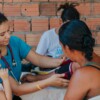
In 2021, SHP’s Department of Physical Therapy established a partnership with a local FQHC, Cahaba Medical Care, whose network of clinics offers low-cost healthcare services to uninsured and underinsured individuals in Birmingham, Alabama and the surrounding areas. Physical therapy (PT) is an allied health service that is considered non-essential and is thus unfunded at the FQHC. Inspired by 1 Peter 4:10 and recognizing needs in the community, second-year PT students and supervising faculty volunteer their time and resources to run a student-led clinic providing PT services at the FQHC that would otherwise not be offered.
As we prepare our graduate students for this service, we provide a context for what it means to live in a medically underserved community. Samford University’s campus is located in Homewood, Alabama, and is a short drive from one of the FQHC’s primary locations in the West End neighborhood of Birmingham, Alabama. Despite being separated by less than seven miles, the average life expectancy in Homewood is 79.5 years, while the average life expectancy in West End is 68. The disparities between these communities extend far beyond a decade of life expectancy; residents of West End are less likely to have access to primary healthcare providers, less likely to have medical insurance, and four times more likely to experience poverty than their Homewood counterparts.[6] As a result, many of the patients seeking care at our clinic have chronic health conditions that have caused significant pain and mobility issues for years but have never before been treated by a physical therapist.
The realization of the complexity of our patients’ health conditions and life circumstances is often overwhelming for our second-year students, who at the initiation of their time in the clinic have completed less than half of their graduate education. Despite their relative inexperience, they are often tasked with treating patients whose management would be challenging for even the most seasoned PT. Our students admit to struggling with the fear of not being enough for these patients—not having enough skills, or enough knowledge, or enough resources to offer them the care they deserve. Our advice to them in these moments of self-doubt is simple: show up, be present, treat your patient with honor, and realize that it is a privilege to be trusted with their story. We remind the students that imago Dei applies not just to our patients; our students are also created in God’s image, and in these moments of fear they can trust that his light is still visible in them.
A few months ago, a patient presented to clinic with severe pain. She was clearly not excited to be at PT and told the student working with her that she had come only at the insistence of her physician. As the student began asking our standard intake questions, the patient indicated that she had been in constant pain for years and had no reason to think a PT visit was going to offer her any relief. The patient then shared with the student several personal challenges she was experiencing outside of her pain, including grief over the recent loss of a family member and feelings of loneliness. Observing the encounter from afar, both the patient and student bowed their heads, and we heard our student begin praying. While we traditionally offer prayer at the end of each patient encounter, this was the first time to see a prayer occurring at the beginning of a session. Afterwards, the session progressed uneventfully and as the patient left, she scheduled a return visit for the following week.
As we debriefed with the students at the end of clinic that day, we asked the student what had happened. She shared that in that moment, she felt overwhelmed with everything the patient was facing and knew that she was incapable of helping the patient on her own. She asked if she could pray over their session and then proceeded to ask God for his guidance and provision over their time together, and that he would use her to offer the patient some relief. The student reported that from the moment of the prayer, the mood of the patient encounter changed. The patient’s defensiveness eased as did the student’s anxiety. They were both more relaxed and engaged with each other, even exchanging some jokes and laughs. The student was able to guide the patient through some exercises and provide education about managing her symptoms. The patient left that day still experiencing the pain she arrived with; however, she also left feeling less alone.
Reflecting on the theological concept of imago Dei, encounters like these reinforce the notion that we need to treat everyone as image bearers of God. Not a story of radical healing, but rather the everyday work of consistently showing up for each other, even when it feels overwhelming; celebrating small victories, even when we would prefer large ones. Acknowledging that while we cannot always eliminate someone’s burdens, we can share them. Recognizing that even as his image-bearers, we alone will never be enough, but that through him, we are never doing it alone.
Service and Mission Track for Physician Assistant Students
Samford’s motto, “for God, for learning, forever,” has always served as a reminder that education is not only about intellectual training but about shaping who our students become. The physician assistant program at Samford strives to embody this mission by cultivating clinicians who care for the whole person. Therefore, we launched the Service and Mission (SAM) track in collaboration with a clinical partner, Christ Health Center (CHC). Christ Health Center is a Birmingham-based faith-inspired community health ministry committed to providing comprehensive, affordable care to the underserved while addressing the physical, emotional, and spiritual needs of each patient. The goal was simple: create a clinical pathway that helped students see medicine as a calling grounded in service, compassion, and dignity. What unfolded was far richer than we anticipated.
Christ Health Center was a natural partner for this work. They are a FQHC that serves individuals and families whose lives are often shaped by financial strain, chronic illness, emotional trauma, and barriers to access. Christ Health Center’s team has a clear commitment to treating each person with the dignity rooted in Genesis 1:27—the belief that every human being bears the image of God. When our students enter that space, they encounter a kind of healthcare that is intentionally relational, attentive, and grounded in grace.
When we describe the care at CHC as “grounded in grace,” we mean that it begins with a theological conviction about who the patient is. If every person bears the image of God, then dignity is not something achieved through responsible behavior, financial stability, or good health. It is already present.
In practice, this shifts the tone of the clinical encounter. Missed appointments are met with questions rather than irritation. Medication nonadherence becomes an opportunity to understand barriers rather than assign blame. Even difficult interactions are approached with the assumption that the person in front of us carries inherent worth that illness or circumstance cannot erase.
Over time, that posture shapes the clinician as much as the patient. Students begin to slow down, to listen more carefully, and to resist reducing people to diagnoses or social histories. Grace, then, is not an abstract theological ideal. It becomes a steady way of practicing medicine.
Over the past year, we have had the opportunity to watch our PA students live out the image of God in ways that surprised, encouraged, and ultimately reshaped our understanding of how clinical education forms a person. We talk often about empathy, presence, and service; but the SAM track offered us a real-world setting where those ideals became habits.
Throughout the year, we have heard countless stories from students about the ways they are learning to see the image of God in their patients. One student described a man experiencing homelessness who returned to the clinic repeatedly, not because of the medication he received, but because the staff treated him with dignity. The student realized that what mattered most to the patient was the sense of humanity he experienced during each visit. As she put it, “Sometimes the healing happens before we ever pick up a stethoscope.”
Another student shared an encounter that captured the heart of what the SAM track hopes to cultivate. She began a visit with a woman receiving treatment for addiction and spent several minutes simply listening before the provider entered the room. The patient opened up about her long struggle with addiction, her time in a recovery home, and how she was beginning to feel curious about faith for the first time in her life. At the end of the appointment, the woman quietly pulled the student aside and thanked her for treating her like a person rather than a problem to be solved. The patient said that people so often only saw her addiction and not her worth.
A third student reflected on how prayer and presence shaped her understanding of patient care. She had witnessed how even a brief, simple prayer, whether over grief, illness, or everyday concerns, could bring profound peace to patients and remind them that God was near. These moments helped her reconnect with the deeper purpose of medicine: to help heal and serve God’s people so they can live into the calling God has placed on their lives. Through encounters with patients facing poverty, incarceration, addiction, and trauma, she learned to pause and remember that every person is made in the image of God and deserves dignity, respect, and love. She also saw how patients’ lives began to change when they themselves started to believe that truth.
Together, these student reflections show how the SAM track is shaping future clinicians who recognize the sacredness of every encounter. They are learning to see their patients not only through a clinical lens, but through the eyes of Christ, eyes that notice worth, honor dignity, and affirm the image of God in every person they serve.
Another important dimension of this experience is the formation of servant leadership. The concept, first articulated by Robert Greenleaf, describes leadership not as the pursuit of status but as a commitment to the flourishing of others.[7] Subsequent scholarship has expanded and refined the model, emphasizing its relational, ethical, and developmental dimensions.[8] Its theological roots, however, precede modern theory. Jesus’s description of greatness, “whoever wants to become great among you must be your servant”[9] reframes authority as responsibility rather than privilege.
Clinical environments provide a daily apprenticeship in this kind of leadership. Healthcare is inherently hierarchical, yet it is also deeply interdependent. Students work alongside attending physicians, resident physicians, advanced practice clinicians, nurses, medical assistants, and social workers. In that setting, leadership rarely announces itself. It often looks like stepping in quietly, helping without being asked, advocating for a patient who struggles to be heard, or absorbing tension so that a team can function more effectively.
Within the SAM track, servant leadership is not taught primarily as theory but practiced as habit. Students begin to recognize that honoring the image of God in patients also requires honoring it in colleagues. Authority becomes stewardship. Competence becomes service. Over time, they learn that influence in healthcare is less about control and more about responsibility—about using one’s training and position for the good of others. In this way, leadership formation becomes inseparable from theological formation: both are rooted in the conviction that those we lead and those we serve alike bear the image of God.
The SAM track, in many ways, makes visible something we hope all of our students carry with them: that the image of God is not an abstract doctrine but a practical guide for how we see and treat others. When students engage patients with this conviction, it shapes not only the quality of care they provide but the kind of clinicians they are becoming.
Our hope is that the SAM track continues to grow as a space where theological conviction and clinical excellence are formed together. The difficult encounters and the deeply rewarding ones alike slowly shape students into clinicians who recognize that caring for people is more than a profession; it is sacred responsibility. As they move into their careers, we desire that their practice bear quiet witness to the truth of 1 Peter 4:10—that their gifts are entrusted to them not for status, but for service.
Lingua Dei—Bilingual Program
As Christians, we accept as a fundamental faith claim that human beings are made in the image of God, embodying God’s likeness and reflecting his divine nature in the world. Inherent in the precept is that each person possesses intrinsic value and dignity as an image bearer of God. Offering a graduate degree in speech-language pathology at a Christian university, it is important to see each student as God’s image bearer. This view will have implications in the classroom, but it also has implications for our faculty teach students to interact with their clients in the field. We are called to assist students to see each client they serve as an image-bearer of God. Through these encounters, we gain a clearer vision of the divine character. But what does that divinity sound like? What is the language of God, or lingua Dei? About five years ago, one of our faculty members was working with a preschooler and her mother in an outpatient clinic. The child, Maria (pseudonym), was hard of hearing and used listening and spoken language (LSL) as her primary communication mode. Maria was a binaural hearing aid user who spoke only English, although her mother and the rest of their family spoke primarily Spanish within the home. As the faculty member was coaching Maria’s mother during a shared book reading activity, and Maria’s newborn brother was in a carrier beside their mother on the floor, he would periodically shift around in his carrier, and she would whisper words of comfort to him in Spanish.
About halfway through the book, Maria identified a picture in the book using a Spanish word. Her mom replied, “Oh, she may only know that word in Spanish,” and then she gave her the English equivalent. Maria’s mother was asked, “Why haven’t you used Spanish with Maria?” Maria’s mom shook her head and said, “They told me not to speak Spanish to her because it would confuse her while she was trying to learn to talk.” The faculty member gently put her hand on the mother’s hand and said, “I’m sorry someone told you that, but you can absolutely teach this sweet baby Spanish. That’s the language of your home and your family, and she should have access to that.” This mother’s eyes welled with tears as she began to cry, “No one has ever said that to me. I didn’t know that was okay. I didn’t know I could do that.”
SHP recently received a generous donation to begin an internal grant program to promote service in light of our theme verse, 1 Peter 4:10. The grant program was developed as a mechanism for creating and sustaining meaningful service opportunities for faculty and students. The faculty member in our Department of Communication Science and Disorders learned of the grant program, and her mind quickly wandered back, not to Maria, but to her mother. She remembered, with great clarity, the way that the mother looked at her when told that she could, and should, be speaking in Spanish to her hard of hearing daughter. In partnership with a bilingual intervention specialist, we conceptualized and proposed a service-learning project for the first round of 1 Peter 4:10 grant submissions: Expanding Access to Spanish Resources for Alabama’s Deaf and Hard of Hearing Children Learning to Listen and Talk.
Maria’s story is evidence of a larger, historically prevailing narrative still present among some parts of the LSL community, that bilingualism splinters linguistic resources for children who are deaf/hard of hearing (D/HH) learning to listen and talk.[10] Thus, the majority LSL professionals historically rejected bilingualism in favor of counseling families who speak Spanish in the home to only use English. However, more recent literature has affirmed supporting LSL development in the home language.[11] Unfortunately, research has not yet translated to practice for Spanish-speaking families of children who are D/HH due to lack of access to Spanish-speaking providers, interpreters, and resources and materials in Spanish. In strategic partnership with a local organization that provides LSL services to children who are D/HH and their families, a grant was fully funded through the 1 Peter 4:10 award to conduct a three-year longitudinal service-learning project to develop LSL-specific Spanish resources for Spanish-speaking families in our state, as well as student-led continuing education training programs for the speech-language pathologists providing their intervention. In its first year, we had eight graduate students elect to participate in the project over the summer semester, providing them with the unique opportunity to develop culturally responsive clinical competence in evidence-based practices for a critically under-served group.[12] At the community level, we believe this project has the potential to positively impact Spanish-speaking children who are D/HH using LSL and their families across the state by addressing the research to practice gap in dual language development, since supporting home language development could optimize both Spanish and English outcomes for these children.
We conceptualized and curated these resources across ten weekly sessions last summer, which also included critical reviews of relevant research articles and didactic teaching. The most meaningful session, though, was the one where Maria’s mother came to talk to our students about her lived experiences as a Spanish-speaking parent of a child who is D/HH using LSL. She affirmed the importance of the work that the students were engaging in to serve a critical need. She described Spanish-speaking families desperately trying to ensure that their children are successful in mainstream culture while also maintaining connection between their D/HH child and family through shared language. As the mother walked out after the session, our faculty member had the opportunity to share with her that she and Maria had inspired the whole project. She turned with fresh tears in her eyes, but this time they meant something entirely different. As she gripped the faculty member in a strong embrace, she said, “Thank you for giving me this full circle moment. Now I know that everything was worth it. This has become my testimony.”
What is the language of God? What does the Bible tell us about the language that God speaks? The story of Hagar gives us an important clue. Hagar’s story begins in Genesis 16:1–3. She is originally from Egypt, so she brings a different background, different customs, a different language to Abraham and Sarah’s home, working as Sarah’s maidservant. At Sarah’s insistence to Abraham, Hagar becomes pregnant with Abraham’s child, which results in her being mistreated and running away. An angel of the Lord pursues and finds her in Genesis 16:7–12. During their encounter, the angel promises good things for her son. We know that Hagar understood the angel’s blessing because Genesis 16:13 says, “thereafter, Hagar used another name to refer to the Lord, who had spoken to her. She said, ‘You are the God who sees me.’”[13] God sees his image in Hagar and makes promises for her provision, opening her eyes to her “seen-ness” as well. In a second encounter in Genesis 21, Hagar and her son, Ishmael, are once again thrown out of Abraham’s household and exiled into the wilderness. But God hears their crying in their hunger and intervenes by first meeting their needs for survival. Through the angel, God then assures Hagar that he will make her son into a nation as well. In Hagar’s story, God both sees (imago Dei) and understands (lingua Dei) her in her time of need; likewise, she sees and understands the angel of the Lord. Both Hagar and Ishmael are bearers of both the image and language of God, even though they come from a different culture and speak a different language than Abraham, the father of the great nation of God.
Hagar’s story tells us, as a Christian speech-language pathologist, that we are made in God’s language as well as his image. Just as God communicates with his children in ways that we can understand, as practitioners, we are called to be access expanders by doing the same with our clients. In other words, we pray for ourselves and for our students: may the Holy Spirit enable the lingua Dei in us to understand the lingua Dei in you.
Interprofessional, Short-Term Medical Mission to Ecuador
While each of the graduate programs in SHP have service activities for students as described above, the school has the unique opportunity for students to serve interprofessionally every summer. The summer of 2025 saw the ninth and tenth teams of students and faculty from SHP on mission in and around Quito, Ecuador. Yet the heart for serving the people of Ecuador began nine years prior, with two young first-year PT graduate students seeking a fun service-learning opportunity for themselves and some classmates and friends. Little did we know how this would develop into a shared passion for service across years of students from multiple disciplines. From a team of 15 PT students and one faculty member, to now two teams of a total of 49 faculty members, alumni, and students from programs in PT, speech-language pathology, and PA studies, the opportunity to serve God’s people in Ecuador has left an indelible mark on the hearts of many from SHP.
These service-learning trips to Ecuador are more than a journey across continents—they are a living testimony to the beauty and dignity of the imago Dei in every person encountered. Both in the bustling environment of inner-city Quito and the quiet simple cloud forest villages where the rainforest meets the mountains two hours outside of the city, our teams witness firsthand what it means to serve others as faithful stewards of God’s grace, as exhorted in 1 Peter 4:10. This verse is the heartbeat of each week in Ecuador. Each act of service—whether assessing a patient’s pain, teaching an exercise, or praying with a family—is an expression of God’s grace through our hands and words. The diversity of our gifts, both professionally and personally, mirrors the diversity of the Body of Christ, each member uniquely equipped to contribute to the healing and restoration of others.
Throughout each week, our teams are reminded that every person bears the image of God, and therefore possesses inherent worth, dignity, and beauty. In Quito our students care for individuals and families burdened by poverty, disability, and trauma. Yet beneath those hardships, we see radiant reflections of God’s image—joy, resilience, and hope that transcends circumstances. This past year, one of our students reflected that her main purpose was to make each patient feel “heard, seen, and loved by our God.” This simple yet profound goal embodies the truth of imago Dei: to see and honor God’s likeness in others, regardless of language, background, or ability.
In the cloud forest, the same truth takes root in the soil of community. Students work in tiny villages, offering clinical care with limited resources but abundant compassion. They quickly learn that service is not defined by medical expertise alone, but by the humility to listen, pray, and love as Christ did. When a small group of students encountered a family facing both injury and hunger, they responded not only with healthcare but with food and prayer—embodying the stewardship of grace that 1 Peter 4:10 calls us to live out. As one student reflected, “We were the unexpected answer to this family’s prayers.” In that moment, the boundaries between giver and receiver blurred, and the image of God was revealed in both.
The interprofessional nature of each team amplifies the theology of imago Dei in practice. Each discipline brings a unique set of skills and knowledge, yet all share a common purpose: to restore, to heal, and to serve. During nightly reflections, students recognize how God uses their diversity as strength. What began as separate programs—PT, PA, and Speech—became a single unified body. This collaboration is not only a professional lesson but a spiritual revelation: that service rooted in the imago Dei calls us to see one another as co-laborers in God’s redemptive work.
By the end of the week in Ecuador, students understand that their greatest impact was not found in their clinical knowledge and skills, but in their willingness to be fully present—to touch, to listen, to pray, and to affirm the divine worth of each person they met. They learn that the imago Dei is not a distant theological concept, but a living reality encountered in the faces of patients, teammates, and even themselves.
As each team returns home, they carry these truths with them: that our gifts, when surrendered to God and in service to him, become instruments of his grace; that every person we serve bears his image; and that through service, we participate in the ongoing work of reflecting his glory. Our time in Ecuador is never merely a service-learning trip—it is a visible manifestation of imago Dei lived out through the faithful stewardship of God’s people.
Conclusion
As we try to live out 1 Peter 4:10 in practical ways, faculty in SHP try to challenge students to live out their faith through the profession to which God has called them. James 2:17 states, “. . . faith by itself, if it does not have works, is dead.”[14] While we recognize that we do not pursue works as a means to earn the favor of God, our works are done as an overflow from our faith in God. The faculty in SHP endeavor to prepare our students by training the head for knowledge, their hands for skills, and their hearts for service and compassion. These goals are actualized as we provide opportunities for students to use the unique gifts and talents that God has given them to serve others and to make meaningful contributions to the local and global communities and thereby manifesting imago Dei.
[1]. 1 Peter 4:10, NIV.
[2]. SHP offers undergraduate degrees in communication sciences and disorders (Bachelor of Science [BS]), exercise science (BS), health sciences (BS), sport administration (BS), and sports medicine (BS). Graduate degrees are offered in performance and applied sport science (Master of Science [MS]), physician assistant studies (MS), physical therapy (Doctor of Physical Therapy), and speech-language pathology (MS).
[3]. Genesis 1:27, ESV.
[4]. 1 Peter 4:11, NIV.
[5]. A Federally Qualified Health Center is a non-profit clinic that receives funding from the federal government to provide primary medical, dental, and mental health services to medically underserved individuals regardless of their ability to pay. See “Federally Qualified Health Center (FQHC)”, US Centers for Medicare & Medicaid Services, accessed April 1, 2026, https://www.healthcare.gov/glossary/federally-qualified-health-center-fqhc/.
[6]. Based on database searches of the physical addresses of Samford University and the FQHC in West End. See “Life Expectancy at Birth for U.S. States and Census Tracts, 2010–2015,” US Centers for Disease Control and Prevention, accessed April 1, 2026, https://www.cdc.gov/nchs/data-visualization/life-expectancy/; “Medically Underserved Areas/Populations,” Alabama Department of Public Health, accessed April 1, 2026, https://www.alabamapublichealth.gov/ruralhealth/assets/muapmap.pdf.
[7]. Robert K. Greenleaf, Servant Leadership: A Journey into the Nature of Legitimate Power and Greatness (Paulist Press, 1977).
[8]. Nathan Eva, Mulyadi Robin, Sen Sendjaya, Dirk van Dierendonck, and Robert C. Liden, “Servant Leadership: A Systematic Review and Call for Future Research,” The Leadership Quarterly 30, no. 1 (2019): 111–32, https://doi.org/10.1016/j.leaqua.2018.07.004.
[9]. Mark 10:43–45, NIV.
[10]. Mark Guiberson, “Bilingual Skills of Deaf/Hard of Hearing Children from Spain,” Cochlear Implants International 15, no. 2 (November 25, 2013): 87–92, https://doi.org/10.1179/1754762813y.0000000058.
[11]. Ferenc Bunta, Michael Douglas, Hanna Dickson, Amy Cantu, Jennifer Wickesberg, and René H. Gifford, “Dual Language versus English‐only Support for Bilingual Children with Hearing Loss Who Use Cochlear Implants and Hearing Aids,” International Journal of Language & Communication Disorders 51, no. 4 (March 27, 2016): 460–72, https://doi.org/10.1111/1460-6984.12223; Anna V. Sosa and Ferenc Bunta, “Speech Production Accuracy and Variability in Monolingual and Bilingual Children with Cochlear Implants: A Comparison to Their Peers with Normal Hearing,” Journal of Speech, Language, and Hearing Research 62, no. 8 (August 15, 2019): 2601–16, https://doi.org/10.1044/2019_jslhr-s-18-0263.
[12]. Elizabeth A. Rosenzweig, and Jenna Vossj, “Their Words, Their World: A Paradigm for Culturally Relevant Family-Centered Intervention,” Perspectives of the ASHA Special Interest Groups 7, no. 2 (April 14, 2022): 553–59, https://doi.org/10.1044/2021_persp-21-00074.
[13]. Genesis 16:13, NLT.
[14]. James 2:17, NKJV.