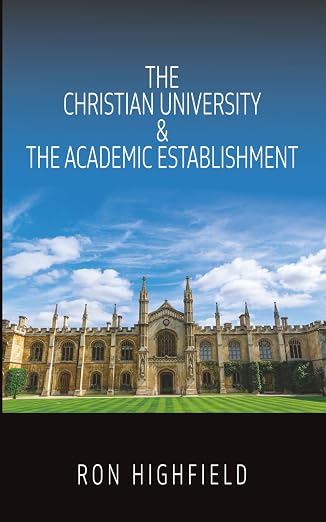
Ron Highfield’s The Christian University and the Academic Establishment arrives at a particularly fraught moment in the history of American higher education. Confidence in the university as an institution has eroded dramatically. Political polarization has drawn colleges and universities into broader cultural conflicts. Debates over academic freedom, diversity initiatives, institutional mission, free speech, and ideological conformity have become fixtures of public discourse. Even among those committed to higher education, there is widespread uncertainty about what universities are for and whom they ultimately serve.
Christian higher education faces these challenges while carrying a second and older burden. For more than a century, Christian colleges and universities have wrestled with a persistent question: Can an institution remain authentically Christian while also participating fully in the intellectual life of the modern academy?
That question is hardly new. It has haunted Christian higher education since the emergence of the modern research university in the late nineteenth century. Yet it gained renewed urgency with the publication of George Marsden’s The Soul of the American University (1994) and James Burtchaell’s The Dying of the Light (1998). Marsden chronicled the secularization of America’s Protestant-founded universities, characterizing it as a move “from Protestant establishment to established unbelief” and concluding in 1992 that “Christianity has only a vestigial voice at the periphery of these vast culture-shaping institutions.”[1] And he challenged Christian scholars to recover a confident Christian intellectual voice. Burtchaell offered an even more sobering narrative, documenting the gradual—and thorough—erosion of Christian identity across dozens of church-sponsored colleges and universities. Together, these works framed much of the discussion over the last three decades or so.
Among evangelical institutions (CCCU) especially, the concern became what many came to call the “slippery slope.” If Harvard, Yale, Princeton, Vanderbilt, Duke, and countless others had begun as explicitly Christian institutions, what confidence could contemporary Christian universities have that they would fare differently? The question was not merely theoretical. Evangelical colleges took this challenge seriously and spent several decades developing what Marsden had described as the “mechanisms and traditions” necessary to sustain Christian identity over time: mission statements, doctrinal covenants, faith-and-learning initiatives, faculty hiring expectations, boards committed to Christian mission, and renewed attention to spiritual formation. The hope was that intentional institutional practices might counter the powerful gravitational pull of secularization.
Yet the story has grown more complicated in recent years. The challenge is no longer described simply as secularization. Christian universities themselves have become deeply divided over the nature of their mission, the meaning of Christian scholarship, the relationship between faith and politics, questions of race and justice, sexuality and gender, academic freedom, and the proper response to contemporary cultural movements. In some cases, the sharpest disagreements are not between Christian institutions and the secular academy but within Christian higher education itself.
It is precisely at this juncture that Highfield’s book appears. His concern is not merely that Christian universities may lose their mission. Rather, he argues that many have already accepted fundamental assumptions of the modern academic establishment and now struggle to distinguish clearly between Christian mission and academic aspirations and prestige. His book stands in the long conversation initiated by Marsden and Burtchaell, but it reflects a different historical moment. If Marsden asked whether Christian scholarship could regain a place within the academy and whether Christian colleges could resist the slippery slope, and Burtchaell warned of the gradual and almost inexorable receding of Christian identity, Highfield asks whether Christian universities have become too dependent upon the academy’s own understanding of knowledge, authority, freedom, and institutional success.
I suggest that Highfield is not responding primarily to the secularization anxieties of the 1990s but rather to the somewhat new ideological conflicts of the 2020s. He is writing in the lineage of Marsden and Burtchaell, but at a moment when the question is no longer simply whether Christian universities can remain Christian, but what kind of Christian they intend to be. It is a contribution to a newer debate about the future of Christian colleges and universities and the possibility of sustaining a distinctive—not to mention “orthodox”—Christian intellectual culture in a fragmented and contested age.
About fifteen years ago, Marsden again addressed the challenge of the slippery slope, this time in a collection of essays responding to an extensive research project on the 130 or so evangelical schools in the CCCU. He observed that these schools had taken the challenge seriously. For the most part, they had put in place the necessary “traditions and mechanisms.” Most of them, he noted, were well anchored and not in imminent danger of slippage. Indeed, he said that these schools could, if they wished, actually move up the slippery slope to an even more solid place.[2]
But Marsden’s optimism may have been somewhat overdrawn. In the twenty-first century, we have faced a steadily growing post-Christian culture. Christian belief has become less familiar, pervasive, and persuasive than it once was, and Christian institutions are much less influential. Profession of faith remains widespread, but “Christian faith no longer provides the moral compass, the sacred symbolism, and the telos [goal] for Western institutions.”[3] Evangelicalism itself has fractured along theological and political lines, and the evangelical colleges (of the CCCU) have themselves experienced fragmentation over issues of social justice (politics, race, gender, and sexuality). One observer sees not two factions (as in the Fundamentalist/Modernist divide) but five.[4]
So, Highfield may also be asking what kind of Christian a Christian university intends to be. There is a whole wide spectrum of possibilities. The recent research of Perry Glanzer and his team gives us a good sense of this. The researchers studied 537 schools calling themselves Christian and scored them according to a set of criteria that reflect each school’s public definition of its identity and mission.[5] They use eleven indicators that give an empirical picture of how an institution’s faith commitment influences its practices. These indicators include Mission statements, website rhetoric, requirements for leadership, VP for Mission (on the executive leadership team), number of required Bible/theology classes, chapel, and several more. Maximum score: 27. They evaluated the whole gamut of schools claiming a Christian identity: Mainline Protestant, Catholic, Evangelical Protestant, independent. The scores ranged from 6 on the low end to 26 on the high.
Years ago, James Burtchaell insisted that a serious Christian school must keep in place three things: first, an explicit, orthodox Christian mission; second, the strict hiring of administrators, faculty, and staff who all support that mission; and three, a fully informed and committed board of trustees that insists on those things happening. Without these things firmly in place, Burtchaell argued, there will be a slow accommodation to secular, elite culture; indeed, orthodox Christianity will move out as the secular ideology moves in.[6] The slippery slope will take its toll. Highfield agrees fully with this insistence.
But among Christian universities in our time, Burtchaell’s insistence on an “explicit, orthodox” foundation is one of the very things that is up for grabs. The word itself has become quaint, unclear, or even oppressive, depending on your crowd. That’s part of the new challenge, which requires a seriousness about Christian history and theology. This challenge is not the main burden of Highfield’s volume, though he underscores the significance of the issue.
Highfield’s main focus is tracing the emergence of the American research university, especially the influence of the German model and the rise of concepts such as academic freedom, tenure, and faculty governance. He argues that these ideas are often treated as absolute principles when, in fact, they arose within particular historical contexts and always function within institutional missions.
Highfield contends that large sectors of American higher education have been shaped by the “New Left” and by intellectual movements such as Critical Theory, Critical Race Theory, and DEI frameworks. He views these movements not just as political positions but as rival moral systems fundamentally at odds with Christian faith. And he argues that Christian universities should actively resist adopting such frameworks into their institutional structures and curricula.
The constructive heart of the book is Highfield’s claim that a Christian university should function primarily as an extension of the church’s witness. He calls for “dual competence” on the part of administrators, trustees, and faculty. They should possess both professional expertise and substantial theological understanding. A Christian university cannot simply have Christian students and Christian chapel programs; its leadership and faculty must consciously embody and advance a Christian intellectual heritage. And faith should be treated as a starting point for inquiry rather than an obstacle to it. He invokes the Anselmian principle credo ut intelligam (“I believe in order that I may understand”).
In his treatment of academic freedom, tenure, and faculty governance, he challenges what many faculty members of Christian schools assume are universal norms of academic life. He argues that academic freedom is not absolute. That every university—including every secular university—defines its own mission and therefore sets boundaries on faculty speech. That Christian universities have both the right and responsibility to define academic freedom in ways consistent with their Christian identity. That tenure should not be treated as permanent protection from institutional accountability. And finally, though faculty governance has an important role, it must remain subordinate to the institution’s mission and governing authorities.
Highfield’s question is always: how can a Christian university participate in the academic world without compromising its Christian identity? Indeed, he wants Christian universities to seek to free themselves from measuring themselves by the academy’s norms and to magnify their role as an extension of the church’s witness.
In this focus, I think it is fair to say that Highfield updates Burtchaell for the present moment: the old drift toward secularization is now intensified by Leftist ideological conformity, by confusion over governance, and by misplaced reverence for the norms of the academic establishment. And Highfield addresses this new intensification with directness and clarity. His book is not a mild critique. It is important because it forces the question bluntly: Who finally defines the university’s excellence—the academic establishment with its fundamentally secular convictions and practices, or the Christian story that called the institution into being? His fundamental claim is that Christian universities should stop measuring themselves by the standards of elite secular institutions and instead recover confidence in their own theological mission.
What we have here is a contemporary manifesto for confessional Christian higher education.
So hear a last word from several key voices that have shaped this ongoing conversation.
- Highfield would say: Do not let “top-tier” aspirations redefine a school’s Christian mission.
- George Marsden would say: Let Christian conviction inform serious public scholarship without apology, and get anchors in place on the slippery slope.
- James Burtchaell would warn: The drift away from a clear, explicit, and orthodox Christian mission usually happens slowly, politely, administratively, and almost invisibly.
- Richard Neuhaus, long-time editor of First Things: We face not just a crisis of secularization, but “a crisis of Christian faith. The question that those who lead a Christian university must answer, and answer again every day, is whether the confession that Jesus is Lord limits or illumines the university’s obligation to seek and serve Veritas —to seek and serve the truth.”[7]
- And finally a question from Stanley Hauerwas to Christian university leaders: What kind of people does your university form? What practices make them Christian? Are you forming Christians or merely credentialed professionals who have good memories of chapel?
I think that Highfield’s volume fits nicely in this small chorus of voices.
[1] George Marsden, “The Soul of the American University: An Historical Overview,” in The Secularization of the Academy, ed. George Marsden and Bradley Longfield (Oxford University Press, 1992), 29–30.
[2] George Marsden, “Moving Up the Slippery Slope,” in The Christian College Phenomenon: Inside America’s Fastest Growing Institutions of Higher Learning, ed. Samuel Joeckel & Thomas Chesnes (Abilene Christian University Press, 2012), 329-40.
[3] Peter Leithart, The End of Protestantism: Pursuing Unity in a Fragmented Church (Brazos Press, 2016), 187. For my explanation of what we mean by “post-Christian,” see “The Church in a Post-Christian World,” In the Great Stream: Churches of Christ in the Christian Tradition (ACU Press, 2021), 203-220.
[4] Michael Graham, “The Six Way Fracturing of Evangelicalism” (2021); Daniel K. Williams, “The Five Emerging Factions in Evangelical Higher Education” (April 5, 2022).
[5] Perry Glanzer and associates, Christian Higher Education: An Empirical Guide (ACU Press, 2023),
[6] James T. Burtchaell, The Dying of the Light: The Disengagement of Colleges and Universities from Their Christian Churches (Eerdmans: 1998).
[7] Richard Neuhaus, “The Christian University: Eleven Theses,” First Things (January 1, 1996)