I had a question: could artificial intelligence (AI) help me visualise the textual form of my thoughts and help me re-work them in a picture. That way I could look at them again in a different light and also have a different medium through which to explain them to other people?
I’m reasonably competent at stringing ideas together into sentences, sentences together into paragraphs, paragraphs into papers, and even papers together into articles and books. For decades, working with words on paper or in oral presentations have been my tools of trade.
But one of the many areas in which God has not gifted me, is art. I cannot draw or paint to save myself. I confess the sin of being envious of those incredible people who can sit down with paint, pen, chalk or pencil, and create something astounding on a flat surface that is representative of reality.
Over the years, I have used the talents of wonderful artists to illustrate the covers and contents of some of the publications and presentations with which I have been involved. Praise the Lord for these skilled people.
But of late I’ve been wondering, just like writing a book where I write and re-write sections several times before I am happy with the finished product, can AI offer me the opportunity to dabble in this creative area of art previously closed off to my clumsy self? Can I interact with ChatGPT (I refuse to say “discuss” because after all AI is just a machine), give AI ideas for a visual output, revise the visual product and revise and revise and revise again? Can I play in this new garden like I like to do in the garden of words, seeking to honour God with a product that gives clarity and expression to my thoughts both for me and my intended audiences?
I can hear some of my good friends say, “Richard, stick to words. At least you have a degree of competence in that arena. Leave the art to the artists.” They may well be right. But maybe “giving it a go” is what we are empowered to do with these new tools as we carry out the cultural mandate in the 21st century.
And so, perhaps heedlessly and with reckless abandon, I pressed ahead in an attempt to answer my opening question. I applied it to the focus of much of my work : Can AI help me visualise my fallible understanding of the gospel in its fullest, reformed, culturally-contextualised, critical realist sense, that tells God’s Big Story, embraces the absolute necessity of the Cross, and that shapes every aspect of life, especially education, both now and forever? Could this new technology help me see on paper or screen what I had previously only been able to express in words or see in my mind?
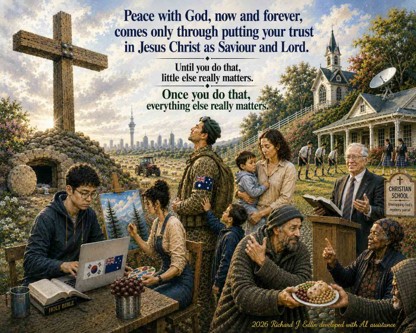
So here is what I did. From previous interactions, ChatGPT was already familiar with my reformational worldview train of thought – I was aware of the fact that it had even “reviewed” my book The Cause of Christian Education for other enquirers. So I gave it the following form of words and I told it to build a preliminary image around these phrases. I told it also to include and highlight the empty cross subtly casting its light over people engaged in everyday life showing both the church and the school as important components.
The specific comments that I developed and gave it were to be broken into three parts:
- Peace with God, now and forever, comes only through putting your trust in Jesus Christ as Saviour and Lord;
- Until you do that, little else really matters;
- Once you do that, everything else really matters
I pressed my computer’s send button and waited to see what would happen.
I must admit to being pleasantly surprised at the initial result. There were lots of things that I wanted to add and/or change, just as is the case with my initial drafts with writing, but now I had the opportunity to generate alterations to the image in order to improve what the technology had initially produced. For example as I experimented,
- I wanted more emphasis on cultural engagement;
- I wanted the church soup kitchen worker giving out the food in front of the mother in the bottom right; to show that his task was not a mere social gospel but was also an expression of the Cross (so he’s pointing over his shoulder to the cross);
- I wanted the Christian school to have a dynamic motto on its sign out front saying, “unwrapping God’s mystery parcel” (thank you Harro van Brummelen) – though the print is quite small;
- I wanted the Bible in every way, how we read it and listen to it, to still be shaping day to day activity;
- I wanted the picture to display ethnic and age diversity;
- I wanted the implication to be that in the light of the Cross, as a deliberate expression of their faith, Christians were engaging the city, the country, the family, the military, the arts, sports, technology etc.
There was so much more (yes, I agree, too much?) that I kept packing into the picture. It’s a dynamic work in progress. So far, it has gone through over 140 iterations! Though I’m resting with how it looks at the moment as you can see below, I can still see changes I want to make. In this way the image responds to my critical realist sensibilities in a manner that no static product ever can.
Elsewhere, I’ve written about the benefits and perils of AI, about the need for us as Christians to address technology holistically from first principles. My purpose here is to just celebrate the new ability that AI has given me, and to attempt to harness it to God’s glory.
Maybe it’s only people like me – academic wordsmiths but who otherwise are artistic troglodytes – who can appreciate the new lease of life that this AI capacity has provided. To my eyes anyway, it has unleashed a new way of expressing what I’m trying to say when I talk about the Christian life and a Christian worldview.