

It seems that highbrow fine art is in popular demand. The spring auction scene in New York shattered records, doubling last year’s total. (A canvas by Jackson Pollock fetched more than 181 million dollars.) Once-niche contemporary art spaces now charge hefty admission prices, and even fusty traditional spaces now attract tourist hordes.
On my recent visit to London, an undisputed world art capital, the demand for fine art was on high display. The Tate Modern – an edgy, traditionally free-to-enter space – was hosting not one but three big-ticket exhibitions with eye-popping admission charges. The Wallace Collection, a gallery of Old Masters in a historic home, was swarming with so many visitors that its brocaded halls were often impassable. And the Hayward Gallery at Southbank Center was hosting a blockbuster show by Anish Kapoor, charging $30 a ticket. (More on that later.) It seems that in a world made increasingly pallid by flat, flickering, fleeting digital counterfeits, things like heft, craftsmanship, texture, and uniqueness become increasingly desirable; they slake some kind of thirst.
Meanwhile, in London’s Trafalgar Square, at the city’s premier art museum (the National Gallery), faith was on display. In the gallery’s prestigious special-exhibition space, spotlit on eggplant-colored walls, were monumental paintings by Francisco Zurbarán, a seventeenth-century Spanish artist whose very brand (to put things in marketing terms) is austere religiosity. Zurbarán’s bread-and-butter, as an artist, was devotional work for religious orders. And this is because he distinguished himself, early on, as a profoundly spiritual visionary. Posters for this blue-chip exhibition display the pensive face of St Peter Nolasco contemplating the martyrdom of his namesake (St. Peter from the Bible) – not your typical summer marketing iconography. In its deep purple darkness, this “show of the summer” promises postmodern eyes something earnest, simple, heroic and transcendent – even if the inevitable gift shop ruins the vibe at the end.
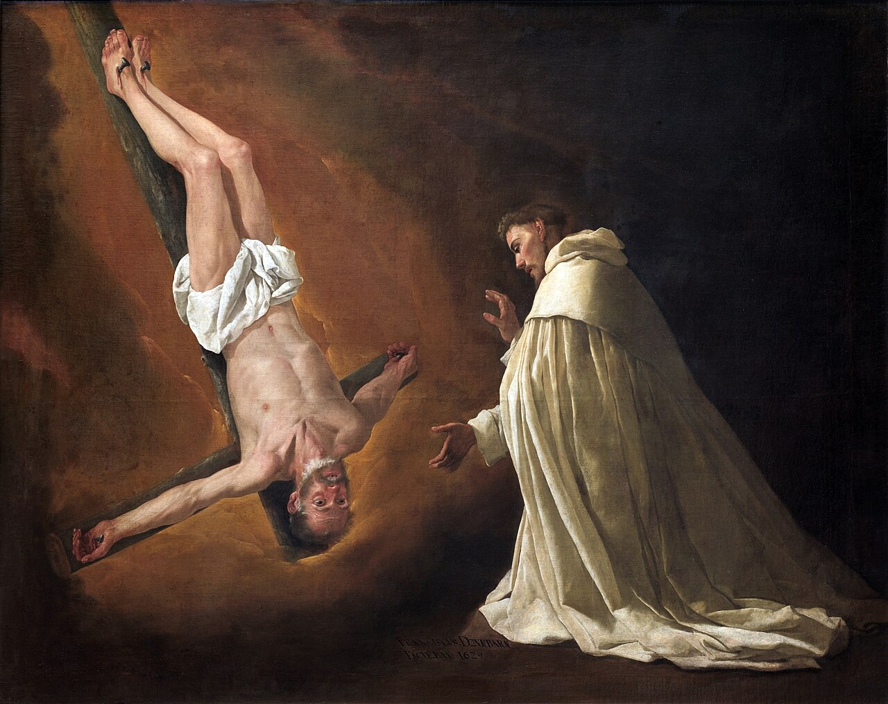
Little is known about Francisco Zurbarán’s life, and his oeuvre is not as extensive as that of other so-called “Old Masters.” Critics fault him for the extreme simplicity of his compositions – often focusing on just one or two figures. Indeed, Zurbarán’s work fell out of fashion for generations after his death due to its austerity. But certain of his masterworks have undeniable iconic power. One of them, the aforementioned vision of St. Peter Nolasco, provides the exhibition’s first visual punch – and it’s unforgettable.
In this early image -one that made Zurbarán’s reputation – the thirteenth century St. Peter Nolasco, founder of a Spanish religious order, kneels with head quizzically tilted and arms gently, unconsciously spread. He seems to be absently mirroring the pose of the mystical vision that has appeared in his chambers: an old man in a loincloth being crucified upside down. There is nothing else in this remarkably spare composition – only two figures. But the crucified figure glows with a mysterious, russet light, and the textures of the shadowy saints (monk and victim) feel quietly real. This is a moment of spiritual encounter made heartbreakingly visceral. And it is also a diagram of something mythic. The two figures, one upright and one inverted, slightly arc toward each other, creating a cyclical movement. They lead into each other and echo each other: they are the same. This is a moment of Eliade’s “eternal return,” showing the perennial call to sacrifice across centuries, bidding all people to give their lives for the good.
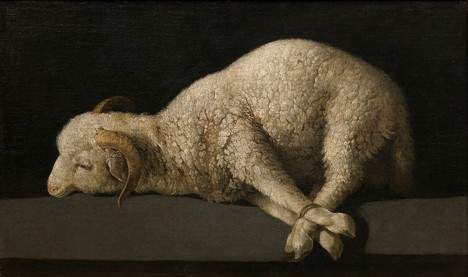
It is not possible to stylishly secularize the raw piety of Zurbarán’s most iconic paintings, and this exhibition doesn’t even try. Earlier shows about religious art have often focused primarily on artistic technique (e.g., the National Gallery’s 2024 Raphael blockbuster) or have sought to find hidden “modern” messaging in pious formulas (as in the Tate Britain’s controversial 2025 rehang of its permanent collection). The new Zurbarán show, however, is refreshing in its contextual straightforwardness. Images of St. Francis of Assisi praying, or of a pitiful lamb lying on an altar, are given their obvious religious due. Zurbarán’s spiritual preoccupations are taken seriously as an important motivating factor in his work.
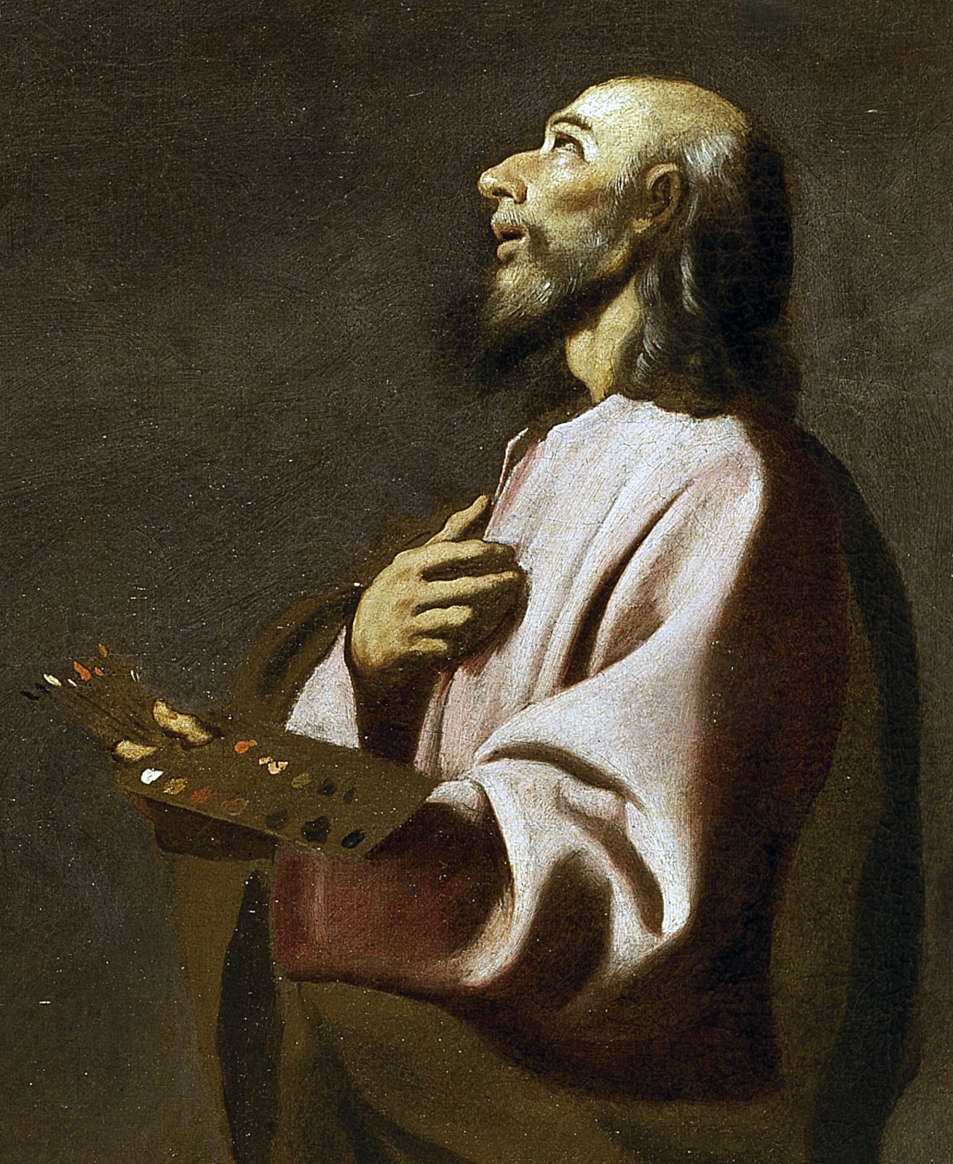
At the end of the exhibition, fittingly, the curators have attempted to evoke Zurbaran himself. And they have done so by locating his visage (possibly) in the portrait of a devout, elderly painter standing beneath the cross of Christ in a late “Crucifixion” scene. This figure, with a hooked nose and bushy eyebrows, looks remarkably specific; he’s not just a type. His left arm holds a painter’s palette with vibrant colors, and his right hand is raised to his chest. Could this be the actual face of Francisco Zurbarán? This figure is supposedly St. Luke (the gospel writer), who tradition holds was the first person to make an artistic image of Jesus. (Perhaps this is due to the narrative detail in Luke’s gospel, showing a talent for observation.) And during Zurbarán’s time, it was common for artists to include their self-portraits in settings like these. The pensive artist in this image, therefore, might be our best clue to Zurbarán’s appearance and personality. He was likely a man of deep faith, perhaps inspired by visionary experiences similar to those recorded in his works.
I think the following seems undeniable: the greatest works of art have religion, spirituality, and the ultimate at their core. Across London, at the Tate Modern, few of the artworks have traditional religious subjects like Zurbarán’s. But the most popular ones still address issues of the spirit, from Frida Kahlo’s anguished self-portraits to the arcane dreamscapes of Surrealists like Max Ernst (who claimed to have spirit guides) to the ghostly, slightly accusatory sculptures of Alberto Giacometti that summon a kind of purgatorial suffering. Even the popular Anish Kapoor exhibition at the Hayward, centered on an artist best known for his abstract “Bean” sculpture in Chicago, draws on Christian iconography for some of its major works! Kapoor’s piece “Flayed,” for example, is explicitly based on Leonardo da Vinci’s “The Last Supper,” even as it uses soft, drooping abstract forms to evoke murdered flesh, locating death at the threshold of the transcendent. Kapoor’s new exhibition, according to one reviewer, argues that “religion begins in sacrifice” – and this isn’t a bad thing! Francisco Zurbaran would agree.
We seek images that speak our inner questions and deepest desires back to us, whether in fulsome shadows, undulating expanses, or mysterious symbols. As we become glutted with vain distractions, we come to desire, ever more greatly, profound and elusive things that challenge us. Cultural events like the National Gallery’s Zurbarán exhibition are evidence of elite culture’s gradual rediscovery of traditional spirituality. At the same time, the advent of generative AI prompts us to zero in on what it means to be human; consequently, true “human differentiators” like spirituality and inspiration come to the fore. As we grapple our way toward new (and old) understandings, great artists of the past like Zurbarán can help us find the way.














I never heard of him before, but that painting is truly striking! Thank you for the introduction.