


As mentioned yesterday, one of the great things about many Christian students entering Christian colleges is that they often have a purpose, and for over a third of them, that purpose is a God-focused one and not simply to be happy, obtain comfort and security, or focus on themselves in some other way. For instance, here are the answers about purpose from a group of first-year students attending a Christian university:
- “I know what I’m supposed to do, which is spread the Gospel.”
- “to grow closer to Christ and bring others to Christ.”
- “spreading God’s word.”
- “Teach people about how God loves them, about how Jesus died for them, about how we don’t have to take on the burdens of living a perfect life because Jesus already did that for us. And he died, and he rose again, so that way we don’t have to deal with that.”
These purposes likely influenced these students’ desire to attend a Christian university. Yet, I think it is important for Christian educators to recognize the limitations of how these students articulate this noble gospel-oriented purpose.
To state the limitation theologically, the students are solely focused on the second great commission, grounded in redemption, instead of God’s first great commission, grounded in creation. Moreover, when interviewing these students again in later years, it was clear that the Christian university they attended had not addressed this limitation. This blog post explains what I mean.
Purpose as an Activity versus Fulfilling One’s Created End
I am going to use someone I will call Greg as an example. In his first year at a Christian university, he claimed, “I know what I’m supposed to do, which is spread the Gospel.” For Greg, his purpose focused on particular religious activities. Interestingly, by his second year, his purpose had changed to relate more to his professional life. He talked about “applying for medical school at some point” during his gap year and then figuring out “whether I want to truly commit myself to global health, whether I want to end up just kind of like working in a hospital system, that’s where things get muddy, but up to about medical school, my purpose right now is just to do well, and then go to medical school, and like, just do the thing I’m supposed to do this day.” One could say that his Christian university experience had simply taught him to think about his purpose professionally instead of Christianly. That’s hopefully not what Christian universities want.
Students like Greg have not learned to articulate how they fit together their various callings, or what I prefer to call their identities, into an overarching purpose. His original purpose was tied to the Christian narrative and the Church, but not much else. Thus, being an excellent professional, friend, neighbor, citizen, spouse, man, member of a volunteer group, etc., all appear unrelated to his purpose unless they involve direct Christian practices such as witnessing. In his second year, he focused on his professional identity, but his purpose was now narrowed to his professional identity.
I want to be clear. I do believe that spreading the Gospel and being an excellent doctor are important ends, but what strikes me about the purpose visions of Christian students like Greg is how reductive they are. Instead of acquiring and articulating a vision for Christian excellence in all of their identities, they only see their Christian purpose as something added to their profession. What I have labeled the “Christ-added” approach. Based on my purpose and good life interviews, a subject I discussed yesterday, it is also clear that Christian universities do not help students change these views.
A Better View of Christian Purpose—Fulfilling the First and Second Great Commissions
To correct this problem, I believe Christian universities need to offer a clearer understanding and articulation of God’s general purpose for humanity that is rooted in the first great commission found in Genesis 1. Genesis 1:27 reveals that we are made in God’s image. Moreover, Genesis 1:28 indicates that we are to bear God’s image while engaging in the first great commission that God gave us, “Be fruitful and increase in number; fill the earth and subdue it. Rule over the fish in the sea and the birds in the sky and over every living creature that moves on the ground” (Gen. 1:28). As Al Wolters reworded this commission in Creation Regained, “We are called to engage in the ongoing creational work of God, to be God’s helper in executing to the end the blueprint for his masterpiece.”[i]
Throughout the rest of Scripture, it is clear that bearing that image involves being excellent in our various sub-identities (e.g., steward, parent, friend, neighbor, worker, etc). We bear God’s image by imitating and clothing ourselves with God’s virtues, such as holiness, love, forgiveness, humility, compassion, mercy, etc., while pursuing excellence in these sub-identities (see Figure 1). Indeed, we reach our God-designed potential as humans when we engage in these ends using God’s virtues.
Figure 1: A Christian Vision of Our Purpose
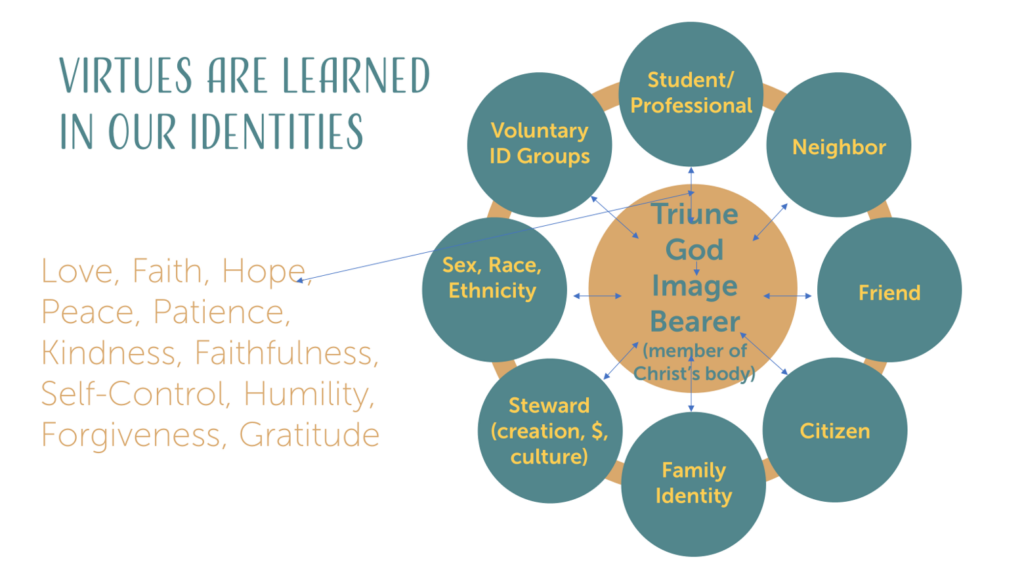
A clear understanding of this First Great Commission and how it relates to our purpose will do four things vital for Christian college students that I currently do not see happening among most of them in my interviews around the country.
First, it provides a foundation for their worth. In this view, they can learn to realize that their worth is not tied to their performance or status in any of their sub-identities. They are worthwhile and valuable apart from their performance or what others think of them.
Second, it provides a foundation for everyone else’s worth. One does not see another person simply through the identity labels that are so common today, but one also does not ignore those sub-identities. Instead, one centers the person’s identity as an image bearer of God. That identity shapes how they see all the other identities. In this way, it prevents reductive thinking related to race, class, gender, etc.
Third, it clarifies our ultimate telos and why we want to go about redemption. It is not simply to get people into heaven. God had an original purpose for us in this world. Through Christ’s saving work, we now have the possibility of more fully and powerfully reengaging in God’s original purpose for this world, while joining Christ in reversing the Fall (what Christ already did for us), and preparing for our present and future citizenship in God’s kingdom.
Fourth, it provides a specific goal in each of our sub-identities that relates to our overall meta-identity as image bearers of God. As II Peter 1:3-5 tells us:
[Jesus’] divine power has granted to us all things that pertain to life and godliness, through the knowledge of him who called us to his own glory and excellence [arete], by which he has granted to us his precious and very great promises, that through these you may escape from the corruption that is in the world because of passion, and become partakers of the divine nature. For this very reason make every effort to supplement your faith with virtue [arete],
The use of the Greek word arete is important in this passage. Just as God is excellent, he calls us to be excellent. To demonstrate the excellence of God, we must exercise God’s virtues. This calling is true for all of us.
Our students need to recognize that they do not need some special calling from God to be an excellent neighbor, friend, family member, citizen, professional, etc. We are all called to be excellent image bearers of God and thus excellent in all of these sub-identities. Becoming like Christ involves demonstrating Christ’s virtues in these various sub-identities.
How Can We Help Students Transform Their Purpose?
Based on my interviews, virtually all Christian college students do not have an understanding of this complexity. Yet, they see the need to get more specific. Take Anne, for instance. As a first-year student, she identified her purpose as “to grow closer to Christ and bring others to Christ.” I hope that every student articulates this kind of purpose, but I still think this purpose has a major danger. It can reduce one’s purpose to devotional or evangelistic activities while leaving out the rest of life.
In fact, by her senior year, Anne was searching for purpose language that would capture the complexity in life she was experiencing: “When I came into [my university], … it was very much that I would give a rote answer, where it was ‘glorify the Lord.’ And then it’s like the rest of it was kind of just like ephemeral…And I thought, after a while, it was like, that’s such an empty answer. To glorify, Lord. Well, what does that mean? Either, then that’s like, at some point, the onus is on me to figure out what that means.” She added, “I also think that I have to be really good at something.” Anne was on the right track. She sensed God was calling her to be and bear God’s image by being excellent in all of our identities.
I believe that key link we need to make in Christian higher education is to help students recognize how their goals fit into the overall Christian purpose I have been describing. Interestingly, when you ask students about their goals, they do talk about being excellent in their sub-identities. For example, here are just a few goals students have shared with our research team:
- Be a good friend to others
- Be a forgiving friend
- Be the best wife I can be
- Be a good student
- Be a good sister
- Take care of my body
- Spend time with nature
When you shift from asking students about their purpose to asking them about their goals, they often turn to thinking about being excellent in their various sub-identities. I should note that one missing and central goal, however, is often learning what it means to be an excellent member of Christ’s body.
Our role should be to help students learn how to connect these goals to their overall purpose—which is to be and bear God’s image. I think a first-year seminar on human flourishing would be a great place to help students make these connections, but it could also be done through faculty and staff who do more than share their conversion story. They can share their testimony about how their purpose is now to seek God’s excellence in every dimension of their lives, as image-bearers of God, while also pursuing professional excellence and being excellent members of Christ’s body.
For more on this topic, see my new book coming out next month, Unleashing the Image of God: Discovering Your Identity, Purpose, Vocation, and Character (Baker Academic).
[i] Al Wolters, Creation Regained: Biblical Basics for a Reformational Worldview, 2nd ed. (Eerdmans, 2005), 43-44.





















Perry Glanzer wisely notes the responsibility of Christian faculty and staff members to deepen student understandings of Christian calling not only because of Christ’s redemption but also in service to God’s creation. Yet, there is more to consider as we ponder our natural and social systems. For example, how should Greg’s Christian faith affect his choice of medical specialty, place of service, scope of patient clientele, and resolve to remain humane in a bureaucratized system of health care? We must teach students, perhaps as juniors and seniors, to question how their callings more fully honor God’s creation and image-bearers in relation to the local, national, and global systems in which we participate. Before they graduate, let us engage our students in pondering how Biblically-based care and justice intersect with structures and policies across the wide scope of God’s creation.
Thank you for clarifying and reiterating the greatest commandment as the ultimate purpose of our Christian walk—I couldn’t agree more. I particularly appreciated the section heading “Purpose as an Activity versus Fulfilling One’s Created End.” Incidentally, a recent editorial in the Christian Education Journal: Research on Educational Ministry (Aug 2026) states, “The ultimate aim of Christian educational ministry is, in a word, discipleship.” I find the term “discipleship” has become somewhat reductionist, conjuring images of little more than spreading the gospel in students’ minds. In my own taxonomy of Christian education, what stands at the very top is the greatest commandment: to love and desire God—with knowing Him and obeying His commands both preceding and proceeding from that love. Without heartfelt affection, our Bible study and Christian actions risk becoming legalistic and meaningless.
(P.S. I’m based in Singapore and teach theological students—pastors, leaders— in persecuted regions.)
I think the teaching of vocation would be just the thing to connect the transcendent (Christ’s saving grace) to the wolfly callings we have in the created (horizontal) sphere. Gustaf Wingren does that beautifully in his Luther on Vocation and I try to do that in my Ordinary Saints. Very earthy stuff that grounds the Christian life inn our callings, including bringing Christ to the neighbor.