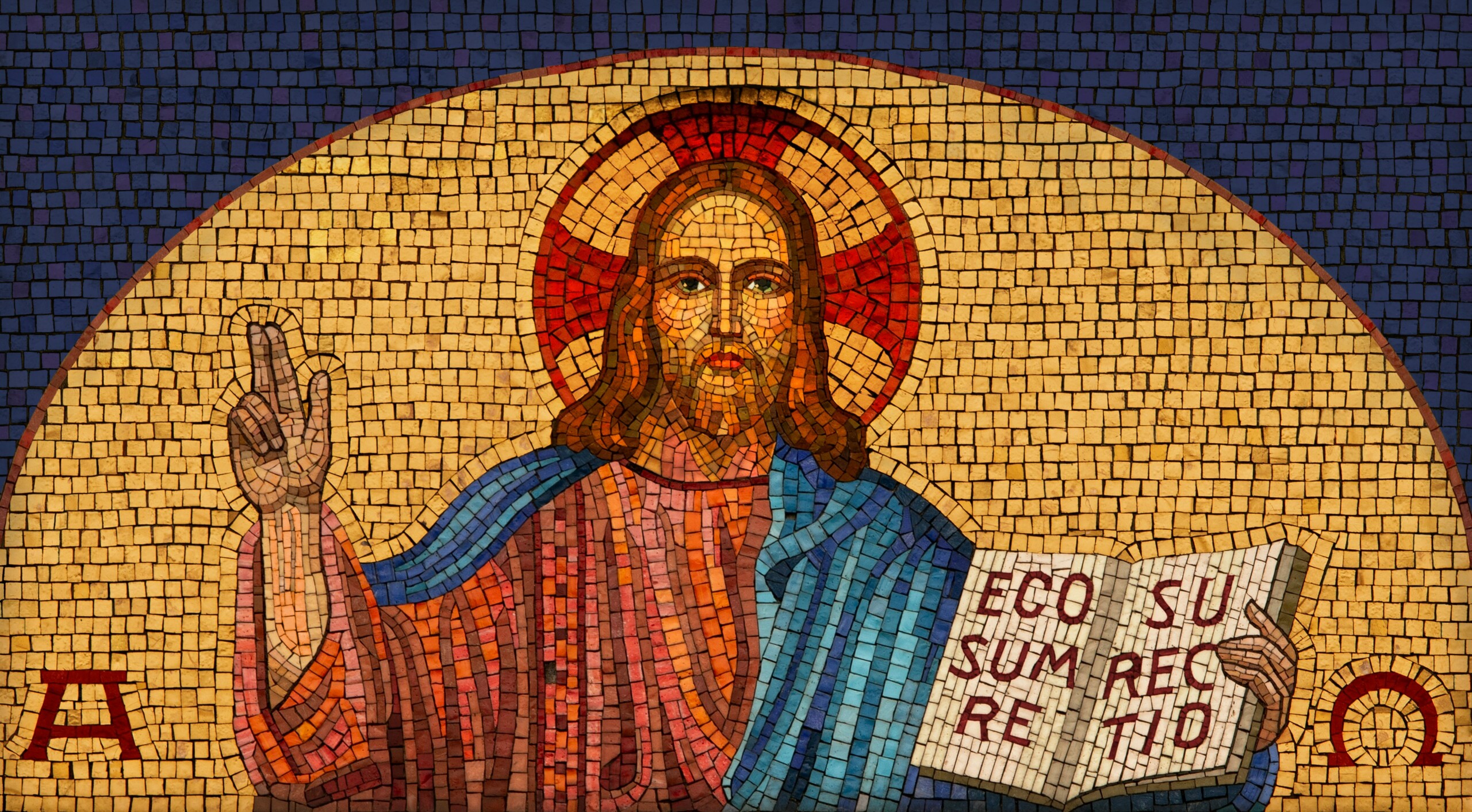
Some months ago, Professor Dongell asked CSR readers to imagine what sort of course evaluations Jesus might receive in his hypothetical role as a course instructor. As it happened, I had raised a related hypothetical only a short time previously in a different context, a small-group study at church: how might Jesus fare in an up or down vote on the campus’s Tenure Committee, particularly at a self-identified Christian college?
My friend Kristen immediately protested the implied doubt in my question about Jesus’s prospects. “But of course he would get tenure. He’s Jesus!” Most CSR readers might agree with Professor Dongell, above, that “If Jesus were a professor, his goal would not be a 100% approval rating [from students].” But this speaks only to Jesus’s goal for himself. At present we are concerned rather with the institution’s goals for Jesus. It leaves unresolved the present hypothetical as to Jesus’s tenurability. This is the Jesus who, after all, lamented “O Jerusalem, Jerusalem, thou that killest the prophets, and stonest them which are sent unto thee” (Mt. 23:37, KJV).
To the extent that Jesus himself identifies here with the prophets of old—this raises the question: do our institutions value prophetic voices?
Institutions and Prophets
Many of us who aspire to positions in higher education, and perhaps Christian higher education in particular, are idealistic by nature. Such idealism, compounded in this case by our liberal arts and graduate school training as critical thinkers, may readily be channeled into something well short of get-along, go-along institutional boosterism. We play—we may even feel divinely or existentially called to play—the prophet. And although few of us today are literally stoned—or crucified—our willingness to blurt out that the emperor is naked may nonetheless exact a heavy price. Sometimes heavier than we’ve bargained for. Even in—maybe especially in—Christian institutions. After all, administrators, tenure committees, and faculty more generally may struggle with any in the mold of Jesus-as-prophet.
A cynic, accordingly, might caution any would-be-prophetic professor to wait until tenure before too conspicuously revealing his or her true colors. Less cynically, but being a realist about the challenges the prophets in our midst may face; and wanting those same prophets, moreover, to thrive and receive a fair hearing—believing that our institutions need such prophets much more than they know—I have returned to my original, somewhat flippant and rhetorical question. Directing my thoughts, first of all, to individuals who identify with Jesus-as-prophet and the long prophetic tradition before (and after) him, to individuals both tenured and yet-to-be-tenured, I would extend the following five invitations.
Advice for Would-Be Prophets
One, I invite any would-be fellow prophets to remember with humility that we are not, in fact, Jesus; that we may not see clearly all that Jesus saw or Jesus sees today. However certain we are as to the righteousness of our cause—perhaps especially when we are certain—to remember that there is much in this world that we see only in part, and at best “through a glass darkly.” Moreover, our own sinfulness will blind us to realities, both inside and outside of ourselves. Again, we are not Jesus.
Two, I invite would-be fellow prophets to refrain from upholding unrealistic expectations for our institutions. I have talked with many newcomers to our institutions over the years, especially those coming from “secular” universities, who arrive starry-eyed, imagining something quite different than what they eventually find. Christian institutions, just as Christian individuals, share in the curse of Adam. While it may be appropriate or even necessary at times to name the structural and “systemic” evil in which we participate, we should not be surprised that the fall extends to our own institutions. Recognizing the pervasiveness of evil—past, present, and future—may guard us from idealizing some alleged “purer” institutional past, or hoped-for millennial state in the future when our own pet schemes for institutional reform have been achieved.
Three, I invite would-be fellow prophets to recognize the fragility of our institutions; moreover, the vulnerability and precarious, permanently untenured condition of our administrators and board members in the face of such fragility. Our presidents do not have the same absolute sway as King Ahab. Among other factors, the cultural and ideological polarization of our society, our churches, and even our own faculty and staff may limit the scope of our leaders’ freedom to pursue the True, the Good, and the Beautiful in ways prophets (especially those who have not served as administrators or board members) may not always grasp.
Four, I invite us to resist the temptation to be Elijah at his worst. Like Elijah, we may imagine that we are the only faithful or righteous or discerning ones, the only members of the faculty or staff who see the evil; who see what most needs to be done to better our institutions. Like Elijah, we need to be reminded—remind ourselves regularly—that we are not as alone as we may think ourselves. And in reminding ourselves of our own hypothetical “seven thousand” colleagues, we would do well to seek out, to affirm, and to celebrate all the good that is being done around us, by those we number among the seven thousand and by our institutions more generally.
Five, I invite would-be prophets to remind themselves of their larger vocations, in their particular institutional roles, and in our common membership in the Kingdom. It is easy for some of us to focus too seriously on our prophetic gifts, to the neglect of other duties and opportunities. The extent to which our prophetic voice will be taken seriously depends, ironically to some degree, in the end, on our effectiveness outside of that role; it depends to some degree on the extent to which we have, in the eyes of our hearers, earned the right to be prophetic.
Advice to Non-Prophets
To this point, I have addressed my reflections to the prophets themselves. Before concluding, I would like to extend briefly, in parallel fashion, five invitations to those who must make decisions about the prophets in our midst—or who must live with the results of decisions made previously, in the form of already-tenured Jeremiahs among us. For any member of the tenure committee; for any administrator, other campus leader, or anyone who must share office buildings, here are five pieces of advice, in turn.
1. Remember that at their best, prophets may be valuable models for students. Contemporary critics of higher education have repeatedly pointed out the conformity, ideological and otherwise, that characterizes too many campuses, and too many academic guilds. Our students need to see examples of “daring to be a Daniel.” As graduates leave our campuses and enter a world where they may be expected to simply “go along,” intellectually, morally, and otherwise, they need to remember living models of the courage to say or do the unpopular.
2. Celebrate the prophets for reminding us that we need, in enterprises great and small, multiple perspectives. In the best tradition of the liberal arts, prophets may promote intellectual diversity, may free us from rigid or narrow framing of issues, may introduce previously marginalized voices to the table. Prophetic voices extend our visions, deepen our conversations. That department that complains the most about a gadfly up for promotion may be the very department that needs the gadfly’s insight and courage the most. The administrator who despises the prophet most may be the one who most needs to consider an alternative perspective.
3. Acknowledge that where there is muck, it is not necessarily bad to have muckrakers. No less than in society at large, Christian colleges and universities have their own long-buried scandals, long-buried (or more recent, unburied and unprocessed) resentments, injustices or perceived injustices too often unmentioned in our public discourse. Might we be more willing to affirm, in fact, the prophet’s predilection for bringing what is festering to the light of day and to shared, constructive engagement—before there’s a crisis? Again, as in Andersen’s fairy tale, we may wish not simply to tolerate, but explicitly to honor the one who dares to say what others are too polite or too fearful to say out loud.
4. Remember the role the prophets of the Old Testament played in calling the people of Israel back to their core commitments and core mission. Just as the ancient Hebrews drifted at times from their founding covenants and calling to be a blessing to the nations at large, so also Christian colleges in a somewhat analogous manner may experience missional drift. Institutionally, we have turned, and continue to turn, to idols and false gods. Among others, idols of respectability and prestige, conformity to the culture at large, institutional sustainability for its own sake and at any cost. To the extent that the prophets among us today are not simply complainers, but calling us to attend to our foundational ideals and institutional reason for being, we may owe them more of a hearing than we’ve given them to date.
5. Finally, especially to the wary administrator or board member, and at the risk of sounding too much of a Pollyanna, I extend the invitation to make friends with the prophet. To make it a priority to reach out when he or she does not reach out one-on-one to you. To say, in the words of Isaiah, “Come, let us reason together.” To invite them for coffee, or a walk around the track. To choose to listen. To celebrate their humanity. Actually, to weigh it in their favor that they care sufficiently about the institution to confront what they consider needs for improvement. To consider the prophets among us an asset to the institution rather than a liability or cross to be borne. To remember I Corinthians 12, especially verses 22 and 23. Again—I invite administrators, in particular, to make a friend rather than a potential enemy or detractor.
The question we began with—would Jesus, in one of our Christian institutions today, receive a fair hearing when he came up for tenure—is obviously unanswerable. As individuals or as institutions, we will not be held accountable on that score. Those of us called to raise our prophetic voices, however, are accountable to act in ways that best steward the prophetic gifts we have been given; to speak in such ways that those around us are most able and most apt to hear. And accountability aside, our institutions will be more likely to thrive to the extent that we accommodate—perhaps even embrace with gratitude—those harsh and grating voices we may find hardest to hear.