


Editor’s Note: This post is the first in a three-part series addressing how we deal with purpose and the good life in Christian higher education.
I remember having a conversation some time ago with the leader of one of the large Christian college partnerships. In the midst of the conversation, I found it surprising that this person admitted that Christian universities are not always the best at producing Christian leaders for the world.
Although the comment’s source surprised me, the observation did not. I had, for some time, noticed that Christians involved in Christian groups on secular campuses went on to be some of the most influential leaders in the broader Christian and secular world. In contrast, Christian students attending Christian universities often seemed to take positions in Christian organizations, become hypercritical of both the church and Christian ministries due to their extensive experience in both, while often avoiding taking Christian leadership in the world.
I thought of that conversation while evaluating research findings from our Templeton grant-funded project. My research team had interviewed 171 undergraduate students from three types of settings: 1) students from two psychology study pools at top-ranked state universities; 2) Christian students at five Centers for Christian Thought at five elite secular universities; and 3) three top Christian institutions.
I find evaluating these kinds of interviews helpful for reminding myself and others that Christian education may not always achieve the outcomes it thinks it does. This post explores the differences we found in how the students we interviewed in these contexts think about the good life, purpose, and worth.
The Good Life
Consistent with our theory of how college students think about the good life, participants identified their vision of a future good life by choosing from 25 different good life ingredients. Of course, students did not list all of those ingredients. Each student’s answer contained anywhere from one to ten of those ingredients.
Table 1 below lists the eight most common ingredients in students’ answers by the three participant groups.
Table 1. Top Good Life Ingredients
| Ingredient | CCT (n=48) | Christian U (n=73) | State U’s (n-48) |
| God (loving) | 54% | 29% | 2% |
| Relationships | 54% | 30% | 42% |
| General Stability | 27% | 22% | 50% |
| Loving Others | 25% | 16% | 15% |
| Happiness | 23% | 30% | 42% |
| Acquiring Virtue | 13% | 14% | 4% |
| $ Stability | 10% | 14% | 29% |
| Traveling | 2% | 3% | 17% |
The most obvious difference is that the majority of Christian students in Centers for Christian Thought (CCTs) articulated loving or serving God as essential to the good life. In contrast, only one student out of 48 (2%) from the psych pools at state universities gave that answer. Instead, they sought and hoped for general stability (50%). Christians participating in study centers were also more likely to see relationships as important for the good life (54% vs. 42%), as well as virtue (13% vs. 4%) and loving others (25% vs. 15%). In addition, they were less likely to include happiness (23% vs. 42%) or traveling (2% vs. 17%). Sometimes we forget how unique committed Christian students are, but this research reveals important differences (we should also remember that most important differences in life are often differences of percentage, not simply dichotomies).
We also found it striking that significant differences emerged between students at Christian Study Centers and those at Christian universities. Less than a third of Christian university students mentioned God in their vision of the good life (29% versus 54% of the Christian study center students) or relationships (30% versus 54%). They were also more likely to focus on happiness (30% versus 23%) versus loving others (16% versus 23%).[1] I found something similar when asking students about purpose and self-worth.
Purpose
With regard to purpose, it is interesting to look at our longitudinal findings from 72 students. Consistent with our grounded theory of college student purpose development, students invariably choose their purpose from a set of twelve ingredients. Below in Table 2 are the results for students we interviewed at T1, which for the majority of them was the first month of their first year.
Table 2. % of Students at T1 Indicating the Particular Purpose Ingredient
| Purpose Ingredient | T1 CHE | T1 CSC |
| God | 35% | 41% |
| Serve Others | 23% | 21% |
| No Purpose | 23% | 21% |
| Career | 9% | 14% |
| Self-Development | 9% | 3% |
| Friends/Relationships | 7% | 7% |
| Acquire Other Virtues | 5% | 7% |
| Family | 5% | 3% |
| Impact World | 5% | 7% |
| Civic | 2% | 3% |
| Experience/Enjoyment | 2% | 3% |
| Make Money/Acquire | 0% | 7% |
At Time 1 (T1), both students at Christian universities and students involved in Centers for Christian Thought (CCTs) at secular universities were fairly close in the extent to which they included God as a key ingredient in their purpose (35% of Christian versus 41% CCT). Twenty months later at Time 2 (T2), the percentage of students at a Christian university who mentioned God in their purpose actually decreased to 33%, while those in CCT’s increased to 59%. These results indicate that the CCTs were doing something right and Christian universities were not.
Table 3. % of Students at T2 Indicating the Particular Purpose Ingredient
| Purpose Ingredient | T2 CHE | T2 CSC |
| God | 33% | 59% |
| Career | 29% | 17% |
| Acquire Other Virtues | 14% | 21% |
| Serve Others | 17% | 17% |
| No Purpose | 17% | 14% |
| Family | 17% | 7% |
| Friends/Relationships | 12% | 7% |
| Self-Development | 0% | 0% |
| Impact World | 7% | 3% |
| Civic | 0% | 7% |
| Experience/Enjoyment | 0% | 0% |
| Make Money/Acquire | 0% | 0% |
Self-Worth
As I have noted in earlier posts and journal articles[2], we also found that institutional context made a tremendous difference in whether students derived their self-worth from God or from other more contingent sources (parents, friends, achievements, etc.). At one CCT, 72% of students indicated they found their worth in God. Yet, only 24% of Christian students at Christian institutions indicated that they found their worth in God. Clearly, for these students, CCTs were doing something better than Christian universities in these three areas.
Why?
I think there are likely numerous explanations for these differences. One hypothesis I have is that Christian universities, like churches, often rely on a simple absorption model rather than engaging in more direct forms of intellectual discipleship. They assume students absorb a Christian understanding of the good life, purpose, and worth simply by being part of a caring Christian environment, when in reality a significant percentage do not. In other words, Christian universities do not hold themselves intellectually accountable to testing whether they are changing students’ views of self-worth, purpose, and the good life.
A second hypothesis I have is that there is something important about consistently committing to involvement in a Christian group on a secular campus despite peer pressure—something that does not involve one’s parents, money, or input, versus committing in one moment to a Christian university (perhaps with one’s parents’ input and financial pressure).
Finally, I think Christian universities fail to recognize the importance of setting forth a Christian theological anthropology that will provide a rich foundation in these areas. This vision of the human person and God’s purpose would communicate to students that our central identity is that we are image bearers of God. That identity provides a stable source of worth, an understanding of our created purpose, which is to be and bear God’s image, and a rich understanding of what the good life entails, which is fulfilling that purpose in all dimensions and identities in our life. We do that by living out God’s virtues in all of these identity contexts (see Figure 1). My forthcoming book, Unleashing the Image of God: Discovering Your Identity, Purpose, Vocation, and Character(Baker Academic) provides some ideas about how to address these issues.
Figure 1: Building a Vision for the Good Life on a Theological Foundation

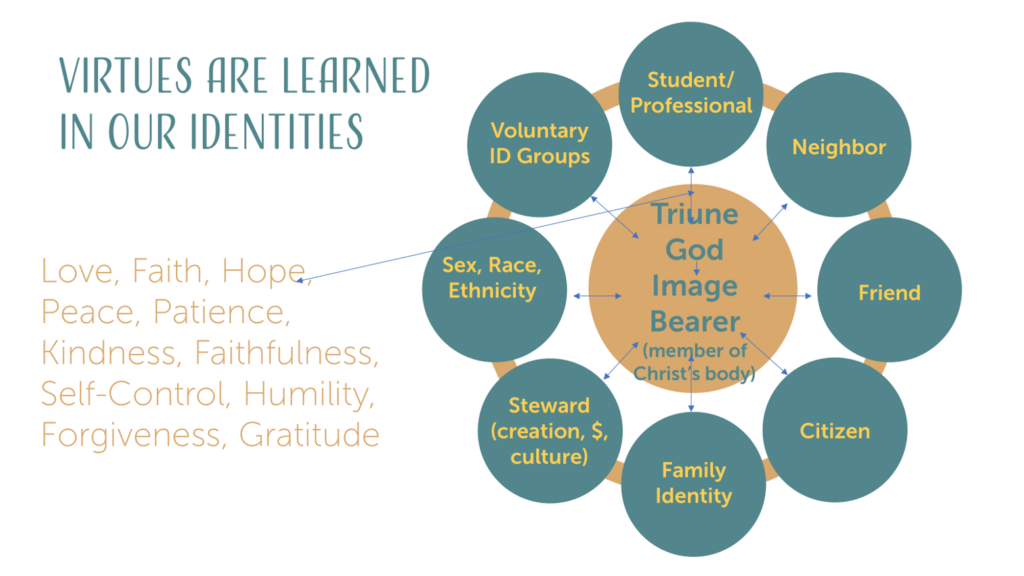
I think a first-year seminar that explored these three questions in light of a robust Christian anthropology and understanding of identity would be a helpful start. If students start with problematic understandings of their worth, purpose, and the good life, this initial class could propose a vision for purpose and the good life that takes into account one’s core identity and how it relates to pursuing excellence in one’s other identities.
In addition, we need faculty and staff who do more than share their Christian identity or perhaps their conversion story. We need to share our testimony about how we seek God’s excellence in every dimension of our lives, as image bearers of God, while also pursuing professional excellence. In addition, we need to share honestly about the difficulties of that journey, our limitations and shortcomings along the way, and how we have to rely upon the triune God’s grace, strength, and wisdom as we put our lives together in a quest to fulfill the good life God has set before us.
For more on this topic, see my forthcoming book, Unleashing the Image of God: Discovering Your Identity, Purpose, Vocation, and Character (Baker Academic).
[1] For more on longitudinal differences, see Perry L. Glanzer et al., “How Students’ Views of the Good Life Change While in College: A Qualitative Longitudinal Analysis,” Journal of College and Character, 27(1), 1–19. https://www.tandfonline.com/doi/full/10.1080/2194587X.2025.2602496
[2] For our two major journal articles on this topic, see: Perry L. Glanzer, Jessica Martin, Elizabeth Bounds, Karen Melton, Ted Cockle, and Sarah Schnitker, “Sources of Self-Worth in U.S. College Students: A Grounded Typology,” Journal of College Student Development, 65, no. 5 (2024): 507–26. https://doi.org/10.1353/csd.2024.a940718; Perry L. Glanzer, Jessica Martin, Elizabeth Bounds, Ted Cockle, Sarah Schnitker, and Karen Melton, “The Challenge of Finding Noncontingent, Universal Worth for Elite U.S. College Students,” Self and Identity 23, nos. 3-4 (2024): 268-87. https://doi.org/10.1080/15298868.2024.2357848.






















Having lived for twenty years as a Christian in a secular, religiously superstitious culture (Japan), I noticed that for both myself and the full-time missionaries I knew, that over time, our Christian values became not only a core aspect of each one’s identity but also a means of personal strength and cultural “survival” in an environment with very different and sometimes clashing values. I suspect that the Christian students in secular universities have a similar experience; their values give them not only identity but also strength to “survive” in a potentially and sometimes truly hostile environment. They appreciate not only one another’s but also the Lord’s presence and help in their lives. Those at Christian U’s don’t need the strength their brethren at secular U’s require and perhaps don’t “treasure” their values and identity because they do not feel countering pressures from their environment.