


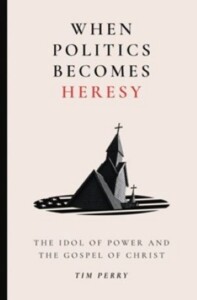
When Politics Becomes Heresy: The Idol of Power and the Gospel of Christ
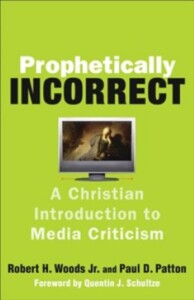
Prophetically Incorrect: A Christian Introduction to Media Criticism
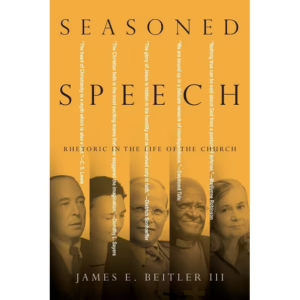
Seasoned Speech: Rhetoric in the Life of the Church
At first glance, or even third, one might have difficulty seeing the connection between these three books. However, each makes a significant argument for the life of the church in this divisive age. How can Christians with divergent beliefs and markedly different political positions communicate with one another? How can the fractured church communicate to the many outside the church, sharing with them the Good News? Because the arguments among Christians are so extreme, the work of the church in reaching non-Christians is at risk. Because the arguments among Christians are so severe, the church often seems unable to encourage, edify, and unify its own members. Major Protestant denominations are losing membership, and painful tales of church fractures are growing. For example, In Losing Our Religion, Russell Moore, minister and editor of Christianity Today, relates his bitter journey out of the Southern Baptist Convention where he had been a member since childhood.[1] What to do? At least one possible aid may lie in the study of rhetoric. The new book addressed in this essay, When Politics Becomes Heresy, a finalist in the politics and public life section of the 2025 Christianity Today Book Awards, offers deep insights into our present conflicted trends. The two older books help us to recognize the role of rhetoric in those trends.
Rhetoric, not just or mere rhetoric, as people often encounter it, need not be lies, baloney, or propaganda. Rhetoric is an ancient discipline with its roots among the Greeks and Romans, and it figured as a major part of the early university curriculum. Although both the field and its definitions have often proved contentious, Aristotle’s definition is most commonly accepted—“the faculty of discovering in the particular case what are the available means of persuasion.”[2] James Beitler in Seasoned Speech: Rhetoric in the Life of the Church analyzes the rhetoric of five diverse Christian writers: C. S. Lewis, Dorothy Sayers, Dietrich Bonhoeffer, Desmond Tutu, and Marilynne Robinson. Demonstrating deep knowledge of both the history and concepts of rhetoric, Beitler makes a convincing argument for the value of rhetoric study in the life of the church.
Many Christian scholars over the years have considered rhetoric positively; Beitler lists Augustine and Erasmus, and Hugh Blair, George Campbell, and Richard Whately, ministers who advocated the use of rhetoric in schools and seminaries during the late eighteenth and early nineteenth centuries, along with modern scholars (12). Indeed, St. Paul advises in Colossians 4: 6, “Let your conversation be always full of grace, seasoned with salt, so that you may know how to answer everyone.”[3] In Acts 17 Paul himself demonstrated rhetorical skills in his speech at Athens. Christians need to reflect on their communicating, both in service of effective witnessing and in service of self-reflection.
The influence of C. S. Lewis (1898–1963) on Christian thinking has been considerable, as through Mere Christianity (1952), his apology for Christianity for modern believers. Through his rhetorical analysis of Lewis’s God in the Dock: Essays on Theology and Ethics (1970), Beitler maintains that ethos is particularly demonstrated by Lewis. Ethos is one of the three major appeals a rhetor should consider in creating an argument, according to Aristotle. Ethos is an appeal from character; what is thought about the speaker/writer. Lewis demonstrated respect and concern for his audience; he did not dismiss anyone, and he did not come across as self-righteous. Beitler summarizes that the nature of the ethos of Lewis was shown in “his willingness to address his audiences on their own terms, his forthright yet humble stance, and his attempts to cultivate communities characterized by goodwill” (37). Lewis made it a point to talk about the beliefs that unite Christians, rather than separate them. Moreover, Beitler commends “Lewis’s willingness to dialogue openly with non-Christians about matters of faith” (48).
Dorothy Sayers (1893–1957) is known for her popular mystery series about Lord Peter Wimsey and her essays on such matters as Christian education. Beitler contends that Sayers in her play, The Zeal of Thy House (1937), and other writings presented the importance of Christian creeds and doctrines in a winning way. Sayers’s rhetorical method in her plays is a technique advocated by Roman rhetorician, Quintilian, enargeia. Enargeia “involves depicting an event so vividly . . . that one’s audience feel[s] as they would if they were really there” (66). Sayers artfully and imaginatively represented the creed by “dramatizing dogma” (64). To achieve this end, Sayers, according to Beitler, used visualization to move the story. She also insisted on using “contemporary, everyday language—a rhetorical choice that helps the dramatist to move audience members” (73). In addition, Sayers used vivid realism “not only to move her audience but also to confront and disturb them” (74). The basic beliefs of the church, like the Christmas story, are not hidden in language but revealed in their power in Sayers’s work, from plays to novels to essays.
Dietrich Bonhoeffer (1906–1945), German pastor, theologian, and martyr at the hands of the Nazis, and Desmond Tutu (1931–2021), South African minister, activist, and winner of the Nobel Peace Prize, were both rhetors involved in politics. Beitler uses the rhetorical concept introduced by rhetoric scholar Kenneth Burke, identification, to characterize Bonhoeffer’s rhetoric in various essays, lectures, and writings. Beitler states, “For Burke, identification included all of the ways in which speakers and writers align themselves, or are aligned with, their audiences” (101). Bonhoeffer began to stand against Hitler’s government in 1933 “with rhetorical countermeasures that aimed to re-identify German Christians with those whom Hitler had displaced—Jewish Christians and, along with them, Jesus Christ himself” (104). A humiliated Christ who dies for all people is the Christ Bonhoeffer sought to preach, without flowery language. Bonhoeffer was executed for his beliefs.
Likewise, Desmond Tutu spoke out against the policy of apartheid in South Africa as anti-Gospel, and he worked his entire life, often in dangerous situations, to destroy the policy and bring new life to South Africa. Beitler applies to Tutu the concept of constitutive rhetoric, the idea that “our language that surrounds us influences all aspects of our lives” (138). Thus Tutu’s activist “ministry often involved stationing himself with the marginalized and the suffering, and his willingness to preach and comfort in the midst of charged situations” (131). Tutu worked and spoke for reconciliation and forgiveness while acknowledging the violence and destruction caused by apartheid. Beitler notes that “Desmond Tutu resolutely advanced a constitutive rhetoric that defined personhood in terms of human interdependence . . .” and “time and time again, Tutu positioned South Africans of all backgrounds as dependent upon and responsible for one another’s flourishing as humans” (138–39). Tutu sought to bring South Africa together by engaging in discussion with all South Africans. As a rhetor he was direct and plain, and called on the principles of Christianity to show people how to live with one another.
Finally, Beitler approaches the work of novelist Marilynne Robinson (1943-), author of the Gilead novel series. He brings back the notion of ethos—character. This concept of ethos is expanded here to include context and place. Robinson used lyrical language in portraying her characters sympathetically, both Christian and those struggling with faith. In addition, she portrayed the settings for characters as meaningful and powerful. Beitler notes, “Robinson’s verbal artistry—and her clear desire to describe rural Iowa in beautiful and even majestic ways—explains in part why so many readers want to spend time in her world” (175). Avoiding rejection of this world that God created, Robinson creates a place that “performs that hospitality for its readers by avoiding a didactic stance, and, instead, by dwelling with questions of the Christian faith” (189). Robinson’s rhetoric is inviting, relatable, and moving.
Ultimately, Beitler maintains that there is no one kind of rhetoric that Christians must use to represent Christ in the world, as shown by the diversity among Christian writers examined. Mikhail Bakhtin (1895–1975), literary theorist and philosopher, contributes the notion of heteroglossia, the use of many languages, a notion that Beitler advocates. He concludes, “I simply want to affirm the notion that, if the gospel of Jesus Christ is truly to reach the whole world, the church’s witness must go forth in multiple languages, through a variety of mediums, by the way of different genres and voices, using a host of rhetorics” (212).
Seasoned Speech provides a thought-provoking and well researched argument for the church to attend to rhetoric. The book is not an easy read and will appeal most to those with some background in rhetoric. A key lacuna in the book is that Beitler ignores the place of rhetorical analysis or evaluation—in what ways Christians can not only witness to others but can think critically about their own rhetoric and the rhetoric to which they are exposed. The other two books addressed in this essay will show how this evaluative element is more important than ever.
In ancient times, the discipline or field of rhetoric focused on speech, mostly in politics and law courts. Then with the advent of writing, rhetoric was extended to the written word. Today, however, rhetoric cannot include only spoken and written speech. With modern technologies, humans communicate in a variety of ways, not only through sermons but YouTube, not only in essays but text messages, not only at community talks but Instagram. Modern media require even more extensive rhetorical study. Scholars of rhetoric have long noted that the impact of rhetoric extends to much besides the written or spoken word, as Marshall McLuhan declared in Understanding Media: The Extensions of Man in 1964.[4] Richard Toye observes in Rhetoric: A Very Short Introduction (2013) that the concept of “visual rhetoric” includes how things like “clothing, gesture, and the use of physical space can reinforce messages.”[5] Rhetoric applied to media is referred to as media criticism, media literacy, or technology literacy, the ability to think critically about all the media.
Thus, it is appropriate to include in this essay’s consideration of rhetoric a book written a decade and a half ago, Prophetically Incorrect: A Christian Introduction to Media Criticism, by Robert H. Woods Jr. and Paul D. Patton. In this book, Woods and Patton summarize their goal:
[w]e have labored to inspire our readers toward a prophetic sensibility in all that they do, whether consuming, creating, or critiquing popular media. We need spiritual discernment to see beyond the big three moral issues—sex, violence, and profanity—to recognize how popular media mythologies reinforce North America’s dominant framing story by idolizing consumption and preaching worldly success. (129–30)
Woods and Patton assert that Christians today, like the Old Testament prophets, need to critique the media and our culture from a foundation of God’s justice, peace, and mercy. Christians should sometimes be social critics. They do not mean that Christians should be evangelists of the Social Gospel. Christ is the only answer; good works do not save. However, the media do influence everything.
The Old Testament prophets, like Jeremiah, told truth to power, and not only were the personal behaviors of the Old Testament kings called into question, but also the whole society’s willingness to oppress the poor and marginalized and to celebrate greed and materialism. Woods and Patton proceed to examine how and why Christians today should be prophets “in the small-p sense . . . to interpret events from a biblical perspective, to tell it like it is and how it should be” (xxxii). Chapters include such titles as “Cultivating a Prophetic Voice,” “Considering Humanity’s Plight,” and “Shocking the Complacent.” Rhetorical critics of the mass media need to consider the content, the technologies, and the institutions that control media messages. Questions need to be asked continuously to challenge the materialism of advertisements, to confront the stereotypes of TV and films, to search out quality news sources that do not simply reflect the “story of stuff” (70), to dismantle “the celebrity worship syndrome” (55), and to save us from the constant distractions of social media that waste our time, often making us jealous of others who have more but leaving us indifferent to those who have little. Christians need to interrogate their own media and media messages, too. The authors state:
. . . tribes on the Left and the Right practice their own brand of tribal correctness by “preaching to the choir” and telling already-loyal audiences what they want to hear. And rather than seek out media that introduce discomfort and provoke change, we prefer programs or magazines that confirm our tribe’s position (or perceived superiority) over another. The results of such practices are as inevitable as they are disappointing: fragmentation, ideological division, and local rather than unified effort. (122)
In contrast, the authors declare, “Christian media must ultimately be less concerned with evoking applause from their audience than provoking thoughtful, sometimes uncomfortable reflection” (16). Prophets will encounter resistance, though. The Old Testament prophets were often persecuted. Several prophetic questions that each of us can ask of media are suggested by Woods and Patton as follows:
What vision prompts my decision to create or consume media content? Where in the media do I find evidence of the Bible’s call for justice and servanthood along with its unmistakable warnings about wealth and greed? What is the ultimate purpose of media in the light of what the Bible says about justice and the reconciliation of all things in a hurting world? When I critically examine my own tribe’s media ownership and practices, what hidden priorities come to light? Prophets do not hesitate to ask what our media should look like and how they might address the world’s greatest needs. (35)
The medium itself requires questioning, too. A print newspaper and a video game have different inherent biases and appeals.
Throughout the book, Woods and Patton offer specific strategies for media critics. Media prophets can engage in media fasts, avoid “tunnel vision” (total concentration on one justice issue, such as abortion), employ indirect strategies like satire at times, and challenge “media idolatry” (81), the myth that media technologies will solve our problems, especially, we can add in our current moment, artificial intelligence. Anyone can be a media critic; it takes time and reflection. However, study of rhetoric and the media also has a place in communal church Bible study, Sunday School, and Christian schools and colleges. We should note that such work has to be carefully planned so that the rhetorical ethos of a C. S. Lewis or Marilynne Robinson prevails, an approach that is welcoming and respectful. Diverse Christian authors offer numerous insights and ideas for practice. (See, for example: Always On: Practicing Faith in a New Media Landscape by Angela Williams Gorrell; Redeeming Technology: A Christian Approach to Healthy Digital Habits by A. Trevor Sutton and Brian Smith; and Faith in the Age of AI: Christianity through the Looking Glass by Dan Scott.[6]) In these media-dominated times, Christians cannot afford to ignore media criticism. Of course, knowledge is not salvation. Understanding rhetoric will not solve all problems. Nevertheless, Woods and Patton make an excellent Christian argument for media criticism. They declare that Jesus himself “exposed and confronted the dominant consciousness in his own day and offered a radically different narrative. His radical faith and prophetic voice included attacks against institutional power and injunctions against his disciples’ pursuit of self-interested power” (18).
Prophetically Incorrect is a brief book, well developed and passionately presented. The notion of Christians as modern-day prophets (little “p”) who ask the hard questions through media criticism is worthy of attention in the church. The sin of consumer capitalism as our religion, the notion that what we have is what matters most, proves destructive for all citizens.
This takes us at last to a brand new book focused on the contemporary cultural moment. In When Politics Becomes Heresy: The Idol of Power and the Gospel of Christ, Tim Perry, lead pastor at a Lutheran church in Canada, applies a knowledge of church heresy to the Christian church today, arguing that Christians need to examine themselves in light of ancient heresies. Although not a direct case for the study of rhetoric or media criticism, Perry demonstrates a solid grasp of rhetoric in making arguments relevant to the polarization in churches and society. He also interrogates the rhetoric of contemporary politics. Like C. S. Lewis or Dietrich Bonhoeffer, the ethos Perry engages is welcoming, serious, humble, and Bible-centered, He says the book is not meant to be an argument, but rather a “lament,” a “plea,” a “call,” a “panarion” (a catalogue of heresies and how to treat them), and “my last love letter” to evangelicalism (1–2).
Perry describes five ancient heresies visible in churches today, three of which apply significantly to rhetoric and media and will be examined in more depth. Perry begins with language meanings. Heresy happens when people who claim to be Christians deny some essential belief, such as the Incarnation. He adds that heresy is “the obstinate assertion of self-will over against the mind of the church universal, while insisting that one nevertheless remains a Christian” (22). Heresy is a serious word.
Perry starts with an explanation and history of simony. Simony is named after Simon Magus, a sorcerer who in Acts 8:9–25 was spreading the Gospel successfully until he thought he could pay the apostles to give him the Holy Spirit. “When Simon saw that the Spirit was given at the laying on of the apostles’ hands, he offered them money and said, ‘Give me also this ability so that everyone on whom I lay hands may receive the Holy Spirit.’ Peter answered, ‘May your money perish with you, because you thought you could buy the gift of God with money’” (8:18–20). In the Middle Ages, simony came to mean the buying and selling of church offices or “divine objects.” A church member could, for example, receive time out of Purgatory by buying indulgences. Perry maintains that modern simony swaps the positions of church and state. Christians exchange God’s promises for political issues and power, reversing “the dynamic of kings and emperors approaching bishops and popes” (51). Perry declaims, “When the Bible is misused to make difficult and complex issues seem easy, it is being used to browbeat faithful people into coming to a solution prematurely. It is deploying the language of faith to secure a position in politics. It is Simony” (49). Perry adds, “When a political position guards the doors to the church rather than the gospel, that gospel is being treated as a means to a political end. And that is Simony” (51). He further notes, “When the gospel is sublimated to politics, when the Holy Spirit is offered for sale to a worldly purpose, what belongs to God is rendered unto Caesar—that is Simony” (52–53). As with each heresy, the author recommends repentance. He adds here prudence as a response. Perry recommends “the use of proper caution; deliberation in decision-making, using reason in both self- and community governance” (53). Here is where rhetoric and media criticism have a place.
“Outside Scripture, Simon is also remembered as the founder of Gnosticism. Whether or not that is the case, it’s certainly true that Gnosticism finds its way into the pages of the New Testament,” explains Perry (65). St. Paul wrote letters to the new churches suffering from heresies, and Gnosticism may have been a major entanglement. There were Gnostic versions of other religions, too, but all involved “secret knowledge,” as the word means in Greek. Most alarming, the Gnostics thought Christ might not have been God and man. The major error is that of denying the incarnation and death and resurrection of Christ as key to salvation. Instead, Christ’s teachings were the sources of the “secret knowledge” Christ withheld from the Twelve but was then understood by the elite Gnostics. They could figure it out themselves. Gnostics thought “the world needed no conversion. Christian faith was entirely compatible with the world as it was” (75). The church needed adjusting to the culture. In contemporary terms, Gnosticism is seen in the urge of evangelicals to be “relevant” rather than true, to offer self-esteem rather than repentance. Perry maintains that “Like them [the Gnostics] we sought to bring Jesus to a culture by closing the gap between the two as much as possible. Like them, we ended up adopting the culture, losing Jesus, and scorning our own piety” (82). He continues, “The contemporary evangelical Jesus, whether on the right or the left, bears little resemblance to the Jesus of the Bible” (82).
Finally, Perry asks, “What would Jesus do? Depends on the Jesus. He is entirely captive to the political needs of social conservation or social progress” (83). Gnosticism can be seen in the conspiracy theories (secret knowledge) of the right, the QAnon movement, and the lust for power, noticeable in the Moral Majority of the 1980s. Gnosticism can be seen in the arrogant elitism on the left, political correctness run amok, belief in the “power of the state to silence any evangelical dissent to the LGBTQ+ agenda” (83), and the lust for power. As Perry says, the universal need for the suffering and risen Christ has lost its truth. For too many in the Protestant church today, “The culture doesn’t need to be converted; other Christians do” (83).
The appropriate response to Gnosticism, as with Simony, is of course repentance. Perry also advocates for realism, a realism that sees the world for what it is—fallen. “We’re not simply finite and therefore ignorant. We’re also sinners who willfully embrace blindness,” he observes (86). Especially biblical realism is needed, that of the Old Testament prophets as well as the New Testament Apostles. Perry explains further, “But the Bible is not a handbook, and its purpose is not to produce a happy, well-adjusted life. Its purpose is to absorb the world, to tell the truth about it, and to call it and us to repentance” (87). The world is a horror because of humanity; that is the reality.
In chapter 4, Perry takes on Arianism: “The tradition is clear, Arius is the bad guy for denying the full divinity of the Son,” leading on to the Nicene controversy (96). One form that the Arian heresy takes in today’s culture is that Christ is reduced to a good man who offers self-help advice. Perry adds, “If the gospel is subservient to a political message, then salvation is no longer about something God has done. It is about something we must do. . . . If we are Simoniacs and gnostics, in other words, we are invariably also Arians” (95). If Christ, true God and true man, is not the center of the Gospel, works become the alternative to salvation. Christians have always been subject to the appeal of a works-based theology. The Reformation was proclaimed over this very issue.
Indeed, Perry recommends focus on the Incarnation, particularly in worship. He suggests all evangelicals confess the Nicene Creed in church services. He states, “a creed is the intellectual expression of faith. It is an act of worship” (116). A creed is not a substitute for the Bible—it captures the essentials of the Good News. For those many churches still confessing the creeds, study of the history of the creeds may reawaken appreciation of the Incarnation. Perry further notes, “Athanasius could see what Arius could not; if the Son was a creature . . . then he was not the Savior” (121). God become human while remaining God—it is the greatest mystery.
In chapters 5 and 6, Perry takes on the heresies of Pelagianism and Donatism. Pelagianism conveys rejection of original sin, the idea that all people and the world itself are fallen. Pelagius emphasized freedom and responsibility, ignoring the real state of nature and human nature. Says Perry, “For Pelagius grace accompanies all people, helping them do what is in their natural power to do: seek forgiveness for past sins, avoid sin, pursue virtue in the present, and attain the holiness without which no one shall see God in the future” (130–31). Applying this to the contemporary moment, Perry announces that in the place of the incarnation, death, and resurrection of the God-man, “we have been fed a thin gruel of moral training from the right and social justice from the left” (125). Thus, politics can become a means of salvation.
Donatism was a more local schism from the North African church in which church members maintained that the clergy had to be without sin. Perry says, “According to the Donatists . . . the church’s holiness is entirely the holiness of its members. . . . If anyone lapses in their pursuit of perfection, they are by that action put outside the church” (160). Thus, single issues or single sins could get one excommunicated. Perry discerns that these issues or sins are often ones on which the Bible has nothing to say, at least directly:
The Bible is quite clear on chastity before marriage and fidelity after, but it does not speak with the same clarity on how to respond to gender dysphoria. Similarly, while the Bible places human beings as the center of God’s creation, created in God’s image . . . it says nothing whatever about . . . fossil fuels. Does the Bible speak to these? Certainly. But discerning just what the Bible says is a matter of prudential judgment. (166)
Contemporary Christians have a hard time deciding what is essential Christian teaching, not a new problem. Martin Luther talks about the paradox of the sinner and the saint. We all remain sinners and must repent daily, but we Christians are also saints, washed in the blood of the Lamb. Christians should be able to disagree on many matters because we are all just human, imperfect. The Bible still requires interpretation. Some can and should dissent (Luther being a prime example), but we do not all have to believe exactly the same things; nor should we condemn those who do not agree. Perry states:
So Donatism follows hard on the heels of Pelagianism, theologically if not chronologically. If we come to believe so fiercely that we [not Jesus] are building the kingdom that we will not countenance any criticism of our program, it’s all too easy to see our opponents not simply as mistaken, but as evil. And evil must be eradicated. If God’s on our side, we’ll start the next war. (171)
Perry has written a short book that packs a punch. He does a good job of giving the historical setting for the five heresies he examines. Although the ideas and their connection to our times are not always easy to understand, one does not need a PhD to do so. Most important is the ethos Perry communicates. He is not out to censure one side in the polarization the church faces today, and claims, like Paul, in the last chapter, that he himself is the greatest sinner. The ethos here is inviting and humble, a model for readers. Perry declares the following:
I do believe the indictment includes all of us. Further, I have deliberately cast that indictment as heresy to indicate that it is a spiritual problem first. We will not straighten out our political issues until we’re clear that we have gone astray spiritually. The solution is not to switch sides, and still less to carve out a political third way. The solution is to repent, in the sense of the New Testament word metanoia. Aided by grace and fueled by godly sorrow for sin, we need to change our minds and actions. To forsake the broad way that leads to destruction, and search again for the narrow way that leads to life. To cultivate prudence and patience, faithfulness in witness, and a political civility that recognizes the important but secondary place of politics in our lives. (176–77)
Perry ends the book with Psalm 119:94—“O Lord, I am yours, save me!”
In conclusion, how do three very different books by unique Christian writers, written over a period of fifteen years, connect to one another and the American Christian church now? Perry in When Politics Become Heresy examines “the language of the world in which late modern evangelicalism finds itself entangled . . . in short, the language of politics” (20). Language, whether in print or Tik Tok; constitutes the context of our culture. Woods and Patton in Prophetically Incorrect conclude that “a prophetic communication model can help Christians to defect faithfully from the culture’s dominant narrative while providing a message of hope in a hopeless time” (18). Beitler in Seasoned Speech declares, “I believe the people of God stand to benefit greatly from sustained and theologically responsible engagement with the Western rhetorical tradition” (11). Of course, Bible study is central, but exploring how we communicate, how we persuade and are persuaded, is worthy work for all in the church. In his conclusion to the history of rhetoric, Toye states the following:
At many times and in many places, rhetoric has been seen as a complete system of education . . .—it has also been highly controversial, seen by some as a technique by which the unscrupulous can deceive the masses. It has links to literature, science, commerce, and private conversation. . . . This is why the investigation of rhetoric—and the ways it is contested—is a good starting point for understanding social and political questions more generally. [7]
Rhetoric can also reveal to us much about the church and its issues.
It is all too easy for us all to behave like the Pharisee who thought himself better than that other poor guy praying in the temple. The Pharisees, devoted to religion, thought they could perfect themselves. Perhaps they were afraid and thought they needed to save the religion and culture. Perhaps the Pharisees got lost in their own words and rules. Christ tried to tell them he was speaking of another kind of kingdom, but they stuck to the politics of the time and belief in their own good works. Language, in particular, rhetoric, the art of persuasion in whatever medium, can help win converts or lose the church respect, can enable Christians to communicate civilly with one another or tear communities apart, can point to Christ’s salvation or reinforce the national narrative that things and power are what we should seek. A study of rhetoric can reveal modern heresies that plague us now. These three books all point Christians to the importance of minding our rhetoric.
[1]. Moore’s book, Losing our Religion: An Altar Call for Evangelical America (Sentinel, 2023), tells an agonizing story but not an uncommon one.
[2]. Aristotle, The Rhetoric of Aristotle (Prentice Hall, 1932), 2.
[3]. All biblical citations are from the Concordia Self-Study Bible, NIV (Concordia, 1986).
[4]. Marshall McLuhan’s Understanding Media: The Extensions of Man (MIT Press, 2002) almost created media studies when it came out in the 1960s. Many familiar phrases come from the book such as “the global village” and “the medium is the message.”
[5]. Richard Toye, Rhetoric: A Very Short Introduction (Oxford, 2013), 33. This book is an excellent introduction to rhetoric.
[6]. These books come from different neighborhoods of the Christian world—one is written by a seminary professor of theology—Angela Gorrell, Always On (Baker, 2019); one is co-written by a Lutheran minister and a psychiatrist—A. Trevor Sutton and Brian Smith, Redeeming Technology (Concordia, 2021); and one by the former pastor of two evangelical megachurches who is now spiritual director at a mental health facility—Daniel Scott, Faith in the Age of AI (Eleison, 2023). Few readers will agree with every word in each book, but the three represent the widespread Christian interest in media literacy and media criticism.
[7]. Toye, Rhetoric, 31.



















One Comment