


A Theology of Health: Well-Being and Human Flourishing
What does it mean to flourish? The Israelites in Babylon likely did not imagine that they would prosper in exile. Yet through the prophet Jeremiah they were instructed to build houses, plant gardens, and seek the good of the city in which they lived, even knowing that the exile would outlast most of them. Flourishing, in that moment, did not mean immediate deliverance but learning to live faithfully within displacement. And yet God promises that he has plans “to prosper” them and not to harm them, to give them a future and a hope.
Today, Jeremiah 29:11 is among the most frequently searched verses in Scripture.[1] In a culture inclined toward individual reassurance, it is easy to hear the promise “to prosper you” as a guarantee of personal success. Yet the promise was spoken to a displaced community, not isolated individuals. And the word translated “prosper” is the Hebrew word shalom—a far richer vision than material well-being.
Appearing more than two hundred times in the Old Testament, shalom usually signifies far more than the absence of conflict. It names the fullness of life as God intends it—personal and communal well-being, faithful relationships, justice, and communion with him. To seek shalom, therefore, is to seek the restoration of God’s intended order for creation.
Just as the Israelites wrestled with what it meant to flourish amid exile, so too have recent periods of cultural upheaval provoked renewed reflection on human wholeness. Since World War II, four major intellectual movements—represented by influential authors and widely read works—have explored different dimensions of this search for flourishing.
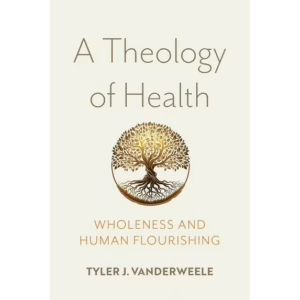
The most recent of these is Tyler VanderWeele’s A Theology of Health: Wholeness and Human Flourishing (Notre Dame University Press, 2024). VanderWeele offers an integrative account that draws together physical health, personal virtue, relational well-being, and social conditions within a theological vision of flourishing grounded in God’s purposes for creation. To appreciate the significance of his contribution, however, we must first trace how earlier postwar thinkers examined different aspects of flourishing or its absence in their own time.
Flourishing 1.0: Staying Human in the Absence of Meaning
Viktor E. Frankl, Man’s Search for Meaning. Beacon Press, [1959] 2014, 180 pp. $25.95, ISBN: 9780807060100.
Rollo May, Man’s Search for Himself. W. W. Norton, [1953] 2009, 214 pp. $16.95, ISBN: 9780393333152.
Paul Tillich, The Courage to Be, 3rd ed. Yale University Press, [1952] 2014, 187 pp. $18.00, ISBN: 9780300188790.
It is no surprise that some of the most poignant reflections on the wholeness of humanity expressed in the notion of shalom emerged in the wake of World War II. The staggering loss of an estimated sixty million lives, including six million Jews and others murdered in German concentration camps, forced a reckoning with what it meant to remain human amid atrocity. Yet the postwar industrial boom introduced a different kind of crisis. Having survived the horrors of war, societies now confronted a subtler but no less existential question: what did it mean to be human in an age of prosperity, technological progress, moral disorientation, and, in some cases, totalitarian governments? What, in other words, was it all for?
In the Western world, no longer dominated by a shared Christian worldview and moral frameworks, the question of how a person might live a meaningful life as a responsible, inwardly-directed whole person was at the forefront of the minds of three well-known authors whose works continue to resonate with readers to this day.
The theme of life’s meaning is central to the work of Victor Frankl (1905–1997), a Viennese psychiatrist who spent three years in concentration camps, losing his parents, wife, and brother to their horrors. Soon after his release, he wrote a book in German about his experiences of finding personal meaning amidst the brutality of the camps. In 1959, an English translation of the book, now titled Man’s Search for Meaning, became an international bestseller. His main thesis was that finding meaning was the chief condition of survival. His experiences and his psychiatric practice led him to emphasize that it is not suffering alone that destroys the human condition but suffering without meaning. He argues that meaning cannot be found directly through the pursuit of happiness but only through personal responsibility, love toward others, and the motivation to bear suffering. In one of his most famous quotes, he writes, “Man does not simply exist but always decides what his existence will be, what he will become in the next moment” (122).
If Frankl asks how a person remains human in the extremity of suffering, the existential psychologist Rollo May (1909–1994) asks how a person retains humanity in the subtler emptiness of modern prosperity. Where Frankl’s exploration of meaning in suffering can be traced to his experiences in concentration camps, May’s was the booming industrial postwar West—outwardly successful yet inwardly adrift.
May explored themes of loss of selfhood, inner direction, and powerlessness in his 1953 book, Man’s Search for Himself. May notes that in the absence of any sense of self, people are not only empty but also adrift from authentic relationships with others. To move beyond this emptiness, people must take responsibility for their lives and choices, gaining self-consciousness through perseverance and diligence toward a creative end. The yearning for self-knowledge cannot be achieved through introspection but is shaped by responsible action toward something greater than oneself. This responsibility may lead to anxiety, but May sees this as a normal state of being truly human that can be channeled toward creativity as people seek out their true hearts’ desires. He emphasizes that such a move requires courage to be authentic amid modern anxieties.
Frankl and May argued that human beings can endure suffering and emptiness by choosing responsibility and courage. Yet in both accounts, meaning is an open-ended concept to be willed, pursued, and acted upon—but not grounded in any ultimate reality. The courage to live authentically is affirmed, but they do not answer the question: courage toward what end? If flourishing is to be more than psychological stamina, it must rest on something deeper than personal resolve.
The postwar existential search for meaning sought to recover selfhood but did not pursue the deeper foundation that sustains not only the self but all reality. The German-American theologian Paul Tillich (1886–1965) bridged the gap between existential selfhood and what he called the “ground of being.” Having served as a chaplain in the German army during World War I, he grappled with non-being, anxiety, and meaninglessness. He agreed with Frankl and May on the importance of courage, responsibility, and authenticity, yet insisted that such fortitude, relying only on personal resources, cannot overcome human guilt and estrangement. In his 1952 book, The Courage to Be, Tillich argues that the deepest threat to flourishing is the anxiety of meaninglessness when life lacks any unifying ultimate concern.
Rather than constructing meaning inwardly, Tillich turns to God as the source of ultimate concern. The courage to struggle for meaning in the face of finitude is grounded in belief in God, who is not a being among beings but the ground of being itself—the power of being in which all finite existence participates. God is thus both transcendent and intimately near, the source of courage against non-being.
For Tillich, the search for meaning is less about discovering a specific purpose than affirming one’s existence despite meaninglessness. A meaningful life involves being “ultimately concerned” with something so vital that one would risk one’s life for it. God does not remove anxiety but becomes the source of faith and grace amid mortality, guilt, and doubt. Grace gives the courage to affirm being—to accept oneself despite the “infinite gap between what we are and what we ought to be” (189). True courage acknowledges anxiety yet chooses to live and act in its presence.
Frankl, May, and Tillich illuminate different dimensions of the postwar search for meaning in a fractured world. Frankl shows how meaning can sustain human dignity even in the extremity of suffering. May explores the courage required to live authentically amid the quieter emptiness of modern life. Tillich grounds that courage in a reality beyond the self, locating hope in God as the “ground of being.” Together they reveal that flourishing cannot be reduced to comfort or success but involves the struggle to remain fully human amid anxiety, suffering, and moral uncertainty. Yet their focus on the interior life leaves a further question unresolved: if flourishing involves more than personal resilience, what kind of social and moral order is necessary for human beings to flourish together?
Flourishing 2.0 The Justice of Shalom
Hannah Arendt, The Human Condition, 2nd ed. University of Chicago Press, [1958] 2018, 349 pp. $26.00, ISBN: 9780226586601.
Cornelius Plantinga Jr., Not the Way it’s Supposed to Be: A Breviary of Sin. Eerdmans, 1995, 202 pp. $24.99, ISBN: 9780802842183.
Nicholas Wolterstorff, Until Justice and Peace Embrace, 2nd ed. Eerdmans, [1983] 1987, 207 pp. $25.99, ISBN: 9789024225507.
In the immediate post-war period, the writers representing Flourishing 1.0 primarily examined the crises of flourishing within the interior life—questions of meaning, selfhood, and the courage required to live amid despair. Yet they were also attentive to the broader cultural forces that produced such crises. Tillich, for example, warned that political systems such as Communism and Nazism demanded the surrender of selfhood for the promise of security, demonstrating how entire societies could fall into patterns of collective anxiety and spiritual distortion (xviii).
Building on this recognition, the second movement shifts focus outward—from how individuals stay whole in a damaged world to the social and moral conditions that allow communities to thrive. The question moves beyond just how the self endures meaninglessness, to what is necessary for human life together to embody the wholeness of shalom.
In The Human Condition, the philosopher Hannah Arendt (1906–1975) asks not merely how individuals survive under repressive political conditions, but what kind of world makes fully human life possible. She examines how modern societies become capable of systematic dehumanization through the rise of mass bureaucracy, the reduction of politics to technical administration, and the erosion of public spaces where citizens can act meaningfully together.
Arendt argues that this transformation produces what she calls “worldlessness”—a loss of shared meaning and memory. When stable institutions and common spaces weaken, individuals retreat into private life or conform to mass society. The result is not simply personal alienation but the collapse of the public realm necessary for human plurality and agency.
Central to her argument is the distinction between labor, work, and action. Labor concerns biological necessity and survival; work produces the durable artifacts of civilization; action, however, is the uniquely human capacity to initiate something new in the presence of others. Modern society, she contends, elevates necessity and production while marginalizing action—the political activity of speaking and acting together in public. When labor and consumption dominate, the space for shared responsibility and collective meaning diminishes.
Yet Arendt offers hope in the concept of natality—the idea that each birth carries the possibility of new beginnings through action and speech. For her, progress matters less than preserving institutions and public spaces where plurality—people gathering together in common life without surrendering their distinctiveness—can flourish. Human thriving requires not merely inner resilience, but a world structured to sustain shared meaning. Flourishing, therefore, is not primarily an individual achievement but a collective and structural reality.
Decades later, theologian Cornelius Plantinga Jr. and philosopher Nicholas Wolterstorff turn explicitly to the biblical concept of shalom to ground such ultimate meaning. Plantinga focuses on sin as disordered shalom, whereas Wolterstorff emphasizes shalom in the context of justice, exploring how Christians can pursue and live in a world guided by God’s shalom.
In Not the Way It’s Supposed to Be: A Breviary of Sin, Plantinga begins not with sin but with its opposite—shalom, the biblical vision of “universal flourishing, wholeness, and delight” (10). Shalom describes the right ordering of creation: the harmony of God, humanity, and the created world in relationships marked by justice, fulfillment, and peace. It is not merely a condition of individual well-being but an interwoven reality in which human life, communities, and the natural world exist in proper relationship before God.
Against this vision, Plantinga defines sin as the culpable “vandalism” of shalom. Sin is more than the breaking of divine law; it is the disruption of the goodness God intended for creation. Human wrongdoing damages relationships with God, with others, and with the created order. While cultural forces can shape behavior, Plantinga insists that human beings remain responsible moral agents whose actions distort the flourishing they were created to nurture.
Yet sin is never purely private. It spreads through habits, institutions, and cultural patterns, embedding itself in social structures that perpetuate injustice and disorder across generations. In this way, the disruption of shalom becomes both personal and systemic, shaping the moral and social environments in which communities live.
Plantinga’s account ultimately moves beyond diagnosis to prescription. God’s grace calls human beings to participate in the repair of creation. Flourishing, therefore, requires both personal repentance and the patient reweaving of relationships that sin has torn apart.
If Plantinga shows how sin vandalizes shalom, Nicholas Wolterstorff asks what justice must look like if shalom is to take concrete form in communal life.[2] In Until Justice and Peace Embrace, he argues that justice is indispensable to the realization of flourishing. Drawing on the biblical vision of peace in Isaiah, Wolterstorff describes shalom as life lived in right relationship—with God, with oneself, with others, and with the created world.
For Wolterstorff, justice is both God’s gift and humanity’s calling. It requires more than avoiding wrongdoing; it calls people to actively seek the good and cultivate the conditions in which communities can flourish. Justice therefore involves a double task: resisting injustice while also nurturing the goods that sustain human life together.
Because human life is relational, justice cannot be understood as an individual achievement. The flourishing of persons depends upon the recognition of mutual claims that arise from our shared humanity. These claims take shape within communities whose institutions and practices either sustain or undermine the possibility of shalom.
Yet Wolterstorff also insists that the pursuit of justice ultimately depends upon God’s initiative. Human efforts alone cannot bring about the fullness of peace the prophets envisioned. Instead, God’s people pursue justice in hope—trusting that God’s redemptive purposes extend beyond their own efforts. In this way justice becomes a central expression of flourishing. To seek justice is to participate in God’s work of restoring the wholeness intended for creation.
Arendt, Plantinga, and Wolterstorff shift the discussion of flourishing from the interior life of the individual to the moral and institutional structures that shape communal life. Arendt diagnoses the fragility of the public world, Plantinga exposes sin as the vandalism of communal shalom, and Wolterstorff calls communities to pursue justice as its restoration.
The first movement wrestled with existential survival in a fractured world. The second movement reasserted God’s purposes for creation through justice and communal repair in the presence of sin. Yet neither movement focused primarily on personal well-being. That shift would emerge at the turn of the twenty-first century with the rise of positive psychology, which sought to understand flourishing through empirical studies.
Flourishing 3.0: The Empirical Turn
Martin Seligman, Flourish: A Visionary New Understanding of Happiness and Well-Being. Simon & Schuster, 2011, 349 pp. $18.00, ISBN: 9781439190760.
Jonathan Haidt, The Happiness Hypothesis: Finding Modern Truth in Ancient Wisdom. Basic Books, 2006, 297 pp. $19.99, ISBN: 9780465028023.
Mark R. McMinn, The Science of Virtue: Why Positive Psychology Matters to the Church. Brazos, 2017, 193 pp. $22.00, ISBN: 9781587434099.
What if the attributes of flourishing could be identified, defined, and studied as a social phenomenon, allowing those insights to inform interventions designed to improve well-being and happiness? What if science itself could be harnessed to advance human flourishing? Many social scientists pursued enthusiastic answers to these questions. The chief architect of what would become known as positive psychology is psychologist Martin Seligman. Prior to 2000, Seligman was best known for his research on learned helplessness—the tendency for individuals to stop trying when repeated efforts fail to produce desired results, even when circumstances later improve. Over time, however, Seligman became increasingly interested in the opposite question: what psychological attributes enable optimism, resilience, and well-being? This shift marked a pivotal turn not only in his own career but in the field of psychology more broadly.
As president of the American Psychological Association, Seligman used his presidential address in 2000 to launch what would become the positive psychology movement. Rather than continuing psychology’s dominant focus on pathology and disorder, he called for a systematic scientific study of strengths, virtues, and human flourishing. Through research collaborations, institutional leadership, and the development of new scholarly networks, Seligman helped reorient psychology toward the empirical study of well-being.
Seligman argues in Flourish: A Visionary New Understanding of Happiness and Well-Being, that authentic happiness extends beyond hedonic pleasure to a deeper sense of well-being rooted in meaningful purpose. He defines flourishing through five measurable elements—positive emotion, engagement, relationships, meaning, and accomplishment. Within this framework, flourishing becomes both an object of rigorous scientific study and a set of practices that can cultivate resilience and well-being. What had long been the province of philosophy or theology was, through Seligman’s work, brought into the realm of empirical research and personal development.
While Seligman focuses on modern social science findings to promote well-being, the social psychologist Jonathan Haidt reaches further back toward antiquity. In The Happiness Hypothesis: Finding Modern Truth in Ancient Wisdom, he brings ancient philosophical and religious insights into conversation with contemporary psychological research, asking what enduring wisdom about human flourishing might be confirmed by empirical study.
Haidt argues that happiness, found in the perceptions of one’s own well-being, does not reside solely within the individual nor entirely in external circumstances, but emerges from the relationship between the two. Human flourishing, he suggests, depends upon meaningful love, satisfying work, and connection to something larger than oneself.
Throughout the book, Haidt opens each chapter with texts from Scripture, Buddhism, or Hinduism, not as theological authorities, but as conversation partners whose insights can be tested against psychological evidence. Even as an atheist, he treats religious traditions respectfully, using them to illustrate recurring human intuitions about moral growth and relational harmony. For example, in discussing moral self-awareness, he invokes Jesus’s admonition about the log in one’s own eye to demonstrate how recognizing one’s own bias reduces conflict and strengthens relationships (80).
Like Seligman, Haidt acknowledges that happiness is shaped partly by genetics and circumstance. Yet the emphasis of positive psychology remains on what individuals can cultivate—relationships, purposeful work, and habits that foster connection and belonging. In his closing pages, Haidt summarizes the conditions for flourishing: “Just as plants need sun, water, and good soil to thrive, people need love, work, and connection to something larger. . . . If you get these relationships right, a sense of purpose and meaning will emerge” (239).
While Haidt engages religious texts with respect and intellectual curiosity, he stops short of grounding happiness in any transcendent claim. In his account, religion is psychologically beneficial, associated with stronger social bonds and a sense of belonging, but it primarily contributes to well-being rather than serving as its foundation. Spirituality is examined for its measurable effects, not for its ontological claims. Jonathan Haidt demonstrates the limitations of the utilitarian, “what works,” orientation in positive psychology when he writes, “I don’t believe there is an inspiring answer to the question, ‘what is the purpose of life?’ Yet by drawing on ancient wisdom and modern science, we can find compelling answers to the question of purpose within life” (238). Positive psychology may affirm that religion correlates with happiness, but it shows little interest in religion as the ultimate source of flourishing.
Clinical psychologist Mark McMinn is not among the architects of positive psychology, but he is a thoughtful Christian interlocutor of the movement. In The Science of Virtue: Why Positive Psychology Matters to the Church, he argues that positive psychology offers important insights into human strengths and well-being that the church should not ignore. Turning to Christian virtues such as gratitude, humility, forgiveness, hope, and love, McMinn shows how empirical research on these virtues can illuminate their practice while insisting that they are grounded in the Christian faith.
At the same time, he cautions that positive psychology is overly positive, giving little attention to grace, redemption, or the brokenness of sin that necessitates them. By focusing only on measurable variables, hope in positive psychology becomes purely an agentic strategy with identifiable goals rather than a cry of the soul oriented toward God. For McMinn, Christian virtues must be understood outside of positive psychology’s purely empirical and individualist frameworks. They are cultivated in Christian community, and as Christians grow in virtue, they strengthen the church.
Perhaps most significantly, McMinn questions the movement’s implicit standard of the good. In positive psychology, what is good and true is defined by what increases measurable happiness. There is little consideration of a telos beyond human flourishing itself. Psychology may illuminate how virtues function and contribute to well-being, but it cannot determine why they ultimately matter or toward what end they are directed. Even when the tools of positive psychology help people live more purposeful lives, humanity alone is the measure of meaning.
Seligman, Haidt, and McMinn illuminate different dimensions of the empirical search for flourishing. Seligman establishes a framework for studying well-being empirically, identifying measurable elements such as positive emotion, engagement, relationships, meaning, and accomplishment. Haidt brings ancient philosophical and religious wisdom into dialogue with contemporary psychology, showing how practices of love, work, and connection shape human happiness. McMinn, writing from a Christian perspective, affirms the insights of positive psychology while questioning its underlying assumptions, reminding readers that empirical research can illuminate how virtues contribute to well-being but cannot determine why they ultimately matter or toward what end they are directed.
Together their work deepens our understanding of the conditions that support human well-being, yet it leaves a larger question unresolved: how do the many elements of flourishing—meaning, justice, happiness, virtue, and spiritual life—belong together within a coherent account of human wholeness?
Flourishing 4.0: God’s Shalom and the Wholeness of Human Flourishing
Tyler J. VanderWeele, A Theology of Health: Well-Being and Human Flourishing. University of Notre Dame Press, 2024, 369 pp. $42.00, ISBN: 9780268208332.
One of the most ambitious attempts to answer this question appears in Tyler VanderWeele’s A Theology of Health: Wholeness and Human Flourishing. An epidemiologist whose work has helped shape contemporary research on flourishing, VanderWeele engages many of the themes explored by earlier writers—meaning in the face of suffering, justice within community, and the empirical study of well-being—but he approaches them from a distinctly theological starting point. For VanderWeele, flourishing is not merely a psychological state or a social condition, but the wholeness of a person created and redeemed by God.
Building on his global empirical research on flourishing, VanderWeele defines the health of a person broadly as human wholeness: a state in which the major domains of a person’s life are good (21). Within the health of a person, he identifies seven interrelated domains—bodily health, happiness, meaning and purpose, character and virtue, close relationships, good community, and spiritual well-being.
While the first six have appeared in contemporary flourishing research, most notably in the 2025 Global Flourishing Study that VanderWeele has co-directed,[3] A Theology of Health explicitly centers spiritual well-being as indispensable rather than merely instrumental, because it orders the rest toward their ultimate end in communion with God. Empirical research may illuminate the structure of flourishing, but theology defines its telos. Human flourishing therefore encompasses bodily, relational, and social goods, but ultimately finds its center in one’s relationship with God—described as communion, love, charity, or friendship with him (22). As VanderWeele writes, “the love of God is the foundation for our restoration to wholeness” (201). Within this vision the categories of health extend beyond the body: wholeness and brokenness, sin and salvation, and right communion with God and with one another all become questions of health. God appears less as judge than as healer, and sin less as a legal penalty than as a disordering of the human person and a separation from God’s purposes.
The book revisits many of the themes explored by the above authors. Like Frankl, May, and Tillich, he reflects on the meaning of life, the experience of suffering, and the relationship between physical health and the deeper questions of human existence. Like Arendt, Plantinga, and Wolterstorff, he recognizes that flourishing depends upon the health of communities and the justice of the institutions that sustain them, while also acknowledging how sin disrupts the shalom of God’s creation. And aligned with Seligman, Haidt, and McMinn, he affirms that happiness, meaning, purpose, character, virtue, and religious practice contribute measurably to well-being. Yet VanderWeele does more than gather these insights together. By integrating theological reflection with empirical research, he situates them within a broader account of flourishing in which suffering, sin, healing, and restoration are part of the larger movement toward the wholeness—or shalom—of the person before God.
VanderWeele develops this vision by carefully defining the domains of flourishing and showing how each is intertwined with the others. Flourishing cannot be reduced to any single dimension of life; bodily health, relationships, character, meaning, community, happiness, and spiritual well-being are mutually reinforcing. A flourishing community, for example, depends not only on healthy structures and leadership but also on people of character, meaningful relationships, and a shared sense of purpose (58). Sin, understood as a disordering of the person and of creation, disrupts each of these dimensions and the relationships among them. Healing, therefore, is not merely a bodily condition but a process of restoration that unfolds as individuals and communities are drawn back toward God’s purposes.
Yet flourishing in VanderWeele’s account does not imply perfect wholeness in this life. The restoration of God’s creation to its intended purposes remains incomplete, and illness and suffering remain part of the human condition. Even when one domain is diminished—such as bodily health—other domains of flourishing may deepen. Physical illness, for example, can give rise to stronger relationships, greater insight into life’s meaning, stronger character, and deeper communion with God (166). In this way, the domains of flourishing remain dynamically related. Loss or suffering in one area reverberates across the others, sometimes diminishing them, yet at other times drawing individuals and communities toward deeper forms of flourishing.
To develop this argument, VanderWeele structures this book in a manner reminiscent of Thomas Aquinas’s Summa Theologica, presenting his case through a series of propositional statements. The book unfolds in three movements, echoing creation, fall, and redemption. In the first section, he argues that health should be understood as the wholeness of human flourishing. The second examines sin and ill health as disruptions of that wholeness, while the third turns to healing and salvation as the restoration of the person to right relationship with God and others. Each section advances its claims through concise propositions and brief explanatory sub-propositions, typically one or two pages long. In using this propositional structure, VanderWeele repeatedly emphasizes that flourishing depends upon the proper ordering of all dimensions of human life, each influencing and sustaining the others.
VanderWeele writes in a style accessible beyond the academy while grounding his work in extensive scholarship. The text itself is direct and readable, while detailed footnotes provide theological, philosophical, and empirical literature that informs his argument. Although his theological framework draws heavily from Aquinas and Catholic social thought, the themes he explores—health as wholeness, the restoration of relationships with God and others, and the pursuit of human flourishing—resonate across Christian traditions. Because much of his work emerges from public health research, he invites scholars and practitioners alike to consider the role of spiritual well-being in fostering human flourishing. In doing so, he suggests that discussions of health, whether in medicine, psychology, ministry, or social policy, cannot be fully understood apart from deeper questions of meaning, virtue, community, and humanity’s relationship with God. Seen in this light, his work can also be understood as a response to the many intellectuals who have shaped the modern conversation about flourishing.
The authors considered in this review illuminate its many and varied dimensions. Frankl, May, and Tillich remind us that flourishing must confront suffering and the search for meaning. Arendt, Plantinga, and Wolterstorff show that flourishing cannot exist apart from justice and the health of communities and institutions. Seligman, Haidt, and McMinn demonstrate that practices, relationships, virtues, and habits of life contribute measurably to flourishing. Each perspective reveals an important part of the picture, yet each by itself remains incomplete.
What VanderWeele offers in A Theology of Health is a framework that holds these dimensions together. Meaning in suffering, justice in community, empirical insights about well-being, and spiritual communion with God are not just individual accounts of flourishing but interwoven expressions of the wholeness Scripture calls shalom.
For those engaged in Christian ministries, including colleges and universities, devoted to the well-being of individuals and communities, this insight carries an important implication. It is possible to pursue many good things—education, economic opportunity, healthcare, or community development—while still losing sight of the larger vision that gives those efforts coherence. When these goods are treated as separate objectives rather than as interconnected dimensions of flourishing, the pursuit of shalom becomes fragmented. Wholistic ministry therefore requires more than addressing individual needs; it requires seeing how the goods of human life fit together within God’s purposes for creation.
Jeremiah’s exhortation remains as relevant today as it was for the exiles in Babylon: seek the shalom of the city. Such flourishing is personal and communal, spiritual and material, grounded in the recognition that God’s redemptive purposes extend to every dimension of life. The challenge before us is not merely to identify and invest in the individual elements of flourishing but to discern how they belong together within the larger work of God’s restoration. VanderWeele invites us to see flourishing not as the pursuit of isolated goods but as participation in God’s restoring work—the shalom he intends for his creation.
[1]. “The 100 Most Read Bible Verses at Bible Gateway in 2024,” Bible Gateway, December, 4, 2024, https://www.biblegateway.com/learn/bible-verses/most-read-bible-verses-2024/.
[2]. See also Nicholas Wolterstorff, “Teaching for Shalom: On the Goal of Christian Collegiate Education,” in Nicholas Wolterstorff, Educating for Shalom: Essays on Christian Higher Education, eds. Clarence L. Joldersma and Gloria G. Stronks (Eerdmans, 2004), 10–26.
[3]. Tyler J. VanderWeele, Byron R. Johnson, Piotr T. Bialowolski, Rebecca Bonhag, Matt Bradshaw, Thomas Breedlove, et al. “The Global Flourishing Study: Study profile and initial results on flourishing,” Nature Mental Health 3, no. 6 (2025): 636–53.






















One Comment