

As an art historian, I often begin my courses with a discussion of metanarratives: big picture, “mythic” structures that shape values and give meaning. There are metanarratives of “progress” (like American “Manifest Destiny”) and metanarratives of cyclical return (like the medieval “four ages of man:” birth, maturity, decline, death). And for some of us, especially today, there can be metanarratives of irrevocable disaster: out-of-control civilizations hastening their own extinction.
But Christians have a different metanarrative, and this is how I want to frame it today:
For Christians, the whole arc of history is simply the discovery of what it means to be human.
The ancients foreshadowed it, Jesus manifested it, and we, downstream of his example, lurch to bring it to fulfillment in all the particulars of time and space. We, together, actualize what it means to be human.
And Art History shows us where we’ve been.
For among human products, visual artifacts are the most densely and instantaneously symbolic, carrying a thousand meanings at once. (Indeed, “a picture is worth a thousand words!”) Taken together, sequences of pictures can show broad movements in human understanding, including self-understanding, attitudes toward the environment, and the development of technologies.
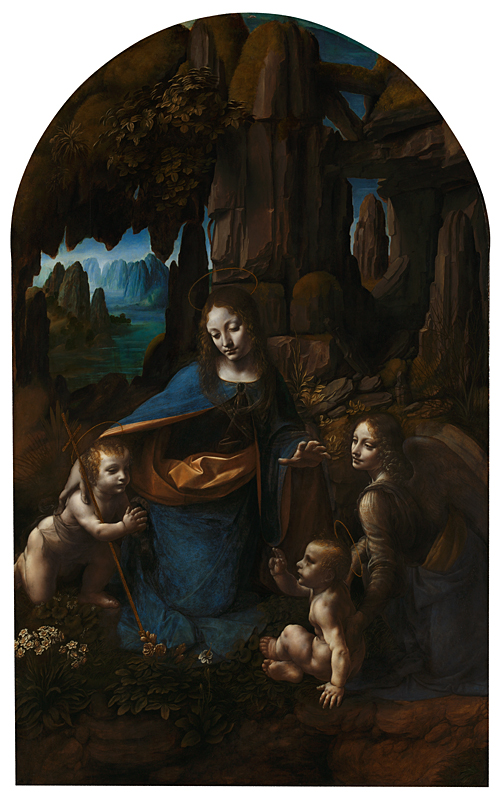
One picture (say, Leonardo da Vinci’s “Madonna of the Rocks”) can reveal (all at once) implicit attitudes about gender, childhood, nature, mathematics, light, beauty, and the divine. The conditions of its making can also reveal historical truths about devotional practices and scientific facts about light refraction and rock formation.
Paired with images from before its own era and after, artworks like Leonardo’s “Madonna” (both the earlier and latter versions) have the power to illuminate the sweeping trajectories that span individual lifetimes, hinting at the cosmic rhythms of what Christians call “salvation history.” And this history is simply the discovery of humanity as it was meant to be, in the image of the suffering Christ, brought about by His incarnation and redemption.
Humanities instruction in the academy has never quite, perhaps, embraced the Christian narrative I sketched above. In the Renaissance, when the Humanities as we know them were arguably born, Platonic ideals of humanity were often invoked, but in a cyclical pattern of rise and decline that did not give the unique Christ event its historical due. Later, Humanities instruction could be framed as a narrative of modernist “progress” toward better, more advanced (and more implicitly Euro-American) ideas and techniques – but Christian truth was often deemed obsolete in this scenario! In a recent stage, humanities instruction has been focused on the dismantling of insufficient frameworks through the tools of critical theory. This has left us in an open space, without consensus about values, canons or the direction of history.
And yet: Christ did come. He did establish his kingdom. And he did seed a restored vision of humanity into the world. We must bear witness to this in all its forms! Now, more than ever, Christian educators must own these facts! By the grace of God, we have access to the true cultural-historical metanarrative, and we must proclaim it.
Here are some guiding words in my own reorienting process:
- Humankind was made for God, in God’s image. We were made to mirror God and be mirrored by him in a loving gaze of admiration and recognition. But the glass fractured. With the coming of Christ, however, the fractures are being restored, and the new image of humanity emerges, glimmer by glimmer, age by age, partially and tantalizingly, in its providential quest to reclaim its identity in God.
- Art and literature tell that story profoundly and beautifully, from a million unique viewpoints. And that story is emphatically, excitingly, our story, bequeathed by our ancestors. I want my students to love art and literature that tells this story, because it is their story. It is their identity, passed on by people who loved and bled and suffered – an honest and hard-won identity far better than TikTok popularity or the syntheses of AI phantoms.
The philosopher GFW Hegel is famous for having (somewhat heretically) posited a “World Soul” that is always in the process of discovering itself through a cosmic dynamic of trial, error, reflection, and correction. Hegel’s philosophy inspired the progressivism of the (now discredited) modernist worldview (along with various streams of heterodox, modernist Christianity); thus, it’s tempting to toss him out.
But Hegel’s insight had some merit. For our God is a Trinity of persons, gazing upon, recognizing, and praising each other forever. And human history is, I think, the same! Each generation that passes leaves an image to gaze upon, recognize, praise, and refine, in our collective human quest for total understanding and love. God sees, knows, and loves perfectly forever. Our goal is to become like Him and join with Him, thanks to the grace He is constantly pouring out, ever more richly, as the centuries pass. Through the drama of history, we lurch toward God’s own, perfect understanding in our quest to unite with the Trinity.
A Christian study of culture is authentically Trinitarian when it recognizes the grace of God active in the world, manifesting in the beautiful actions, monuments, songs, liturgies, and images that the human family creates in ever-growing measures of diversity and complexity. A Christian study of culture is authentically Trinitarian when it praises the face of Christ in the world, unleashing the joy of a spiritual dance (perichoresis, according to the ancients). This is how we, as a people of God, come awake.
For more about culture and its connection to the transcendent, listen to the Visually Sacred podcast, hosted by Arthur Aghajanian, from the Foundation for Spirituality and the Arts. Katie Kresser: Windows to the … – Visually Sacred: Conversations on the Power of Images – Apple Podcasts


















Thank you for this powerful reminder: “Now, more than ever, Christian educators must own these facts! By the grace of God, we have access to the true cultural-historical metanarrative, and we must proclaim it.” As always, such a rich perspective!