
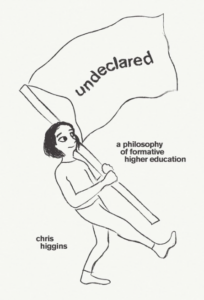
Undeclared: A Philosophy of Formative Higher Education
Are college students awake to the kind of person institutions are forming them into? Or are they similar to the cow in David Shrigley’s cartoon that looks at the milkman and asks, “What the hell are you doing?” (49). In the same way, are faculty members awake to the education they are providing their students? Or are they too caught unawares, with their attention focused instead on politics, enrollment, and committee work? How would our institutions change if everyone woke up? Maybe students would cry “O Captain, My Captain!” as their professor walks into class. The theater would be packed to watch as students and faculty find their own voice through King Lear. And on the quad in the sunshine, students and faculty would wrestle with questions together: What are the implications of being made in the image of God? How does our humanity relate to United States Foreign Policy? Then on rainy days, they would help the recently-made homeless worms find shelter in safer places than the dangerous sidewalks. There would not be a rush to get through one’s education and move on with living in the “real world.” Instead, students would be engaged in the real world of the present, during this “interval” that is college (101). With questions of education during this interval on his mind, Chris Higgins critiques many facets of higher education in his recent book, Undeclared: A Philosophy of Formative Higher Education, and offers an alternative proposal through the help of mentors such as Hannah Arendt, Michael Oakeshott, John Andrews Rice, John Dewey, and others.
Higgins brings to life this philosophy over three long essays and three shorter essays he calls “interludes,” which work together to suggest a tapestry of formative higher education. These essays bring to life several questions: What do institutions mean when they say they offer a whole person education? What does a whole person education say about the individual student? What is the role of general education? How does aesthetics work together with general education? Is higher education really a public good as it seems to value prestige and selectivity? Is training students in the field they are going to enter after graduation sufficiently vocational education? These questions and more could be considered on their own, but Higgins does well to connect them together. For Christian higher education professionals, the question rarely asked, but often answered poorly, is the meaning of a whole person education. Though not focused on faith-based education, this book by Higgins can help those involved in Christian higher education to reconsider their purpose and better articulate the education they provide students. Furthermore, considering Higgins’s work may reveal components of Christian education that need revisiting.
The focus of Higgins’s first long essay is what he refers to as soul action. This phenomenon is a way of trying to articulate what occurs in whole person education. The naming is borrowed from a Ralph Waldo Emerson epigraph: “the one thing in the world, of value, is active soul. This every man is entitled to; this every man contains within him, although, in almost all men, obstructed, and as yet unborn” (13).[1] Higgins describes soul action as an active work of integrating parts of oneself into a coherent whole, both complete and undivided. We often think about whole person education incorrectly because we fail to think about its meaning and implications. Whole person education, part of the work of formative education, is not something educators do to students. Students do not simply receive a whole person education; they are invited to participate in their own self-formation. Higgins writes: “Whereas (modern mass) schooling begins with compulsion, formative education begins by awakening agency and orienting the student to the task of formation” (18). This is the much narrower path but the one that probably leads, in the truest sense, closest to what Christian higher education is marketing to students. Students need to be introduced to different parts of themselves, do their own digging too, and then these parts need to be integrated into a dynamic whole that will continue to develop as they grow and change. And to add to the complication, the teacher himself or herself ought to be aware of his or her own formation that is ongoing as well, and to teach from this stance.
Higgins’s writing in this first essay on soul action also centers on the need for reform of general education. If general education requirements are going to be thought of as meaningful opportunities for the self-cultivation and soul action Higgins writes about, then administrators need to examine it, faculty need to wake up, and students need to be convinced. Higgins sums up the solution and the problem when he says, “Gen Ed should be the place where students find an alternative to the grind [hence college as an ‘interval’], an antidote to fragmentation, a space to collect themselves and check their bearings. Instead, we propel students to various corners of campus through curricular wormholes of forced election” (59). No wonder English majors skip Meteorology and pick Intro to Sociology merely because they heard it’s a “movie class.” Liberal arts colleges have created a checklist for students and called it whole person education.
Reframing and probably restructuring general education could provide an opportunity to explore the idea that college is meant to be an “interval” or respite rather than the next step towards your calling (Oakeshott, as cited by Higgins, 101). The second long essay focuses on a defunct college’s unique, dynamic, and aesthetic education, which acts as a case study for Higgins’s philosophy. Black Mountain College, a small institution running from 1933 to 1957, is presented as a case study of formative education. Higgins describes Black Mountain College as a place where “faculty [were] recruited not to fill departmental slots but to exemplify the quest for dynamic, integrated personhood. Students [were] greeted with the expectation that this is a place to confront and cultivate oneself” (109). There needs to be time and space for the college student to develop. This is not meant to be escapist from the real world; instead, it is meant to be a time when deep learning can occur. There is an opportunity for many small colleges to be described the way Black Mountain College is by Higgins. Unfortunately, it seems for many that college is still the time to grind to get ahead and be set up at the best internship and then job available. But at Black Mountain, there was a community of learners across all disciplines who engaged in a general education that was anchored in aesthetic education. This aesthetic education was not meant to train artists but was again meant to wake students up. Higgins references Dewey’s description of the person who pays no attention to aesthetics not as “ugly or utilitarian” but as “routine . . . numb” (74). Great films, works of art, plays that bring tears to eyes have the effect of—to borrow from Maxine Greene—helping get one’s soul out of bed.
In his final long essay, Higgins argues that this soul-waking, aesthetic education even better prepares students for their vocation and the proper way to live out their chosen vocation in the communities where they become members. He suggests that a formative education through a revigorated general education curriculum enables students to accomplish the tasks of vocational education neglected in mainstream higher education: “Finding a worthy calling to which you are suited; cultivating the ethical understanding necessary to enact your vocation with integrity and public purpose; learning how to grow into and through your work; learning how to grow out of your work, if and when the time comes” (206). Surely a student’s major will give the training he or she needs to find a job and do the work required, but is the student prepared for more? He argues that these other tasks are necessary for the student to not fall into the tragic fate described by John Dewey: “Nothing is more tragic than failure to discover one’s true business in life, or to find that one has drifted or been forced by circumstance into an uncongenial calling” (207). As students are being formed by the institution they are in, is the institution aware of what kind of person they are sending forth from their campus upon graduation? “Vocations are mediums for soul action,” and so the work students are doing during college continues thereafter (74). Students are not completed projects when they walk across the stage or get the degree but instead have been trained on how to continue the work of self-cultivation.
Higgins should not need to look back to Black Mountain College as the example of formative education. Instead, he should be able to look to the small private Christian liberal arts college. Reading Higgins’s philosophy leads me to believe that Christian liberal arts institutions should be leading the way in formative education. What better place is there than a Christian educational community for students and teachers alike to wrestle with questions of truth, beauty, justice, and right living? Instead, it often feels like the general education is something students just know as a list of classes, made of easy A’s or ones to avoid, that they must sit through to get their degree. We could do a little better. May we pay attention to what is occurring in our lives and the lives of our students, offering them a vision of Christian education that is demanding, painful at times, life-giving, and soul-forming.
[1]. Ralph Waldo Emerson, “The American Scholar,” Speech, Phi Beta Kappa Society, Cambridge, MA, August 31, 1837, reprinted in The Collected Works of Ralph Waldo Emerson, ed. Robert E. Spiller and Alfred R. Ferguson, Vol. 1 (Belknap Press of Harvard University Press, 1971).