
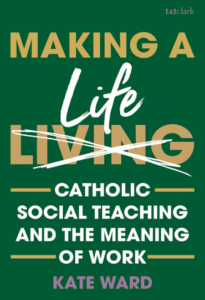
Making a Life: Catholic Social Teaching and the Meaning of Work
Most students come to college with plans for a job but seldom consider their need for a theology of work. Their parents have told them they will one day require money, and they almost all want to pursue lives filled with meaning, but they are often held hostage to economics in understanding precisely what it is they are doing. They regard work, almost by default, as labor pursued for pay. In further conversation, they begin to see things differently with the recognition that work existed in the Garden of Eden before the Fall. With this realization, they suddenly have permission to see work as a good. Some may even feel an obligation to widen the scope of terms like “calling” or “vocation.” Freed from the belief that work is about financial gain alone, regardless of the disciplines they decide to pursue, they may find themselves shackled to the duty of calling without any intellectual basis for seeing how work figures into their everyday lives.
Kate Ward, associate professor of theology at Marquette University, argues in Making a Life that Catholic social teaching can help foster conversations about the meaning of work today. The project is certainly timely, as a new generation has widely protested older models of work—especially promises of success and independence through steady achievement and a commitment to corporate norms over the long haul. Ward speaks directly to this generational divide: “In the United States, the mainstream culture around work—‘workism’—expects long hours, high productivity, and a strong connection between work and personal fulfillment, to an extent that is noticeably different than in other wealthy economies” (3). Ward argues that Catholic social teaching deserves careful consideration not because it comes from the Vatican but because it relies on modes of human reasoning that are accessible to people of all backgrounds. She draws specifically on her experience with labor unions as well, suggesting that Catholic social teaching continues to be held in high esteem even among non-Catholics in such circles because it relies on reason and the “internal logic” of natural law (12).
Unlike other studies of work, which may focus on an overarching biblical narrative, provide advice for success, or instruct readers on how to balance competing values, Ward draws heavily on the centrality of human personhood in Catholic social teaching (CST)—especially in papal encyclicals such as Rerum Novarum (1891), Populorum Progressio (1967), and Laborem Exercens (1981)—because they reflect and advance an authoritative and “consistent tradition” in modern Catholic theology. Thus, contending against popular misconceptions of work, Ward argues that, according to CST, “humans have a deep, innate desire to innovate and create, collaborate with others, and change ourselves and the world around us, and the tradition views all these types of purposeful activity as work” (19). This definition inherently distances work from financial incentives, centering the ways that work shapes workers rather than only on the goods work produces. Ward repeatedly returns to these guiding beliefs, explaining variously throughout the book that “work is any activity through which humans transform the world—any of the things, systems, and people around us—using our uniquely human abilities to create, reason, and learn” (20).
Understanding work in this way—holistically, with a priority on its subjective sense (i.e., how work changes the worker)—allows CST to proclaim simultaneously that work is (1) good, (2) a duty, and (3) often bad for people. Work is good for its connection to the most ordinary tasks of life, serving God through activities that transform the world. Work is a duty because it is part and parcel of human living in the world; everyone should have the opportunity to develop their “skills and potential, and to help our families, our societies, and future generations of humanity” whether through paid or unpaid activities (28). Yet work is often bad for people when it is “alienating work” or causes “moral injury” (32, 125). Instead of bolstering human life through acts that reflect our creativity, vulnerability, and capacity for transcendence, bad work is monotonous, stifling, or harmful. Interestingly, Ward notes that some work, such as sex work, is “alienating by its very nature” but naming it “work” allows for a recognition of the “right to dignity” and holds hope for the potential for reform, including realistic alternatives for such workers (34). Other work is bad due to the conditions under which it is performed (e.g. prison labor) or its tendency towards self-alienation (e.g. overwork). CST teaches, on the contrary, that vulnerable human bodies require legal protection and the benefits of rest (“a sacred duty and the responsibility of both workers and employers” 37).
Three middle chapters explore these principles by taking up the work of caregiving, food, and creativity. I particularly appreciate two aspects of Ward’s selection of these three themes. First, Ward’s case studies encourage readers to consider work in decidedly non-traditional ways. For instance, the chapter on caregiving draws on various teaching documents to show that the unpaid labor of care for family benefits society, requires tremendous skill, and recenters the relational dimensions of human living in the world. Similarly, the chapter on food preparation draws on a sacramental vision of creation to contrast the positive transformation of material goods to the exploitative practices related to farm workers and land use. Meanwhile, the chapter on creativity (“Do Artists Work?”) draws heavily on the Catholic philosopher Josef Pieper’s theories of leisure to explore the tensions between activity and passivity in artmaking, nature walks, and other forms of self-care. Second, in these chapters—and, indeed, throughout much of the book—Ward highlights the unique implications of CST for work performed by women. Thus, Ward challenges various ways that Catholic teaching documents have tended to rely on traditional gender roles (such as regarding men as primary breadwinners), while simultaneously supporting the value of women’s work both inside and outside the home. I found myself grateful at every turn to read Ward’s thoughts on the implications of CST for women, and I would happily encourage my own students to weigh these chapters carefully for insight into the ways men and women each experience different aspects of meaningful or alienating work in the world.
The final chapters turn specifically to just labor practices, compensation, and forms of political action. By centering the subjective sense of how work shapes workers, CST condemns unjust working conditions as a profound violation of human rights and dignity (121). Ward assembles data to provide a compelling account of the ways that many United States households are unable to afford the basic necessities for survival—“rent, food, child care, transportation,” etc. (127). Where the stay-at-home mother was once a family’s insurance against catastrophe when a father became unable to work due to unemployment or disability, the two-income structure of most households potentially harms individuals, families, and communities. According to Ward, while CST avoids setting policy agendas in favor of promoting “truth” applicable in different times and places, CST has provided some “specific proposals” that have evolved “with the times,” such as the family wage, family grants, and a basic income guarantee (131ff). Most readers will not find these policy discussions entirely satisfying—they reflect the “primer” nature of the book much more than how a detailed monograph might address similar topics—but I did find Ward’s introductory thoughts to be accessible as a starting place for students wading into these waters for the first time. Readers will be intrigued, too, by Ward’s commitment to CST’s wider vision of political reform, which encourages collaboration between government, employers, and workers: “the solution is solidarity, to know and act on the fact that we are all responsible for one another” (156).
Recently (though after the publication of Ward’s book), Pope Leo XIV issued his first encyclical, Magnifica Humanitas: Safeguarding the Human Person in the Time of Artificial Intelligence. Many commentators noted that Leo issued it on the 135th anniversary of Rerum Novarum, the influential pastoral letter on worker’s rights, penned by his namesake predecessor Pope Leo XIII. As Ward’s book shows, many of the most influential encyclicals have directly addressed the meaning of work—whether in the context of human rights (Pacem in Terris, 1963), the economy (Populorum Progressio, 1967), or the environment (Laudato Si’, 2015)—and Magnifica Humanitas is no exception. With Ward’s book in hand, one can easily discern how Leo’s guidance on generative AI stands within a long tradition of Catholic reflection, centering the working subject rather than utility of products when he writes of “the convergence of automation, robotics and AI [that] is rapidly transforming the very structure of work” and the necessity that companies “design systems that are centered on the human person and not solely on performance” (§150). Ward’s Making a Life is not an exhaustive account of this tradition, but her book contains a vivid and engaging explanation that could help many readers to reflect on the meaning of work in a time of rapid technological change.