Prophetically Incorrect: A Christian Introduction to Media Criticism
In ancient times, the discipline or field of rhetoric focused on speech, mostly in politics and law courts. Then with the advent of writing, rhetoric was extended to the written word. Today, however, rhetoric cannot include only spoken and written speech. With modern technologies, humans communicate in a variety of ways, not only through sermons but YouTube, not only in essays but text messages, not only at community talks but Instagram. Modern media require even more extensive rhetorical study. Scholars of rhetoric have long noted that the impact of rhetoric extends to much besides the written or spoken word, as Marshall McLuhan declared in Understanding Media: The Extensions of Man in 1964.[1] Richard Toye observes in Rhetoric: A Very Short Introduction (2013) that the concept of “visual rhetoric” includes how things like “clothing, gesture, and the use of physical space can reinforce messages.”[2] Rhetoric applied to media is referred to as media criticism, media literacy, or technology literacy, the ability to think critically about all the media.
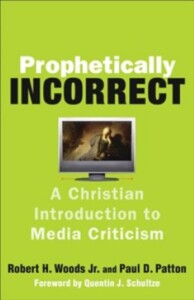
Thus, it is appropriate to include in this essay’s consideration of rhetoric a book written a decade and a half ago, Prophetically Incorrect: A Christian Introduction to Media Criticism, by Robert H. Woods Jr. and Paul D. Patton. In this book, Woods and Patton summarize their goal:
[w]e have labored to inspire our readers toward a prophetic sensibility in all that they do, whether consuming, creating, or critiquing popular media. We need spiritual discernment to see beyond the big three moral issues—sex, violence, and profanity—to recognize how popular media mythologies reinforce North America’s dominant framing story by idolizing consumption and preaching worldly success. (129–30)
Woods and Patton assert that Christians today, like the Old Testament prophets, need to critique the media and our culture from a foundation of God’s justice, peace, and mercy. Christians should sometimes be social critics. They do not mean that Christians should be evangelists of the Social Gospel. Christ is the only answer; good works do not save. However, the media do influence everything.
The Old Testament prophets, like Jeremiah, told truth to power, and not only were the personal behaviors of the Old Testament kings called into question, but also the whole society’s willingness to oppress the poor and marginalized and to celebrate greed and materialism. Woods and Patton proceed to examine how and why Christians today should be prophets “in the small-p sense . . . to interpret events from a biblical perspective, to tell it like it is and how it should be” (xxxii). Chapters include such titles as “Cultivating a Prophetic Voice,” “Considering Humanity’s Plight,” and “Shocking the Complacent.” Rhetorical critics of the mass media need to consider the content, the technologies, and the institutions that control media messages. Questions need to be asked continuously to challenge the materialism of advertisements, to confront the stereotypes of TV and films, to search out quality news sources that do not simply reflect the “story of stuff” (70), to dismantle “the celebrity worship syndrome” (55), and to save us from the constant distractions of social media that waste our time, often making us jealous of others who have more but leaving us indifferent to those who have little. Christians need to interrogate their own media and media messages, too. The authors state:
. . . tribes on the Left and the Right practice their own brand of tribal correctness by “preaching to the choir” and telling already-loyal audiences what they want to hear. And rather than seek out media that introduce discomfort and provoke change, we prefer programs or magazines that confirm our tribe’s position (or perceived superiority) over another. The results of such practices are as inevitable as they are disappointing: fragmentation, ideological division, and local rather than unified effort. (122)
In contrast, the authors declare, “Christian media must ultimately be less concerned with evoking applause from their audience than provoking thoughtful, sometimes uncomfortable reflection” (16). Prophets will encounter resistance, though. The Old Testament prophets were often persecuted. Several prophetic questions that each of us can ask of media are suggested by Woods and Patton as follows:
What vision prompts my decision to create or consume media content? Where in the media do I find evidence of the Bible’s call for justice and servanthood along with its unmistakable warnings about wealth and greed? What is the ultimate purpose of media in the light of what the Bible says about justice and the reconciliation of all things in a hurting world? When I critically examine my own tribe’s media ownership and practices, what hidden priorities come to light? Prophets do not hesitate to ask what our media should look like and how they might address the world’s greatest needs. (35)
The medium itself requires questioning, too. A print newspaper and a video game have different inherent biases and appeals.
Throughout the book, Woods and Patton offer specific strategies for media critics. Media prophets can engage in media fasts, avoid “tunnel vision” (total concentration on one justice issue, such as abortion), employ indirect strategies like satire at times, and challenge “media idolatry” (81), the myth that media technologies will solve our problems, especially, we can add in our current moment, artificial intelligence. Anyone can be a media critic; it takes time and reflection. However, study of rhetoric and the media also has a place in communal church Bible study, Sunday School, and Christian schools and colleges. We should note that such work has to be carefully planned so that the rhetorical ethos of a C. S. Lewis or Marilynne Robinson prevails, an approach that is welcoming and respectful. Diverse Christian authors offer numerous insights and ideas for practice. (See, for example: Always On: Practicing Faith in a New Media Landscape by Angela Williams Gorrell; Redeeming Technology: A Christian Approach to Healthy Digital Habits by A. Trevor Sutton and Brian Smith; and Faith in the Age of AI: Christianity through the Looking Glass by Dan Scott.[3]) In these media-dominated times, Christians cannot afford to ignore media criticism. Of course, knowledge is not salvation. Understanding rhetoric will not solve all problems. Nevertheless, Woods and Patton make an excellent Christian argument for media criticism. They declare that Jesus himself “exposed and confronted the dominant consciousness in his own day and offered a radically different narrative. His radical faith and prophetic voice included attacks against institutional power and injunctions against his disciples’ pursuit of self-interested power” (18).
Prophetically Incorrect is a brief book, well developed and passionately presented. The notion of Christians as modern-day prophets (little “p”) who ask the hard questions through media criticism is worthy of attention in the church. The sin of consumer capitalism as our religion, the notion that what we have is what matters most, proves destructive for all citizens.
[1]. Marshall McLuhan’s Understanding Media: The Extensions of Man (MIT Press, 2002) almost created media studies when it came out in the 1960s. Many familiar phrases come from the book such as “the global village” and “the medium is the message.”
[2]. Richard Toye, Rhetoric: A Very Short Introduction (Oxford, 2013), 33. This book is an excellent introduction to rhetoric.
[3]. These books come from different neighborhoods of the Christian world—one is written by a seminary professor of theology—Angela Gorrell, Always On (Baker, 2019); one is co-written by a Lutheran minister and a psychiatrist—A. Trevor Sutton and Brian Smith, Redeeming Technology (Concordia, 2021); and one by the former pastor of two evangelical megachurches who is now spiritual director at a mental health facility—Daniel Scott, Faith in the Age of AI (Eleison, 2023). Few readers will agree with every word in each book, but the three represent the widespread Christian interest in media literacy and media criticism.