
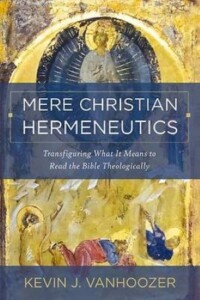
Mere Christian Hermeneutics
In Mere Christian Hermeneutics, Kevin J. Vanhoozer offers what may be his most pastorally ambitious and ecclesially conscious work to date. While firmly rooted in the technical world of theological interpretation, the book’s animating concern is not merely how Christians read Scripture, but who Christians are becoming as readers, and how that reading shapes faithful action in the world. For Christian academics working outside traditional theological disciplines, particularly in applied fields such as marketing, management, economics, and the social sciences, this book arrives at a moment of real need. Faith integration in business education has often oscillated between thin moral add-ons (“Christian values applied to X”) and thick confessional claims that struggle to translate into pluralistic professional contexts. Vanhoozer’s proposal of a “mere” Christian hermeneutic offers a way forward that is theologically serious, ecclesially grounded, and pedagogically flexible.
To get the most from this book, it helps to situate it within Vanhoozer’s corpus. Vanhoozer’s career-long project has been the rehabilitation of theological interpretation of Scripture against both modernist reduction and postmodern fragmentation. Earlier works such as Is There a Meaning in This Text? (2009) established his resistance to interpretive relativism, while The Drama of Doctrine (2005) reframed doctrine as improvisational participation in God’s communicative action.[1] Later texts like Faith Speaking Understanding (2014) continued this trajectory, emphasizing Scripture as divine discourse that summons responsible human response.[2]
Mere Christian Hermeneutics represents both continuity and development. The continuity lies in Vanhoozer’s insistence that meaning is communicative, covenantal, and action-oriented. The development lies in tone and target. Where earlier works often engaged scholarly debates head-on, this book consciously broadens its audience. Vanhoozer is no longer writing primarily against errors in hermeneutical theory; he is writing for the church catholic, across traditions, professions, and callings. In that sense, Mere Christian Hermeneutics does not replace Vanhoozer’s earlier works; it distills them. It is a summative text that asks: What must Christians minimally agree on to read Scripture faithfully together, and live it out responsibly in the world?
The adjective “mere” is doing significant work here. Vanhoozer explicitly draws on the spirit (though not the substance) of C. S. Lewis’s Mere Christianity. By “mere,” Vanhoozer does not mean simplistic, lowest-common-denominator, or doctrinally evasive. Rather, he means catholic in scope and creedal in posture: theological minimalism without reduction. A question for the reader to ponder is whether “mere” risks underplaying genuine hermeneutical conflict? Vanhoozer acknowledges this risk but argues that creedal consensus provides sufficient ballast for disagreement without fragmentation. A “mere” Christian hermeneutic affirms:
Scripture as God’s authoritative communicative action;
Christ as the telos of all interpretation;
The church as the primary interpretive community; and
The Spirit as the agent who forms readers into faithful performers.
Importantly, Vanhoozer resists two temptations common in faith-integration contexts. The first is privatized interpretation, where Scripture becomes a source of individual inspiration detached from ecclesial norms. The second is instrumentalized interpretation, where biblical texts are mined for principles that conveniently support preexisting professional practices. Instead, Vanhoozer frames interpretation as participation in the triune economy, a process that shapes habits, virtues, and forms of life. For Christian academics, this is a crucial corrective: Scripture is not merely a source of ethical constraints or motivational slogans; it is a formative script that trains Christians to see, judge, and act truthfully.
One of the book’s most enduring contributions is its continued development of Scripture as the canonical script of God’s redemptive drama, yet Vanhoozer deepens this dramaturgical vision through what he calls a kind of hermeneutical transfiguration. Across his chapter titles and arguments, “transfiguration” names the way Scripture, read within the rule of faith, does not flatten the literal sense but elevates and fulfills it. The literal and the figurative are not rivals; rather, the literal sense is transfigured as readers perceive how particular texts participate in the larger Christ-centered drama. Reading the Bible well, then, is not analogous to extracting information from a manual; it is closer to learning one’s role in a play already in progress, where understanding grows as one grasps how earlier acts are illuminated in light of the climactic revelation of Christ. This metaphor is especially fruitful for applied disciplines. In marketing, for example, students are trained not merely to analyze markets but to perform functions: brand steward, storyteller, persuader, analyst, advocate. Vanhoozer’s hermeneutic presses Christian educators to ask not only what Scripture says, but how it transfigures its readers: what kind of performers it forms, what practices it commends, and what habits it resists. Faithful interpretation culminates not in correct propositions alone but in wise improvisation: acting faithfully in new contexts without abandoning the authoritative script. This insight maps directly onto professional life, where ethical decisions rarely present themselves as clear-cut dilemmas but as ambiguous situations requiring discernment.
Although Mere Christian Hermeneutics was not written specifically for marketers, its themes lend themselves remarkably well to integration with marketing concepts, the discipline I teach, since marketing is an arena in which Christians are called to see truthfully, judge wisely, and act in ways that accord with the gospel’s unfolding drama. Marketing is used here not as a special case, but as a representative applied discipline in which interpretation, persuasion, and public action intersect.
Authority and Trust
Vanhoozer’s treatment of biblical authority as communicative authority parallels core marketing concerns about trust, credibility, and voice. Scripture’s authority is not coercive but covenantal, an insight that challenges manipulative persuasion models and supports ethical communication grounded in truthfulness and respect.
Community and Interpretation
Vanhoozer’s insistence that interpretation is ecclesial resonates with branding as a communal meaning-making process. Brands, like texts, are interpreted within communities. This analogy opens space to discuss how Christian marketers might resist purely extractive market logic and instead cultivate communities shaped by mutual flourishing.
Formation over Information
A recurring theme is that Scripture forms readers over time. This aligns with critiques of short-term metrics in marketing. Just as discipleship cannot be reduced to momentary decisions, brand relationships cannot be reduced to clicks or conversions without distortion.
Improvisation and Discernment
While improvisation is not this book’s key category (it was more central to The Drama of Doctrine), Vanhoozer’s account of interpretive virtue under the authority of the canonical script furnishes a compelling framework for ethical discernment amid ambiguity, a daily reality in marketing practice. Students can be taught to view strategy not as value-neutral optimization but as morally freighted performance.
Witness and Public Theology
The book implicitly supports a vision of Christian vocation as public witness. For marketing students, this reframes their work not as morally suspect persuasion, but as participation in truthful, hope-oriented communication, or (alternatively), as an arena where such witness can be compromised.
Although the examples shared draw primarily from marketing education, they are offered as illustrative applications of Vanhoozer’s hermeneutical framework. In addition to marketing, they should be adaptable to other applied and professional disciplines within Christian higher education.
Practically speaking, Mere Christian Hermeneutics succeeds in several key ways. First, it is teachable. Unlike some of Vanhoozer’s earlier works, which presuppose extensive familiarity with hermeneutical debates, this book is structured to invite readers in. The prose is still dense at times, but it is patient, pastoral, and often disarmingly clear. Second, it is ecumenically usable. By foregrounding creedal commitments rather than denominational distinctives, Vanhoozer makes the book adaptable across Christian institutions. This is particularly important for business faculty who teach students from varied theological backgrounds. Third, it is formational rather than merely conceptual. The book consistently presses readers toward lived faithfulness, making it well-suited for disciplines concerned with practice, not just theory.
Where the book may fall short is in its implicitness: this will likely be most challenging for early-career faculty or institutions without established faith-integration frameworks. Vanhoozer rarely draws out explicit applications to nontheological professions. For some readers, especially those new to faith integration, this may require significant pedagogical mediation. Yet this limitation is also a strength: the book resists pre-packaged applications in favor of deeper reformation of interpretive posture. While Vanhoozer does not explicitly address marketing or business disciplines, his framework licenses these applications without distorting his theological claims. For a marketing professor, Mere Christian Hermeneutics could serve as the theoretical spine of a faith-integration module in at least three ways:
Hermeneutics before Ethics. Rather than beginning with “Christian ethics in marketing,” instructors can begin with how Christians read and inhabit Scripture. Ethics then emerges as performance, not compliance.
Narrative Framing of Vocation. Students can be invited to locate marketing within the larger biblical drama: creation (value creation), fall (manipulation and idolatry), redemption (truthful communication), and consummation (hope and restoration).
Interpretive Humility and Discernment. The book models intellectual humility, resisting both dogmatism and relativism. This posture is invaluable in classrooms navigating contested moral and cultural terrain.
Assignments might include interpretive case studies, brand analyses framed as performances, or reflective essays on how Scripture reshapes professional imagination rather than merely constraining behavior.
Mere Christian Hermeneutics is neither a manifesto nor a methodological handbook. Its significance lies in its careful refusal to separate reading from living, interpretation from vocation, and theology from practice. For Christian academics, particularly those teaching in applied fields such as marketing, the book offers a framework for faith integration that avoids both superficial moralism and rigid confessionalism. Vanhoozer invites readers to attend more carefully to how Scripture forms interpreters over time, shaping habits of judgment, discernment, and action. In a context where both biblical interpretation and professional communication are often treated instrumentally, this work provides a theologically grounded and pedagogically flexible resource for those seeking to integrate faith and learning with intellectual integrity and ecclesial attentiveness.
[1]. Kevin J. Vanhoozer, Is There a Meaning in This Text?: The Bible, the Reader, and the Morality of Literary Knowledge (Zondervan, 2009); Kevin J. Vanhoozer, The Drama of Doctrine: A Canonical Linguistic Approach to Christian Doctrine (Westminster John Knox, 2005).
[2]. Kevin J. Vanhoozer, Faith Speaking Understanding: Performing the Drama of Doctrine (Westminster John Knox, 2014).