
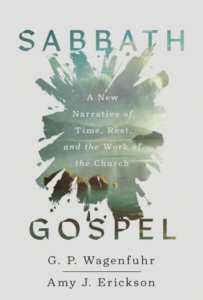
Sabbath Gospel: A New Narrative of Time, Rest, and the Work of the Church
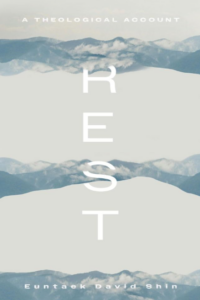
Rest: A Theological Account
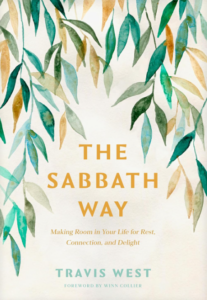
The Sabbath Way: Making Room in Your Life for Rest, Connection, and Delight
Editor’s Note: The following is the second part of Amy Davis Abdallah’s review essay of G. P. Wagenfuhr and Amy Erickson’s Sabbath Gospel: A New Narrative of Time, Rest, and the Work of the Church; Euntaek David Shin’s Rest: A Theological Account; and Travis West’s The Sabbath Way: Making Room in Your Life for Rest, Connection, and Delight.
Genesis, Community, Time, and Work
Amidst their differences, all three texts have several strong similarities, including the desire to provide a theological paradigm, not simply a day off from work. They all spend time in Genesis, center on community, and explore time and work. They are also addressing related but nuanced problems. For Wagenfuhr and Erickson, the problem is that we trust in both our own self-sufficiency and our “dream homes,” idealized “structures” that we think will bring satisfaction and rest, rather than embracing belonging in God’s household and receiving God’s rest. For Shin, we are deeply restless due to our desire for limitlessness, constant dissatisfaction, lack of sharing, and challenging memories, rather than restful due to acceptance of and satisfaction with our portions, sharing, and reframing our memories with God. For West, we are busy, lonely, greedy, work-bound, and disconnected from others and creation, rather than restful, grateful, delighted, and connected to others and creation. Because West’s book is the most practical, it is also most granular and embodied.
An exploration of Genesis is a necessity for books addressing rest or Sabbath. Wagenfuhr and Erickson understand Sabbath in Genesis 1 as enthroning God, who lives with God’s image-bearing divine council members (humans) in a palace garden, Eden. When they sin, humans “move from community to domination, from receiving a home to desiring a dream house, from knowing and being known to projecting a mask of constructed selves” (69). For Shin, the first chapters of Genesis primarily show human failure to embrace God-given limits. In contrast, West delights in God’s delight in Genesis 1–2 where God grants rest to all creation, not as something earned, but a birthright, all of which is distorted by humans in Genesis 3. While these authors do not necessarily begin in Genesis, the first few chapters of the Bible are foundational to each book.
Community is also foundational to each book. Wagenfuhr and Erickson have two discussion questions at the end of each chapter and encourage reading the book with a group of people. They also encourage practicing Sabbath with a group who seeks to give rest to others, not take it. Shin agrees with Wagenfuhr and Erickson when he writes that “restfulness is achieved when we are satisfied with the fruit of our work and when those fruits are shared with others” (56). While he does not include discussion questions, he points out that our rest is only partial if others are restless. And for West, community is one of the four foundations of the Sabbath way—the Sabbath posture toward all of life—so he dedicates approximately a quarter of his book to the topic. The critique that Wagenfuhr and Erickson would offer West is that his reflection questions and practices tend to be individual in nature rather than always communal.
In addition to community, all authors address time, agreeing that humans do not have a healthy or Sabbath-oriented relationship with time. Wagenfuhr and Erickson see God uniting space and time to create place for Sabbath in the first chapters of Genesis. They write that Passover shows that “time begins with freedom” (124), and that all time is shaped around Sabbath and the daily sufficiency of manna. They devote three chapters to how Jesus transforms time through proclaiming the Jubilee (Luke 4:16–20a), recapitulating all time in himself, and inviting us to enter into God’s final rest. Shin’s perspective on time centers God’s time in his interpretation of Genesis 1, where God completes creation, ceases, and then blesses and sanctifies time. God also enters into time, so “God’s time permeates history, forming the grand narrative of God’s work among creation” (115). West again devotes a quarter of his book to time, reorienting us to time as love, presence, and play. His constant query to our actions is: “Is this the way of love?”—a way of living that orients to time differently.
West also devotes one quarter of his book to work, a topic all authors address with nuance. Wagenfuhr and Erickson group work with control and independence, all three of which oppose Sabbath. They do not see work as necessarily negative but understand working the land in Genesis 3 as God’s discipline to bring us to maturity in God’s household. Working the land reflects one of multiple distorted relationships resulting from human sin; it is supposed to discipline us and bring us to maturity in God’s household, but we distort it even more by creating competition. Shin characterizes work differently, connecting our work to our portions. If we accept our portions, even the portion of energy and ability we’ve received, then it is possible for each day to be complete. We do the work we are able to do based on our portions, and then can stop working and rest, having our desires met and our daily work finished. West’s perspective on work is that we often trust work to define us, make us meaningful, and earn our rest. “The Sabbath wants to remind us every week that our lives already matter, and more than we could possibly imagine! . . . The gift of the Sabbath is to burst our belief in limiting lies, and to remind us that rest and delight are birthrights we cannot earn” (55). Thus, none of the authors oppose work, but they do oppose earning rest by it and placing our trust in it.
All the authors seem to be from Reformed traditions, but only two of the books spend time discussing sovereignty and providence: Sabbath Gospel and Rest. Indeed, Wagenfuhr and Erickson see sovereignty as one of the key terms of their book. They nuance sovereignty, however, and see it as “more of a story and a question in the Bible than [as] a theological first principle” (27). When God freely provides food, it symbolizes God’s sovereignty, God’s free and abundant provision. “Sabbath shows the character of God’s sovereignty over his creation and the means of that sovereignty—presence” (61). Life after Genesis 3 is the “absence of Sabbath and its restful, provisioned sovereignty” (74). As we mature in response to God’s discipline, however, Wagenfuhr and Erickson believe we practice signs like circumcision and the Lord’s Supper, and thereby become signs of God’s sovereignty and rest.
As for providence, Wagenfuhr and Erickson nuance the concept significantly. They challenge a doctrine of God’s providence that emphasizes “God’s ongoing governance and direction of the structures of creation” (222) and the misinterpretation that all events are God’s will. Rather, they argue, “History is not the realm of God’s providence; it is the arena of God’s patience” (222). They see the work and worship literature, most of which they critique, as leaning toward the misinterpretation of providence. It is likely they would see Shin’s work leaning in that direction as well. Shin defines providence as the “proactive activity of the creative God who cares for creation” (52–53), involving conservation, concursus, and governance. He mentions providence throughout the text, joining sovereignty and providence when he states that “God is the one who is sovereign over all events, appointing things at their appropriate time” (85). Shin does state that we should push back against evil and distinguishes between “accepting-one’s-portion-as-God-granted and accepting-one’s-portion-as-God-desired-for-our-flourishing” (109). Shin seems to be for justice, but he does not write directly against injustice; it is unlikely he would say trauma is part of God’s providence, but he seems not to take into account traumatic memories in his healing memories chapter. Still, the regular repetition of providence and sovereignty narrow the audience for both texts.
In contrast, West’s book is for everyone, and he makes this repeatedly clear by mentioning people from all different walks of life; this seems both unique and intentional. Wagenfuhr and Erickson’s book is for scholars and students, so it seems odd that they would think their audience might skip the more technical chapter on Leviticus (120), “Life in God’s Household: Lifeblood of the Old Covenant,” which I found to be one of the most intriguing chapters of the book. Shin’s book is also for scholars and students who enjoy philosophy. His illustrations tend to be limited to academic experiences, which further narrows his audience.