
How do faculty at Christian higher education institutions navigate their careers with purpose and with joy? That is the driving question behind our new edited collection, Purpose and Joy: Pursuing a Meaningful Career in Christian Higher Education, available this month from Abilene Christian University Press and Leafwood Publishers. When we first posted the call for chapters in early 2025, we asked questions we ourselves were wondering. Some of our questions were very practical, about the pursuit of promotion, balancing work and home responsibilities, and sustaining scholarship at a teaching-focused institution. Other questions were more philosophical: How do you know when it’s time to move into leadership or administration, and what should leadership at a Christian institution look like? What models are available for living a public faith over the (long) arc of an academic career? What do you do when an institutional culture is no longer a good fit for you? The answers to these questions and more are found in our new collection, each chapter featuring generous writing and stories from colleagues from across many institutions. We hope you will find renewed joy, purpose, and encouragement through this new resource. An abridged excerpt from the book’s introduction follows below.
An Introductory Excerpt Authored by Both Co-Editors
We are convinced that our wonderings about how we navigate our careers with purpose and joy are perennial for college and university faculty. From the beginning of our academic careers we spend significant time developing our scholarly identities and research agendas, often devoting consequential emotional energy and resources to the question of who we want to be and what we want to study and teach. We are likewise trained to see new possibilities and ideas, and then to give them life, whether through writing papers or designing new courses. As we progress toward tenure and promotion in our early careers, we are (hopefully) supported by intentionally scaffolded mentoring to further develop these skills. We have had colleagues jokingly compare getting tenure to completing “thirty-seventh grade,” and in a real sense, it can feel that way. There is a discernible path forward toward a specific goal.
Yet beyond tenure and promotion, the landscape for advancement and opportunity is murkier. Whether a faculty member applies for full professorship, seeks administrative positions, finds work outside academia, or pursues myriad other options, there are divergent opportunities and uncertain ends. Many faculty feel directionless and hesitant as they navigate a criterion-less forward trajectory. As they advance in their careers, faculty also find that they are so busy striving to reach particular benchmarks that they rarely pause to reflect on what they actually want or whether that might lead to fulfillment and a continued sense of accomplishment over the longer term. This ambiguity is also often accompanied by a lack of clarity about how to accomplish particular career goals.
When layered with the complexities of career discernment, a commitment to the Christian faith and work within Christian higher education often increases the sense of urgency and weight of faculty decisions. Christian higher education institutions often layer particular cultural beliefs and spiritual practices on top of other routine assumptions and habits of academics and the academy. Sociological concepts such as the “Protestant work ethic,” “Christian mission,” and “vocational calling” invigorate—or plague—many of us and our colleagues. The Protestant work ethic values efficiency, frugality, diligence, and continuous hard work. The assumption is that if one is equipped to do the work, then one should do the work; for some, there may be a moral or spiritual obligation to do so. Likewise, much is done in the name of “Christian mission” as institutional decisions are made—faculty are hired or fired, budgets are determined—based on a sense that this is what “God has called” a particular college or university to do (human fallibility notwithstanding). Together, these spiritual or religious discourses can add pressure for Christian faculty and/or faculty at Christian institutions to continuously juggle calling, duty, virtue, diligence, and a public-facing faith, at the same time as they often navigate resource-limited environments and their own self-doubts.
The Current Landscape of Christian Higher Education and Faculty Thriving
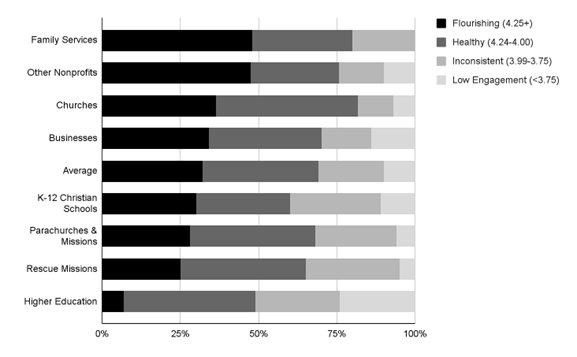
All this to say, faculty often pursue purpose and joy within environments that seem to generate persistent and considerable headwinds.1 For example, the most recent “State of the Christian Workplace” data published by Best Christian Workplaces reveals that among Christian workplaces sampled (including Christian K–12 schools and other Christian nonprofits), respondents from Christian higher education reported the least job satisfaction as compared to other surveyed sectors.2 While all other industries ranged from 4.05 to 4.19 (the average of all sectors was 4.07 out of 5.0), higher education averaged 3.92.3 Higher education is also the only sector in which average employee engagement and morale fall in the “unhealthy” range. Only 7 percent of higher education institutions reported scores that fell within the “flourishing” range (see Figure 1 below).
Figure 1. Best Christian Workplaces by Sector, % of Workplaces Reporting Scores Within Each Range4
This problem is not unique to Christian higher education; authors from across the academy have written about low and falling faculty morale. As one example, Sorgen et al. note in their article on stress in higher education, “heavy workloads, long working hours, pressure to publish, and attempting to balance the demands and expectations of a position in academia can create work-life conflicts and lead to stress among faculty.”5 Additionally, as these trends persist or worsen and “while schools devote significant resources to promote student retention, the amount of time and effort devoted to faculty retention often pales in comparison.”6 As Best Christian Workplaces summarizes in its analysis of higher education, “this data should rightly sound an alarm.”7
Perhaps even more concerningly, a survey conducted by Harvard University’s Collaborative on Academic Careers in Higher Education found that associate professors reported the least satisfaction with their recognition for teaching, mentoring, and scholarship, as compared to assistant and full professors (to say nothing of adjunct faculty).8 Mid-career faculty report feeling “irrelevant, isolated, bored with academic work,”9 a concerning combination that leaves many ambivalent about their futures. These data suggest to us that over time, Christian higher education may lose many emerging leaders as faculty choose to take their skills, talents, and passions elsewhere.
We would be remiss if we failed to point out that gender and race, among other social identities, can also intersect uniquely for particular university faculty. To look at gender as one example, Dr. Lisa Weaver Swartz’s work has highlighted how traditional gender roles shape female faculty experiences and opportunities within Christian higher education.10 Female faculty must navigate historical pressures to be “homemakers” and to manage considerable family and household responsibilities in addition to historical preferences that privilege men for leadership roles. This dual-edged sword can create ideological barriers for both men and women as they navigate their mid-career paths. Women are more likely to work in contingent roles,11 and in Christian institutions, women are more likely to reduce their work hours to accommodate family life.12 Additionally, women who pursue tenure-track positions are less likely to achieve tenure.13 As studies such as the HERI Faculty Study of Undergraduate Teaching Faculty at UCLA14 and writing by scholars such as Wheaton College professor Dr. Esau McCaulley15 remind us, significant barriers exist for international faculty and faculty of color as well.16
The situation is not hopeless, despite the discouraging landscape we paint above. One of the leading voices in the study of faculty and leadership development is Dr. Vicki L. Baker,17 whose research on faculty effectiveness, longevity, and career satisfaction reveals three important areas for continued attention: faculty morale, multifaceted support for faculty work, and better leadership development. Baker’s research in this area, which has frequently focused on mid-career but whose findings also apply more broadly, helpfully defines additional areas for intervention as well: support in discerning institutional and departmental fit; illumination of career paths outside of tenure-track streams; mentorship through teaching, research, scholarship, advising, publishing; and robust conversations about what academic leadership looks like and what it requires.18
Together, these findings suggest that specific interventions designed for faculty at Christian higher education institutions are essential if we are to cultivate faculty thriving. This book is therefore both timely and abundantly necessary. We benefit from robust conversations about the unique opportunities and challenges presented within faith-affiliated institutions, and we likewise benefit from learning from and alongside each other. Our aim with this collection is to speak to each of the barriers and supports identified by Baker and others, above, such that readers can chart a meaningful path forward, contributing to the well-being of Christian higher education institutions.
Book Overview
The book is organized into three sections focused on significant aspects of the faculty experience. Framed by a brief introduction, discussion questions, and an epilogue, each section offers a thoughtful collection of essays written by diverse faculty who together provide a holistic view of faculty life.
To begin, the first section focuses on the “nuts and bolts” of faculty careers, highlighting topics including saying “no” as a way to leave room for saying “yes”, avoiding monotony, applying for tenure and promotion, and building scholarly resiliency and professional flexibility. Inherently practical in its approach, our aim with this initial section is for Christian college faculty to feel well prepared to navigate their careers at faith-affiliated institutions.
The second section builds on the first by highlighting how faculty thoughtfully discern and forge new paths. Perhaps years past the initial relief of securing an increasingly rare tenure-track or permanent faculty position and/or applying for tenure, faculty often find themselves wondering, “What now?” and “What next?”, particularly as they consider a future retirement potentially decades in the future. As such, in this section, we start by exploring the dynamic nature of faculty work calling, before then considering an array of option-expanding opportunities and decision-making frameworks. The chapters in section two look beyond the basics of what is contractually required of faculty, to how faculty can thrive in meaningful and new ways over the longer term.
The final section considers sustainability and joy. In a profession that doesn’t love you back, this section begins by asking what institutional barriers might need to be addressed to ensure faculty thriving before then turning to how faculty themselves can create rhythms of work and rest that feel manageable. Through this section, we hope you’ll see sustainability not just as a to-do list item or something that’s a good idea in the abstract, but how to practically apply principles of joy and rest to your own vocational discernment and boundary-setting in ways that benefit you and the institutions you work within.
So, what do you want to do next? And what will it take to get there? May you find hope and joy as you read the stories presented in this book, and encouragement to pursue your own.
Editor’s note: This essay is an abridged excerpt from the introduction to Purpose and Joy: Pursuing a Meaningful Career in Christian Higher Education (ACU Press, June 2026) that was released today. Used by permission.
Footnotes
- Buller describes these headwinds well, citing several common factors that drive attrition rates among faculty, including: compensation, benefits (and in particular health benefits), limited support for professional development and sabbaticals, unclear tenure guidelines and work expectations, and dissatisfaction with efforts to diversify college campuses. Jeffrey L. Buller, Retaining Your Best College Professors: You Worked Hard to Recruit Them; Now How Do You Keep Them? (Lanham: Rowman & Littlefield, 2021).
- Best Christian Workplaces (BCW), State of the Christian Workplace (Mercer Island: Best Christian Workplaces, 2025).
- This is actually a small improvement from 2024, when the sector average was 3.87. See Best Christian Workplaces, State of the Christian Workplace (Mercer Island: Best Christian Workplaces, 2024).
- Adapted from data from BCW, State of the Christian Workplace, 2025.
- Carl H. Sorgen, Teri Melton Denlea, and Terry Davis, Diamanduros, “Perceived Levels of Stress and Quality of Work-Life of Faculty,” The Journal of Faculty Development 34, no. 1 (January 2020): 32
- Emphasis in original. Buller, Retaining Your Best College Professors, xi.
- BCW, A Comprehensive Employee Engagement Guide for Higher Education (Mercer Island: BCW, 2023), 9.
- Kiernan Mathews, Perspectives on Midcareer Faculty and Advice for Supporting Them (Cambridge: The Collaborative on Academic Careers in Higher Education, 2014).
- James Mullholand, “Slow Down: On Dealing with Midcareer Burnout,” MLA Profession, accessed May 23, 2025, https://profession.mla.org/slow-down-on-dealing-with-midcareer-burnout/.
- Lisa Weaver Swartz, Stained Glass Ceilings: How Evangelicals Do Gender and Practice Power (Rutgers: Rutgers University Press, 2022).
- Elrena Evans and Caroline Grant, eds., Mama, PhD: Women Write About Motherhood and Academic Life (Rutgers: Rutgers University Press, 2008).
- Nancy Wang Yuen and Deshonna Collier-Goubil, eds., Power Women: Stories of Motherhood, Faith, and the Academy (Lisle: IVP Academic, 2021).
- Wang Yuen and Collier-Goubil, Power Women.
- Ellen Bara Stolzenberg et al., Undergraduate Teaching Faculty: The HERI Faculty Survey 2016-2017 (Los Angeles: Higher Education Research Institute, 2019).
- Esau McCaulley, “Easing the Daily Reality of My Strangeness,” The New York Times, March 3, 2024, accessed May 23, 2025, https://www.nytimes.com/2024/03/03/opinion/dei-black-professor-academia.html.
- It is important to note that these barriers create intersectional challenges wherein women of color are particularly prone to experience marginalization within the academy.
- See as examples Vicki L. Baker, Managing Your Academic Career: A Guide to Re-Envision Mid-Career (Milton Park: Routledge, 2022). Vicki L. Baker, A Toolkit for Mid-Career Academics: Cultivating Career Advancement (Milton Park: Routledge, 2024).
- Baker, Managing Your Academic Career.