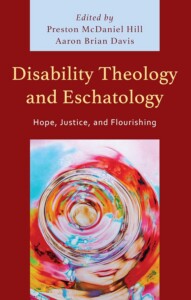
Disability Theology and Eschatology: Hope, Justice, and Flourishing.
What will our resurrected bodies look like? Ample ink has been spilled upon such a question. Augustine, for example, believed our bodies would be redeemed as if they were in the prime of life. He further mused upon the gender, height, weight, and even the length of hair and nails of our resurrected forms. So, too, did he theorize about the existence (or, rather, the lack thereof) of disability in the eschaton. The cessation of pain and suffering is, after all, biblically prescribed in passages such as Revelation 21:4 and Isaiah 25:8.
Is it so obvious, however, that disability will be eliminated from our resurrected bodies? This question is at the center of Disability Theology and Eschatology: Hope, Justice, and Flourishing. This volume, edited by Preston McDaniel Hill and Aaron Brian Davis, complicates long-held theological beliefs surrounding disability and eschatology. The various contributors aim to accomplish the following: offer innovative contributions on the topics of disability theology and eschatology, examine the possibility of the retention of cognitive disabilities in the eschaton, and address the experiences of those with psychiatric disabilities. Such an emphasis functions as a corrective, as these themes have largely been neglected within the broader corpus of disability theology literature. Through the examination of these topics, the authors seek to develop a theology “that is full of hope, justice, and flourishing for all members of the family of God” (9).
Part I of Disability Theology and Eschatology is comprised of four chapters, each of which challenges readers to reexamine their ideas surrounding the role of disability in the eschaton. In the first chapter, “A Theory of Well-Being for Disability Theology,” Aaron Brian Davis sets out to provide a model of disabled flourishing—a model, he claims, disability theologians have not yet adequately articulated. Davis devotes much of his chapter to detailing philosopher William Lauinger’s theory of desire-perfectionism, which emphasizes that while there are some goods (friendship, health, etc.) that objectively contribute to human flourishing, they can only “become good for any given human subject when that subject appropriates their goodness by desiring them” (28). Building upon Lauinger’s work, Davis proposes his own theory, one that melds desire-perfectionism and an eschatology that is inclusive of disabled bodies, which he coins “eschatological desire-perfectionism.” Davis’s proposed theory relies upon the “fantastical” (34) nature of the eschaton—a place in which desires may be reordered, allowing for the flourishing of the disabled and non-disabled alike.
Chapter two, “For the Beauty of Glory,” centers upon the work of Thomas Aquinas, whose theology has long been interpreted to support the elimination view, or the belief that our resurrected bodies will not bear the marks of disability. Derek Estes challenges such a construal, instead asserting that Aquinas’s theology offers fodder for thinking about the retention of disability in the eschaton. Estes’s assertion hinges upon Aquinas’s vision of human flourishing. For Aquinas, flourishing is grounded in “the perfection of relational capacities,” (59) especially one’s capacity for union with God. He points to the scars that mark the resurrected body of Christ—scars that mar and disfigure the flesh, yet do not “detract from the perfection of his resurrected body” (59). Thus, disability does not interfere with our ultimate end—which, of course, is to be united with God.
The third chapter, “Disability, Life After Death, and the Truth,” by Eleonore Stump, opens with a provocative question: “Is there disability in heaven?” (71). To generate an answer to this question, Stump embarks upon an exploration of “the true self.” For the Christian, the true self involves an objective element—being in relationship with God. However, it also involves a subjective element. The true self varies from person to person, as Stump writes, “It might include disability for Harriet McBryde Johnson . . . but not for Helen Keller” (84). Through her exploration of the true self, she answers her initial question: disability might, indeed, persist in heaven—if that is the “heart’s desires of that person” (86).
Chapter four, “Beautiful Bodies,” authored by Maja Whitaker, centers upon beauty standards and eschatology. Such a theme may initially seem out of place in a volume on disability, but as Whitaker explains, “The Christian imagination is deeply shaped by biases against diverse bodies, whether that diversity is along a spectrum of natural variation in relation to skin color, body size, or ability” (99). Augustine, and many other theologians, envisioned certain kinds of bodies as fitting the mold of perfect embodiment. The bodies that fall outside of this mold will be altered in the eschaton. However, as Whitaker argues, perhaps it is not these bodies that will be altered—but rather, our responses to them. Whitaker proposes her own eschatological vision, filled with bodies that deviate from modern beauty norms: a heaven populated with bodies that are overweight, disabled, scarred, and aged.
Part II is dedicated to psychiatric disabilities. The first chapter in this section, “Yo-Yo Hope, ‘Symptom Talk,’ and the Courage Not to Be Well,” authored by Erin Raffety and Emma Worrall, centers upon the experiences of the chronically ill—nearly half of the population of the United States. Despite its prevalence, there has been little theological reflection that focuses solely upon chronic illness. Raffety and Worrall seek to remedy this oversight, questioning: “Who better to teach us about hope than those whose hope is so clearly under threat from death and pain?” (126). The chapter draws upon a study of those living with chronic illness and/or long COVID to challenge traditional articulations of Christian hope—which too often assign blame to the ill person or become a type of spiritual burden to bear. Instead, Raffety and Worrall offer a revised account of hope: hope that goes beyond a cure, or recovery, but rather, a hope that the lives of the chronically ill matter to God.
Chapter six, “The Afterlives of Saint Dymphna,” by Jessica Coblentz, opens by introducing readers to Saint Dymphna, the patron saint of mental illness. Although Saint Dymphna may be less familiar to most than, say, Saint Mary or Saint Francis of Assisi, she and other saints associated with psychiatric disabilities, Coblentz argues, may reveal certain things about mental illness and communion with the divine. Coblentz raises two guiding questions: “What do devotions to the saints related to mental illness reveal about how the saints in heaven relate to mental illness among the living? And what do these perceived relationships between the living and the dead suggest about the place of those with mental illness in our communities—especially our Christian communities?” (160). Coblentz proposes three “patterns of devotion,” in which modern Christians can find community and precedence in the suffering of mental illness. The first is kindred disabled, which construes the saints as companions who shared similar distress and anguish in the throes of mental illness. Next, is the saints as intercessory healers, those who may advocate and heal mental illness. Lastly, as inspired collaborators, those saints who display the spirit of God in the world, namely, through compassion to those in the midst of mental illness.
The next chapter, “‘Ask, Wish, and Believe Through Another’: Dissociative Identity Disorder and a Renewed Doctrine of Fides Aliena,” by Samuel Youngs, focuses on the experiences of those with dissociative identity disorder (DID). Youngs poses the questions: “What if, in the case of a DID patient, not all identities confess or believe? If only one alter has faith in God, what do we make of the salvific status of totality?” (187). To formulate a response to such questions, Youngs draws upon the ancient doctrine of fides aliena, or the “faith of another.” Originally developed in the context of infant baptism, fides aliena holds “that the saving faith of a person or group can count as the faith of one who cannot have faith of their own” (193). As such, Youngs’s chapter does much to assuage the eschatological concerns of those living with DID.
The concluding chapter, “Dissociative Identity Disorder in the Eschaton,” authored by Harvey Cawdron, addresses similar concerns as the preceding chapter, taking up the question: Will DID persist in the eschaton? Cawdron answers in the affirmative, his argument advancing in three parts: He first draws upon the mere-difference view of disability, which claims that while disability may cause one to exist differently in the world than one who is non-disabled, it does not “make you worse off” (214). Next, Cawdron explores how DID can positively contribute to the rich diversity of the eschaton. Finally, he attends to the “Multiple Persons Thesis,” which argues that the various alters within an individual are distinctive persons. Although the “Multiple Persons Thesis” raises certain concerns for those with DID, Cawdron asserts that the eschatological exclusion of such individuals is, ultimately, “inconsistent with God’s love” (218).
There is much to commend about this volume, namely, the attention devoted to topics that have been neglected within disability theology, such as psychiatric disability. Each chapter invites readers to reconsider theological assumptions surrounding disabled bodies and minds. However, some chapters, particularly those centered upon the reexamination of a historical doctrine or figure, may provoke further questions in readers. For example, by offering a retentionist rereading of Thomas Aquinas, Derek Estes’s chapter “For the Beauty of Glory,” challenges readers to reexamine the work of a figure who has long been used to support an elimination view of disability. Although Estes alludes to Aquinas’s belief that physical impairments were the result of original sin, he does not entirely identify how this may cohere with his more disability-positive reading of Aquinas. Similarly, Samuel Youngs’s chapter “Ask, Wish, and Believe Through Another” may also raise questions or concerns surrounding the usage of an ancient doctrine, originally developed in the context of infant baptism, to speak to a modern medical and psychiatric reality. Nonetheless, such lingering questions do not take away from the creative contributions found in both chapters.
Disability Theology and Eschatology accomplishes two of its stated aims—offering innovative contributions on the topics of disability theology and eschatology and addressing the experiences of those with psychiatric disabilities—in a laudable fashion. However, despite the stated intention to “intensively examine” (5) cognitive disability, there is scant material devoted specifically to the experiences of those with cognitive disabilities and whether such disabilities will be retained in the eschaton. Disability Theology and Eschatology remains a worthy addition to the shelves of theologians interested in questions pertaining to disability, hope, and the eschaton.