


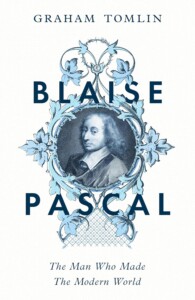
Blaise Pascal: The Man Who Made the Modern World
I am glad that Professor Tomlin appreciated my review of his outstanding book. We are both Pascalians, I wager, so our disagreements are not major. The sticking point is found in how we treat Pascal’s understanding of reason in apologetics, particularly regarding arguments for God’s existence. A few points will suffice:
First, given Pascal’s several in-principle objections to natural theology, I doubt that even the great strides made in that discipline in recent decades would have altered his central critique that reason as rational inference and calculation cannot bring one to the one true God, since this is more a matter of the heart—rational intuition as touched by saving grace. (However, I relish the idea of his genius being let loose on the new data from biology and physics indicating a Creator and Designer.)
Nevertheless, Pascal was no fideist, as Tomlin admits, so reason can remove some barriers to belief. Still, a hard heart will not melt even before the best arguments. The august philosopher, Norman Malcolm, once admitted that a version of the ontological argument was successful, but that it didn’t move him!1 Yet if one reasons to the existence of a Perfect Being and one is not that Perfect Being, at least some humbling before God is in order.
Second, Pascal notwithstanding, natural theology may draw people closer to the living God than Pascal admitted (especially in its more rationally compelling forms). The arguments for God are much more rationally compelling now than they were in Pascal’s day. My 1993 University of Oregon doctoral dissertation critiqued all of Pascal’s reasons for rejecting natural theology and found them all wanting.2 Since Pascal is smarter than I am, it took me about 260 pages to make the argument! Natural theology will not bring one to the gospel, but it may open the door a bit wider, even though the hard heart may still reject God because of pride. I argue that a solid natural theology can be incorporated into the cumulative case that Pascal made for Christianity, which, for him, included miracles, fulfilled prophecy, the anthropological argument, and the uniqueness of Christ. But, as Pascal knew, it is always the Cross that ultimately draws or repels an unbeliever. I shall give the great genius the last word:
This religion so great in miracles, in men holy, pure and irreproachable, in scholars, great witnesses and martyrs, established kings—David—Isaiah, a prince of the blood; so great in knowledge, after displaying all its miracles and all its wisdom, rejects it all and says that it offers neither wisdom nor signs, but only the Cross and folly. For those who by this wisdom and these signs have deserved your trust, and who have proved their character, declare to you that none of this can change us and make us capable of knowing and loving God, except the virtue contained in the folly of the Cross, without wisdom or signs, and not the signs without this virtue. Thus our religion is foolish judged by its effective cause, and wise judged by the wisdom which prepares for it.3













Interesting article! Kind makes “doubting Thomas” look good (if not better).
I wanted to thank both Douglas and Graham for this stimulating discussion. Graham’s book had quite a high profile at last year’s Focus Festival in Newark (UK), and it is very encouraging that a lot of my evangelical brethren and sisters bought it at that time. The accurate understanding of the late pre-moderns like Pascal and Comenius is really important in bringing faith into the modernist/postmodern discourse in most scholarship, and for those of us working in pluralist universities, fundamental. Thank you both.