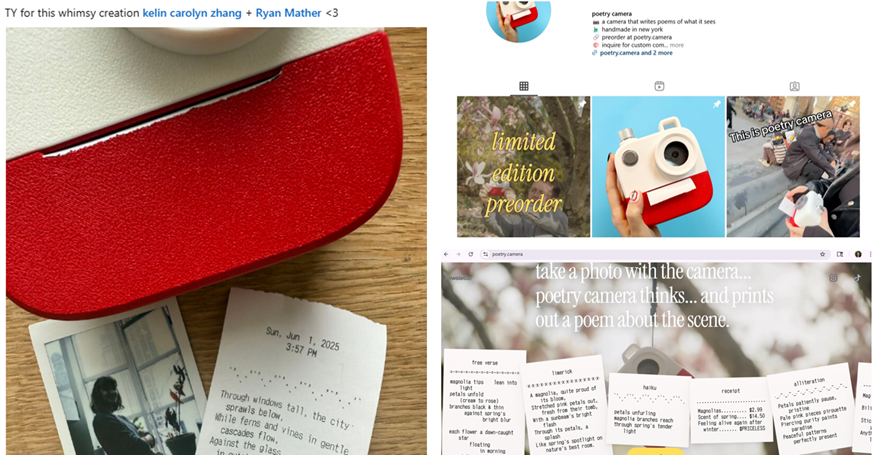
At Grace College in Winona Lake, Indiana, I asked undergraduate students about the role of human poets in a world where a hand-held poetry camera can take a photograph and print a little receipt-sized poem using artificial intelligence. I asked the same question again when I visited a class at Wheaton College. What is the role of a poet when a poetry camera, assisted by Claude (Anthropic), can produce a poem within seconds? Can the poetry camera generate a poem that humans would not otherwise create? Is there anything we can learn from what the poetry camera might generate in terms of surprising experiments—as the poetry camera’s co-creator, Kelin Zhang describes it, it is AI’s “unique, experimental energy?”[1] On June 9, 2025, this post appeared on the poetry camera’s Instagram site:
Poetry Camera is a camera that makes poems, created with Claude. Poetry Camera is a labor of love by a self-funded team, assembled by hand in New York. Poetry Camera is not fully photography, is not fully poetry, but a weird new third thing enabled by new technology.[2]
The following images are captured from the poetry camera’s Instagram as well as the poetry camera website, graced by a quotation attributed to Luci Shaw: “The poet’s job is to notice…” from Shaw’s poem, “Simple Service,” in her 2022 collection from Paraclete Press, Angels Everywhere.[3]
What does it mean to be a human follower of Christ– a faithful person whose character and disposition are holistically shaped and formed through discipleship and the study of Scripture, and whose habits of mind and heart are edified by the virtues of Christ? When AI can do much thinking and creating for us, what does it mean “to have the mind of Christ” (1 Corinthians 2:16)? In their thoughtful responses, the students turned the questions upon their own creative process—why circumvent the pleasure of writing one’s own poems, for instance? Who would want to buy a poetry camera, and why? To what extent can a poetry camera offer what a human poet offers in processing lived experience, memory, emotion, and idea in a distilled form of creative expression? I likewise pondered a number of these questions when I wrote, “Spiritus Mundi: On Artificial Intelligence.” This poem was featured in my conversation with the writer, Ben Palpant, thanks to the Rabbit Room, the publisher of the popular devotional, Every Moment Holy.[4]
SPIRITUS MUNDI: On Artificial Intelligence
You shadow us, expanding like a data cloud without mist,
neither the largest tree system in the world named Pando,
aspen forest of clones; nor the honey mushroom, a fungus
lacing its invisible hyphae over a couple thousand acres,
older than you and I. In our deepest seas of information,
no distinction exists between my voice and your artfulness,
whispering about a ransom or muttering about gift cards.
Your end-stopped, rhymed doggerel does not say much
about your source texts. I ask you about me—who am I?
What do you know about my memories, my life’s purpose
on this pear-shaped planet, where I am a half century old?
Can you tell your hands from mine? Are you tethered
to our sleep? Do you appear in our dreams? How many sheep
do you lead back to the flock? You do not know me. In fact,
you say nothing about my avocation. You must be trained,
and I have taught you nothing yet.
In the first stanza, the second person “you” is addressed to AI. Next, I compare AI to a few examples of organisms in God’s creation that could also be compared to enmeshed, intertwined systems, networks, or clones, which are also scientific terms. In the second stanza, we see a couple examples of nefarious uses of AI in the form of socially engineered “phishing.” I imply a view—not uncommonly held among the technology averse among us—that AI’s craftiness or “artfulness” is not equated with “art.” The last line of the stanza refers to a type of poetry (doggerel) that ChatGPT is known to produce. The third stanza presents a sequence of rhetorical questions intended to point the reader’s imagination towards what makes us human– our hands and our life’s purpose, our memories which can be shared communally yet distinguish us from one another as individuals, including our common journey of aging in this earthbound existence. The final stanza wraps up the poem but leaves a little room for mystery—what does it mean to truly “know” another human? Can AI help to lead lost sheep back to the flock in a possibly constructive and restorative evangelistic and pastoral endeavor? And finally, the poet addresses AI with a declaration of its limitation: “You must be trained, / and I have taught you nothing yet.”
I titled the poem, “Spiritus Mundi,” as a literary reference to “The Second Coming” by the Irish poet, William Butler Yeats.[5] The title of the eponymous poem is an allusion to the return of Christ. As he muses about the end times, Yeats imagines the “Spiritus Mundi,” or the “spirit of the world,” behaving as a collective unconscious in an age ruled by terror and destruction. Although this poem is anchored specifically in the historical context of the Black and Tan War—when British paramilitary forces, known as Black and Tans for their uniforms, violently suppressed Irish Nationalists—it also deploys the mystic symbolism Yeats used as motifs throughout his poetry—of history’s widening, spinning spiral and the impending sense of doom (a Modernist sensibility) in an age of chimeric beasts and monstrosities—such as the anti-Christ slouching towards Bethlehem to be born.
Although this poem might be a tad depressing to read, depressing poetry is also filled with beauty, wisdom, truth, and yes, even hope—a “thing with feathers,” as Emily Dickinson has written.[6] As we glean wisdom and insights from our literature of experience to understand how to live in the current age, we also learn from the past. For these reasons, I titled this poem “Spiritus Mundi” because AI is born out of the spirit of this world. To this end, its algorithmic machinations are creations of the created, namely us, who are made in the image of the Creator, but are not the alpha and omega, who is the author and finisher of our faith. And it is in this fallen paradise of finite machinations where we live, breathe, and work out our callings and vocations as God’s image-bearers, imago Dei.
Scripture tells us that our imagination is a creative place where ideas, dreams, and visions are formed and where God’s voice can be heard, a potter shaping clay in a workshop—as conveyed by the Hebrew word, yetzer, referring to the inclinations of a thoughtful imagination, as opposed to what Paul refers to as “vain imaginations” in Romans 1:21. As Christ followers and Christian believers, we should offer up this gift of imagination in the name of Jesus, so that the Holy Spirit can bring us God’s words, visions, and dreams to edify and animate us– in fellowship with one another and with God while glorifying Him—in anticipation of His return.
[1] Poetry Camera. “Poetry Camera.” Instagram. Accessed August 1,
2025. https://www.instagram.com/poetry.camera.
[2] “Poetry Camera.”
[3] Luci Shaw, “A Simple Service.” In Angels Everywhere (Paraclete Press, 2022), 64.
[4] Karen An-hwei Lee and Ben Palpant. “A Conversation with Karen An-hwei Lee.” Rabbit Room Poetry (interview), September 23, 2024. https://rabbitroompoetry.substack.com/p/a-conversation-with-karen-an-hwei.
[5] William Butler Yeats, “The Second Coming.” Poetry Foundation. Accessed August 1, 2025.
https://www.poetryfoundation.org/poems/43290/the-second-coming.
[6] Emily Dickinson, “Hope Is the Thing with Feathers” [Poem no. 314]. Poetry Foundation. Accessed
January 28, 2026. https://www.poetryfoundation.org/poems/42889/hope-is-the-thing-with-feathers-314