“Never let them see you sweat!”
This phrase was introduced into our cultural vocabulary in 1984. Gillette Company launched a series of antiperspirant commercials where famous athletes, performers, and celebrities followed a similar script, as evidenced by comedian Elaine Boosler:“There are three nevers in comedy. Never follow a better comedian. Never give a heckler the last word. And, no matter how bad a joke bombs (although that’s never happened to me personally), never let ‘em see you sweat. In comedy, being nervous is natural. And, looking nervous is deadly.”
The ads not only encouraged maintaining composure and hiding emotions but also suggested that letting people see you struggle (sweat) was both unfashionable and weak.
I wonder if such a mentality has crept into our pedagogy? Do we allow students to see us personally wrestle with material or subjects we are presenting? Do they ever see us sweat when it comes to matters of faith?
It Starts in Grad School
When most of us start to teach, we are not that far from the ages of our students. The graduate school I attended for my M.A. was predicated on underclassmen being taught by graduate students, who in turn, were being taught by leading scholars. In this context, it made sense to distance ourselves from our students. In fact, in my grad orientation, we were told to keep the focus on the course topic, not our personal lives. Credibility was maintained by being professional. Students didn’t need to know their teachers—grad students—are not only preparing lectures and hosting office hours but also are being stretched to their limits by grad classes with mounds of reading and demanding papers. In other words, don’t let your undergrad students see you sweat.
Christian Professors
Should that mentality continue as we move into a professor role? How much do we bring ourselves into our lectures? Is challenging material only for students to wrestle with, or do we expose ourselves as well? This becomes even trickier when teaching at the Bible Institute of Los Angeles (Biola), where it is fully expected to integrate Scripture and our faith into the classroom—regardless of topic. This integration can be topic-specific, but can also be achieved by simply asking: Who spoke in chapel yesterday? What did your pastor preach on this week? Anyone reading a passage in the Scriptures that you find motivating, or convicting? Any good podcasts out there that make you think?
Having just completed my twentieth year at Biola, the decision to let my students see me sweat has transformed the classroom. It’s good for students to see professors wrestle with their own faith; to show that specific passages, sermons, or course material convict us. I recently had an experience that opened up a conversation in one of my courses that was challenging for all of us—student and professor alike.
Am I the Rich Young Ruler?
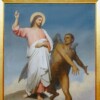
All of us are aware of Jesus’s interaction with a person who has come to be known simply as the rich young ruler. In Mark’s account, Jesus is approached by a man who asks what he needs to do to inherit eternal life. Jesus responds by telling him to follow all of God’s commandments, to which he replies that he’s done so since he was a young boy. Lovingly, Jesus states, “Go, sell everything you have and give to the poor, and you will have treasure in heaven” (10:21). Dejectedly, the man walks away. Why? Mark flatly summarizes, “because he had great wealth” (Mk. 10:22). Though I’ve preached and taught many times from this passage, I’ve always given myself a free pass since, clearly, I’m not wealthy. The reason I don’t feel wealthy is because I live in Orange County, CA, where the median house price is approximately $1.4 million, with upper-level houses starting at $5 million. Neither applies to me.
Yet, I recently had an experience that challenged my assumption. I decided to share my struggle with my students.
I had informed them at the start of the semester that class would be canceled for one week due to a once-in-a-lifetime speaking opportunity. My wife and I had been invited to speak on marriage during a seven-day cruise for Christian couples. We’d never been on a cruise and gladly accepted. “We humbly go where the Lord sends,” I said to my students with a sheepish smile. It was everything we imagined—great Christian teaching, all-you-can-eat buffets, concerts, and docking at exotic ports. One treat was having breakfast delivered to our cabin each morning, so we could enjoy the sights and food from our balcony—again, we are His humble servants.
One morning, while having breakfast, we pulled into a dock in Honduras. As I was enjoying my coffee, the Spirit showed up in an unexpected way. I felt a strong prompting to do a quick Google search on the economic status of Honduras. What I found was sobering. Honduras is one of the poorest nations—behind Haiti—in the Western Hemisphere. Roughly 63% of Hondurans (10.6 million) live in poverty, while over a quarter live in extreme poverty. From the viewpoint of our balcony, evidence of poverty was obvious. In that moment, it occurred to me that I just might be the rich young ruler. No, not in terms of affluent Orange County, but in terms of global wealth.
My Google search revealed a website that asked a haunting question: How Rich Am I? To answer, I put in the combined income (post-tax) of my wife and I and waited for an answer. Keep in mind, we both work at a private Christian university that—like many sister schools—has had to tighten the economic belt in recent years. Many of you reading this can relate. The Result: My wife and I are richer than 98% of the world’s population, which is 22x more than the average person in the world.1
“What do I do with that result?” I asked my students. “Should we have declined the invitation to speak on the cruise?” Based on post-cruise surveys, many couples reported that their marriages were strengthened. There were even some who said the cruise saved their marriage, and divorce was now off the table. Students offered varying responses. Some suggested that instead of going on an excursion, perhaps the cruise could offer one-day service projects to the community or take a portion of the proceeds and give them to local Christian charities.2
I thanked them for their thoughts but probed deeper. “What should I do now, knowing that in the global community I am rich? What changes should I make, considering the average Honduran makes $16 a day, with those in poverty living off less than $1.90 a day? I confessed to them that this was something I needed to sit with the Spirit and seek out his leading. One student chimed in, “I think we have it pretty good.” Many students nodded.
I wasn’t done sweating. [To Be Continued]
- The website explains how this calculation is achieved: “We standardize incomes to account for cost of living differences using 2021 international dollars (based on the most recent International Comparison Program data). We adjust for inflation since 2021 and household size, so the results reflect your estimated global position in 2024 — the latest year for which World Bank Data are available.” ↩︎
- We later learned that the ministry that runs the marriage cruise test-piloted a service project for certain ports and had an encouraging response. They have plans to expand this option on future cruises. ↩︎