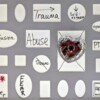
As I mentioned in yesterday’s post, a cruise where we docked at a port in Honduras made me question whether I was the rich young ruler. The day after the Honduras docking, my wife and I were invited to take part in a creative experience designed to help us understand today’s persecuted church. The organizers had converted a seldom-used cruise room to simulate what an underground church service would feel like for those around the world where following Jesus is not safe.
In advance, we were told not to bring a Bible or anything that could indicate we were Christians in case a raid happened. At an unmarked door, we had to use a special knock and show them something nondescript. For us, a red yard string. We walked down three flights of stairs and were ushered into a room. Hymns were sung in a whisper from memory, and the teacher shared from Hebrews 10 with no notes. His question: “What is your breaking point in following Christ? What cost would be too much?” The writer of Hebrews reminds readers that many of them “were publicly exposed to insult and persecution” and other times “joyfully accepted the confiscation of your property.” Why did they endure? They knew they had “better and lasting possessions” in heaven (Heb. 10:33-34). Just as the teacher was finishing, a person ran into the room, alerting us that we’d been discovered and we needed to leave—quickly and quietly.
I told students that although it was just a simulation, my wife and I found it hard to shake. It was difficult not to think about all that we—American Christians protected by religious freedom—take for granted. How many Bibles do we have in the Muehlhoff household? If all electronic and print Bibles were suddenly dangerous to have, how much could I reproduce by memory? How often do I even think of the persecuted church abroad? Do I take the writer of Hebrews’ admonishment seriously to “continue to remember those in prison” and imagine their pain as our own (Heb. 13:3)?
I asked students for any final observations. I laughed when a student said, “Don’t go on a cruise!” We ended our conversation by praying for both those living in poverty and the persecuted church as we headed for the lesson plan of the day.
Cautions in Letting Students See You Sweat
Each professor or educator must determine how much to share with students on a personal level. Some of this might be personality-driven, but if we do share, here are some things I’ve learned along the way.
Don’t overshare. There is a fine line between being authentic and inappropriate. I suspect this will be class-specific. What I share with seniors is different from what I process with first-year students. Some struggles should not be shared with either, but only with our closest friends. We see such discernment when Asaph shares how he nearly lost a foothold on his faith in Jehovah’s goodness (Ps. 73:2). Why? He has “envied the arrogant” when seeing how their evil does not produce judgment, but rather, blessings upon blessings (Ps. 73:4-5). Yet, he refrains from giving full vent to his disillusionment for fear of how it would impact others—especially a younger audience: “If I had spoken out like that, I would have betrayed your children” (Ps. 73:15). We need to understand how much our sharing of struggles can impact a room of emerging adults and their burgeoning faith.
Take a breath. There is a danger of sharing thoughts while they are too fresh. Don’t process with students in real time. Your students are not your spiritual director or pastor. Before I shared observations from the cruise with my students, I bounced my ideas off my wife and a fellow faculty member during a walk. They offered some important suggestions on how to package my spiritual wrestling without overwhelming my students.
Make it about you, not them. Processing what I should do, considering global wealth and the persecuted church, is different from laying a guilt trip on students. Without saying it, my students fully understand the implications attending an elite private Christian university has on their own position on the global rich list. They were invited to the same introspection I was going through post-cruise without directly saying it.
Overall, students have been appreciative of my opening up about my own faith journey. After sharing about my cruise experience, some students hung around after class and told me that hearing from faculty about the ups and downs of faith is why they came to a Christian university. “It makes you seem more real and relatable,” chimed in one student.
Jesus’s Let’s Us See Him Sweat
We should be glad Jesus didn’t adopt a don’t let them see you sweat posture. Luke records a shocking scene where Jesus, in agony, pleads with God. We learn that as he prayed, “his sweat was like drops of blood falling to the ground” (22:44). This depiction of Jesus was used against the early church by critics who claimed the coming Messiah would never be so weak in front of others. Jesus disagrees. Letting us see him sweat was a sign of authenticity, not stoicism. Should we not equally allow such authenticity and struggle—when appropriate—into our classroom?