

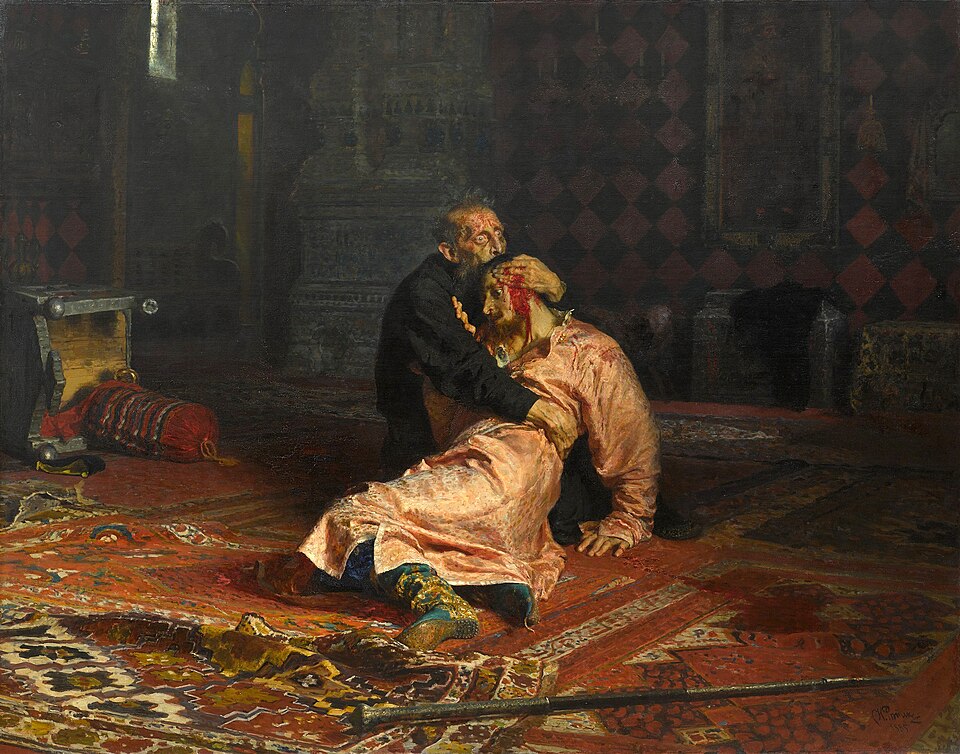
From Ivan the Terrible, to Suleiman the Magnificent, to Logan Roy on HBO’s “Succession,” are powerful fathers doomed to crush their children? And are “paternal” leaders (like “Papa Joe,” Joseph Stalin) all too likely to sacrifice and exploit the people they’re supposed to protect?
In my Art History classes, one image that reliably provokes discussion of this topic is Francisco Goya’s parable in paint, Saturn Devouring His Son (see below).
Francisco Goya, Saturn Devouring his Son, 1820
Ostensibly a scene from Greco-Roman myth, this image shows the gigantic, misshapen Saturn (a Titan) eating the remnants of one of his divine children. In Goya’s rendering, Saturn’s head is maned like a lion, and his eyes are wide with bestial frenzy and astonishment. His victim, meanwhile, is beautifully proportioned, though faceless and desecrated. One gets the sense, here, that a grave ontological error – a blasphemy – has been committed. The wickeder, lesser thing (albeit larger) has devoured the purer and greater. And it has done this (the myth affirms) out of craven fear for its own survival.
I mentioned that Goya’s image is a parable, and not just a mythological illustration. Here’s why. During his lifetime, Goya witnessed numerous injustices and atrocities committed by the powerful against the ordinary people they were supposed to be protecting. The most disturbing examples can be found in the artist’s print series titled “The Horrors of War,” where innocents are slain, and bodies are hung ominously from craggy trees. Goya’s Saturn, in this context, is not just a mythical Titan – he is a personification of corrupt, selfish, inward-turning power. In early 1800s Europe, as the first waves of democratic revolution collapsed in on themselves and devolved into cannibalistic paranoia, Goya bore witness to a pattern as old as time – as old, perhaps, as the heavens themselves.
Goya’s Saturn, indeed, is everywhere, and he still lives among us today. I believe he is inside of all of us, insofar as we all have the capacity to abuse power. (Often; the only thing stopping us is a lack of opportunity!) We can justify the abuse of power in so many ways: a need to acquire or conserve resources, a need to preempt attack, or simply an entitlement to take what we “deserve.” When framed in the right way, almost any exploitative action can seem justified.
But the Christian myth – the Christian story – offers a different paradigm. Among the ancient gods, fathers were indeed threatened by their own children and then moved to destroy them. (This was true across cultures, all over the world, from the Roman Saturn to the Nordic Ymir to the Aztec Mixcoatl). Equally often, divine children schemed against their fathers in order to preempt paternal aggression – or simply seize their place in the sun.
In the Christian story, however, the Son of God willingly leaves his father’s house to sacrificially rescue his father’s lost people! In response, the gentle Father raises up his fallen son and “places heaven and earth at his feet!” What ancient gods would have done these things? What ancient deity was so submissive, impractical, self-emptying, recklessly generous? How inconceivable the Christian story must have felt in a pagan world soaked in the cannibalistic patterns of ancient myth (not to mention the Machiavellian scheming of real people). How eye-opening, shocking, offensive, and ultimately inspiring!
In recent years, our culture has grown poignantly aware of a phenomenon we call “toxic masculinity,” characterized by entitlement, aggression, anger, and pride. We have also found it helpful, sometimes, to un-gender God, in efforts to both rehabilitate the divine image and stress the notion that every person (regardless of gender) is made in God’s likeness.
But I am struck, today, by the way in which the Christian paradigm, at its very origin, transformed the highly gendered (and loaded) notion of Father and Son in the ancient world. In the Christian paradigm, the father/son relationship was no longer a zero-sum scramble for power, a flight from the obsolescence of age, or an Oedipal competition for self-propagation. In the Christian Father and Son, there was – there is – humility, admiration, self-emptying, gift. Indeed, there is a constant yielding one to the other that swirls, builds, and vibrates with overflowing life. Though this beautiful ideal has shone before us for two millennia, we still haven’t fully absorbed it and learned to emulate it or celebrate it properly.
Perhaps many more generations will pass before we learn what real Fatherhood and Sonhood mean, as shown in the life of Jesus. Meanwhile, like Saturn, we, too, devour the divine Son – sometimes in our cruelty, yes. (For what we do to the “least of these,” we also do to Him). But other times, we “devour” Him in the bread and wine of humble Communion, that we may become like Him, in the end.
























Katie, thank you for always causing me to think in fresh ways. As a father of three adult sons, I was struck when you wrote: “In the Christian paradigm, the father/son relationship was no longer a zero-sum scramble for power, a flight from the obsolescence of age, or an Oedipal competition for self-propagation. In the Christian Father and Son, there was – there is – humility, admiration, self-emptying, gift.”
Praise God, we–through modeling God the Father and God the Son–can turn toxic masculinity into relationship with our sons marked by humility, admiration, and self-emptying:)
Katie – I don’t know if you’re still reading comments here… the article is now almost a month ago. As usual I find your reflections here so refreshing–wonderfully free from jargon, from insider language (insider to both the art world and the Christian subculture, such as it is). That said, here’s a question/observation to consider: at the end of your article you suddenly bring up the Eucharist–without context apart from the discussion above about pagan myth and paternal cannibalism and its contrast with biblical fatherhood/sonship. We all know that this pattern of struggle between fathers and sons, mothers and daughters exists and is always with us. It seems so predictable. But what does the Eucharist do to this? How does the invitation to participation in divine cannibalism affect this perpetual problem? It would be illuminating to consider what this invitation to consume the the body and blood of Christ actually accomplishes in this context…