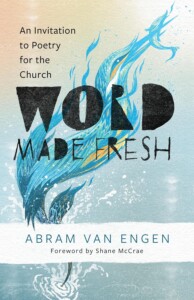
Word Made Fresh: An Invitation to Poetry for the Church
If poetry is ever going to matter again to Christians, we’ll need interesting, winsome, accessible teachers and books to explain the value of verse and show us how it works. One doesn’t naturally “develop a taste” for poetry. We must be taught. Abram Van Engen’s Word Made Fresh can refresh our palate and nourish our taste for poetry.
Van Engen argues that poetry gives us words to experience what we often cannot express. Poetry names things and experiences we struggle to explain or define. Van Engen insists, “Poems broaden, deepen, enable, enliven, challenge, change, and enrich. They do all this for the writer in the process of writing, but ultimately, they aim at a reader who responds. Poetry is not for the poet. Poetry is for you” (5).
That notion might come as a surprise to many readers, especially students who are busy preparing for a place in the economy. Or faculty members who already feel as if they don’t have time to read or assign anything beyond their discipline. Or theologians, for whom poetry may seem a quaint pastime, or even a frivolity. But Van Engen shows us why poetry matters in his careful, delightful, and sometimes surprising expositions of poem after poem.
Word Made Fresh is divided into an introduction and three parts. In his introduction Van Engen leads us into poems by Kay Ryan, June Jordan, Richard Wilbur, and Christian Wiman. As he unpacks the use of theme, form, rhyme, and other poetic devices, we begin to see what he means by saying that poetry is for us.
Van Engen reminds us that God loves poetry, and he turns to Wilbur to show us how we can learn to love it as well. His superb unpacking of Wilbur’s “Praise in Summer” demonstrates some of the surprising ways poetry can not only delight but also instruct us. By the time his pages-long exposition is finished, and Van Engen concludes, “Poetry makes language work in ways that wake us up to the world God made” (13), we believe it. The Wilbur serving readies us for the larger feast to follow.
In part one, Van Engen shows us how to read and benefit from poetry. We must read it personally, as if the poem intended to address some aspect of our lives or experience: “Our response to a poem involves whatever our own lives have brought to it—the memories, associations, experiences, loves, desires, hopes, and worries we hold. There is far more to a poem than a personal response, but never less” (23).
At the same time, reading for pleasure, asking questions of a poem, thinking of a poem like a friend to get to know and spend more time with, learning how poetic form works, and practicing “erasing exercises” can unlock what for many readers is the mystery of verse and allow poetry to enlarge and enhance our experience of the world. He summarizes part one, “Read at your leisure. Read for pleasure. Read personally. Read for the challenge of it, if you like. Read to be challenged when you can. And at any time, when you feel the urge to swim out and explore the depths of a poem you love, erasure [isolating nouns or verbs or thoughts] can aid you as you take the plunge” (153–54).
In part two Van Engen explains why we should partake of more poetry. First, because it helps us to name things and experiences, thus enabling us to fulfill one of God’s first assignments. This is important because “the art of naming discovers new knowledge. It completes creation partly by revealing it” (162). Van Engen heaps on the secret sauce in part two, showing by many delightful examples why we should savor more of verse.
Poetry can also help us in understanding and conveying truth. His exposition of Emily Dickinson’s “Tell all the truth but tell it slant” is as much a delight to read as the poem itself: “Dickinson hangs her discussion of truth between the secular and the religious: something lighthearted, something serious. She winks as she talks of deepest things” (181). Van Engen shows how poetry can cultivate understanding through experience, the experience that comes to us from reading a poem. By telling truth “slant,” poetry makes us think and helps us delight in and firm up our convictions about truth.
In two chapters, Van Engen shows us how poetry works to help us rejoice with those who rejoice and weep with those who weep. That is, poetry awakens certain affections we might not normally experience, or experience as fully as we might, like a new food can enliven a sleeping sector of our palate. Importantly, poetry can lead us into the experience of true joy: “Joy often has a strange quality of feeling like an inbreaking of the eternal, as though a gap opens through one element of the day and time itself becomes suspended” (220). When carefully read, poetry’s many devices and tools widen that gap into a brighter experience of joy. But it can also help us explore the depths of sympathy and sorrow, as Van Engen shows most effectively in his exposition of poems by Anne Bradstreet, Ben Jonson, Anna Akhmatova, and Jane Kenyon. While poetry can be a kind of comfort food in times of sorrow, that’s not primarily how it works. Poets are at their most flavorful when they “create jangle and discord in order not to soothe but to seethe” (270).
Throughout, Van Engen supplies persuasive and enjoyable examples representing the argument of each chapter. His explanations of how poems work and why we should read them include great poets of the past—Donne, Herbert, Milton, Hopkins, Bradstreet, Wheatley, Dunbar—as well as more recent poets—MacLeish, Williams, Hughes, Wilbur, Levertov—and contemporary versifiers—Shaw, Cairns, Collins, Kenyon, Wiman. Most of the poets whose work he examines are Christians, so there’s much nourishment here to help us see and experience our world as the image-bearers of God. Van Engen teaches us to ask questions of poems—What are you about? How do you work? In what ways are we alike? In each exposition, he guides us in understanding the form of a poem and why form matters, since “form remains perhaps the most important element in the making of poetic effects. It creates and constitutes the physical container” (134).
Van Engen’s expositions also remind us that poetry has a long history within the Christian movement and has played an important role as part of a healthy literary diet for enjoyment, contemplation, and spiritual growth.
Poetry can show us life in action, as Van Engen explains in a coda, which leads into part three (though not actually delineated as such) of the book. To make this point, Van Engen serves up Hopkins’ poem, “As Kingfishers Catch Fire.” The poem helps us see the beauty of creation through the motions and manifestations of God’s life in the creatures He has made, especially mankind. For this reason, poetry can make us better people and better theologians. It can inform all aspects and disciplines of theological study to brighten and deepen them and bring out the flavor of theology and overcome a bad taste for theological fare some readers may have experienced. “But ideally,” Van Engen writes, “theology exists to be lived. Experience makes it real. And poems do that. They perform theology by enacting thoughts through the shape and sound of words, so that an idea and an experience become indistinguishable” (253). Poetry as dinner/theatre, sort of.
The other component of part three is “An Invitation and Discussion Guide” to help readers both in putting a group together and beginning to cultivate a taste for verse. This section also includes helpful “Questions for Discussion” which make Word Made Fresh an accessible and delightful menu option for readers from all walks of life and all kinds of interests. This section is a good source for assignments to fill a syllabus on the role of verse in Christian life.
For Christians, Van Engen’s is the best book I’ve read on reading and understanding poetry. It ranks with the best recent volumes on understanding verse, such as Brad Leithauser’s Rhyme’s Rooms: The Architecture of Poetry, and such perennial sources as Mary Oliver’s A Poetry Handbook.1 Poetry, Van Engen explains, has a timelessness about it, like bread and wine: It has satisfied the tastes of believers in every generation. This book is adaptable for many uses. General readers will find it fascinating and enjoyable. Students will learn to be better readers for all their studies. Professors and theologians can find new ways to support and express their interests in verse from Van Engen’s many excellent examples. Readers of poetry will find Poetry Made Fresh a helpful guide for more and deeper reading of verse. And some of each of these groups might even be challenged to try their hand at cooking up a batch of verse to serve to their friends.