


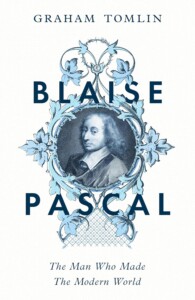
Blaise Pascal: The Man Who Made the Modern World
I am very grateful to Professor Douglas Groothuis for his generous and insightful review of my recent biography of Blaise Pascal. It is good to encounter a fellow scholar who has also found Pascal endlessly fascinating and instructive, and I am honoured to know that, with his long study and close knowledge of Pascal’s works, Groothuis found the book “wide-ranging, well-researched, gracefully written, and compelling.”
The best reviews are ones where you discover more about your own thinking, and about the topic which you have written. And this is one of those. Groothuis grasps clearly what the book was trying to do. In writing it, I wanted to tell Pascal’s story but to do so in a way that explained his ideas and significance for the modern world at the same time. Thus, the book proceeds chronologically but with each chapter drilling down into a particular aspect of Pascal’s life, work, or thought. Groothuis is a philosopher and I am a historical theologian, which may explain some of the differences of emphasis we bring to our reading of Pascal, but I have learnt much both from his own recent book, Beyond the Wager: The Christian Brilliance of Blaise Pascal,1 and from this review.
One issue where Groothuis and I do take slightly different approaches is on Pascal’s approach to reason and its capacity to enable us to know God. He draws attention to “the great strides made in natural theology—which often draw on discoveries in physics and biology—in the past fifty years given by philosophers such as Richard Swinburne, J. P. Moreland, William Lane Craig, and the Intelligent Design movement.” I am aware of this approach, yet he is right that I don’t draw attention to it in my treatment of Pascal.
The reason I don’t is that I am less confident that these arguments would have appealed to Pascal or convince the unbeliever. Arguments from design were common in seventeenth century apologetics but unlike many of his contemporaries, Pascal did not make much use of them, I think for several reasons.
First, Pascal made a sharp distinction between the physical and the metaphysical world, and the value of reason and evidence in each. He believed that scientific rationality was capable of understanding the physical world but not the realm of God. Because of the kind of being he is, God can only be grasped by the “heart,” which for Pascal was a kind of instinctive intuition, rather than reason. I think he was unimpressed by the argument from design as an apologetic device, at least in part because it has a tendency to suggest a God who is the end result of a logical sequence of argument, too much like the “God of the philosophers” than the God of Jesus Christ. As Pascal put it in one of the Pensées:
I marvel at the boldness with which these people presume to speak of God. In addressing their arguments to unbelievers, their first chapter is the proof of the existence of God from the works of nature. The enterprise would cause me no surprise if they were addressing their arguments to the faithful . . . but for those in whom this light has gone out and in whom we are trying to rekindle it, people deprived of faith and grace . . . to tell them they have only to look at the least thing around them and they will see in it God plainly revealed . . . this is giving them cause to think that the proofs of our religion are indeed feeble. This is not how Scripture speaks with its better knowledge of the things of God. On the contrary it says that God is a hidden God. . . . (L781)
This brings us to the second reason why Pascal avoids the argument from design. God refuses to be discoverable through the ingenuity of human reason and so Pascal emphasises the idea of the hiddenness of God. If there is a God, he argues, he must be a Dieu caché. God does not show himself obviously to us so that his existence is apparent to everybody without question. Even in the place where he reveals himself most fully, in the person of Jesus Christ, he remains hidden in the very flesh of Christ, so that it was perfectly possible to meet with Jesus in the first century in Palestine and entirely miss the fact that you were meeting God.
For Pascal, God hides himself for a reason: “He hides himself from those who test him, and he reveals himself to those who seek him” (L444). God’s hiddenness is a deliberate ploy so that only those who are genuinely open to a life-changing encounter with him will find him. Those who are casually interested, wanting to prove God by reason, so they tick the box of belief in God and then move on to other more interesting things, will not find him.
A third reason why I think Pascal does not use the argument from design is his radical Augustinianism. One of the advantages of exploring Pascal’s thought through the mode of a biography is that you realise how his thinking was shaped by the controversies of his time. In particular, Pascal’s relationship with the Augustinian theology of Jansenism is crucial to his spiritual and theological development.
Pascal’s Jansenist-influenced reading of St. Augustine convinced him that our longings were stronger than our logic. Concupiscence means that we no longer think straight. Groothuis is right that there are good reasons for believing in God, and Pascal also thinks there are. Pascal is just less convinced that we are capable of following the logic to that conclusion because our desires get in the way, particularly when it comes to theology and faith.
As I argue in the book and as Groothuis appreciates, the famous argument of the Wager is not an attempt to strong-arm someone into belief in God, but to uncover the real reasons for unbelief, which are moral and not rational. When it comes to knowing God, human sinfulness runs deep. So deep that our desire to resist the claims of God upon us twists our rational capacity, making us come up with all kinds of reasons why God does not exist, unless, that is, grace touches our heart. When divine grace does begin to stimulate a desire for God, then the “proofs” as Pascal calls them, come into play. At that point, Groothuis is right, there is a role for rational and apologetic arguments for God, but not before.
Despite our different emphases on Pascal’s approach to reason, I am delighted that we both consider Pascal an invaluable and wise guide, not just to the history of philosophy and theology, but to our own troubled times. We both find in him a searing vision, wise counsel, and perceptive insights into the human condition before God. I am grateful for Groothuis’s work on Pascal and my hope and prayer is that both his work and mine will bring Pascal’s thought to the attention of many in our modern world—a world to which Pascal has much to say.
[1]. Douglas Groothuis, Beyond the Wager: The Christian Brilliance of Blaise Pascal (IVP Academic, 2024).














Since according to Col. 1 God is the creator of everything “visible and invisible,” he is also the creator of the laws of proof. In that case whatever can be proven would thereby not be God. God is not a conclusion at the end of a chain of reasoning, God is the subject of an experience report. The intuitive grasp of the truth of the gospel is an experience which conforms exactly to the definition of self-evident truth. That’s why the “God of the philosophers” is not the “God of Abraham, Isaac, and Jacob.”
The entire tradition of trying to prove God’s reality has had the western intellectual world looking in the wrong place for centuries.
I explain all this in detail in Can We KNOW Good Is Real?
What a fresh breeze of the Holy Spirit, when one scholar differs somewhat from another, and does so in a loving way. Makes me want to read both books. Thank you Graham.