

The Fearless Christian University
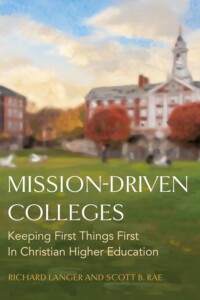
Mission-Driven Colleges: Keeping First Things First in Christian Higher Education

Academically Speaking: Lessons from a Life in Christian Higher Education
Common Themes and Tensions
All three books reviewed in the previous two posts present common themes, such as the need for missional alignment of faculty and administration and the reality of challenges in the current higher education landscape. Langer and Rae directly state “that mission fidelity is everyone’s business,” especially in hiring, and outline ways that faculty and administration need to drive mission (131). They provide practical guidance on identifying missional faculty candidates and emphasize professional development activities aimed at increasing faculty alignment and engagement with mission. Hawthorne dedicates an entire chapter to a discussion on faculty and administration alignment and suggests some practical tips for improving those relationships. They include inviting faculty to board retreats, training for trustees, guiding faculty to develop an institutional orientation rather than a disciplinary one, and transparency and timely communication with faculty when problems emerge (81). Ostrander, having served on both sides of the faculty-administration divide, would agree on the need for faculty and administration to be aligned. His experience at Cornerstone, where he personally delivered news of faculty eliminations and organized receptions for them, underscores the importance of transparency and humane leadership in difficult situations. Ostrander references another leader in Christian higher education, Chip Pollard, president of John Brown University, to whom he attributes the quote, “the higher you rise in an organization, the more important alignment with the institution becomes” (103). Ostrander acknowledges that “in the highly competitive market of private, faith-based higher education, controversy between constituents that goes public can be disastrous” (97). His own narrative demonstrates the complexities of navigating these relationships, particularly when institutional direction or external pressures create friction.
All three sets of authors acknowledge the challenges facing higher education at this moment, such as the “demographic cliff,” evolving perceptions of higher education’s value amidst increasing college costs, and factors that may specifically impact Christian higher education such as an increase in students with no religious affiliation. Hawthorne further describes the shift in values held by the traditional student population on issues such as race, injustice, poverty, and LGBTQ+ that can be cultural challenges for today’s Christian colleges. In acknowledgment, Hawthorne states that “managing even a healthy Christian university became far more challenging” (4). Ostrander provides several examples of these challenges through his lived experience at Cornerstone in which scarcity of resources was a constant reality.
Although the authors share a common understanding of the issues just mentioned, as well as others, the books include areas of tension around several themes and present different visions for a flourishing Christian institution. First is the tension between maintaining mission identity and “fearless” engagement of ideas. Then, in response to the reality of the brokenness of our culture, the necessary tension between cultural opposition and cultural participation. In addition, the authors maintain different perspectives for achieving student formation outcomes and visions for a flourishing institution.
Navigating Mission and Identity: Fidelity and Fearless Engagement
History has shown that Christian colleges can and do experience “mission drift.” Thus, Christian colleges that are driven by a commitment to their mission have good reason to be on guard for ideas that stand in opposition to it. At the same time, Christian higher education institutions have a responsibility to engage the diversity of ideas that currently exist in today’s world so that our students are prepared to courageously work and serve in that world. This tension between mission fidelity and fearless engagement is reflected in all three books.
Langer and Rae provide a strong framework for proactive mission fidelity, emphasizing clear doctrinal foundations and intentional implementation as safeguards against mission drift. Their work underscores the necessity of a robust, actionable mission that truly shapes institutional decisions. In tension, Hawthorne challenges that a pervasive fear of mission drift can cripple institutions, leading to an overemphasis on “protecting the brand” rather than engaging courageously with the world. He advocates for centering the academic enterprise on student experience, daring to consider more expansive views on inclusion and engagement, even if it challenges traditional boundaries. Ostrander’s personal journey illustrates this tension; his career reflects a continuous grappling with institutional identity and his role in mission fulfillment. He acknowledges the tension between academic focus and mission drift for academic leaders and speaks of the “two voices whispering in their ears—one encouraging them toward greater intellectual respectability, the other warning of creeping liberalism” (64).
Cultural Engagement: Opposition, Participation or Faithful Presence?
In the book, Visions of Vocation: Common Grace for the Common Good, Steve Garber, an alumnus of my current institution, explores the tension between “how to know the world and still love it.”1 That tension is reflected in these three books as the authors present their understanding of how a Christian institution of higher education should best engage culture. Should they prepare students to be cultural warriors, set out to transform culture? Or should they prepare students to be a “faithful presence” as proposed by Hunter?
Both Hawthorne and Langer and Rae speak against a cultural critique model for education, that is, an education that is only limited to critically examining modern culture and speaking against those aspects that are not pleasing to God. Both sets of authors advocate instead for an emphasis on cultural engagement that leads to culture-making. Hawthorne takes a clear stand against the cultural opposition approach, stating that “the faithful Christian university avoids culture wars and opts instead for faithful presence” (56). Langer and Rae contend that “when critiquing becomes the essential mark of a Christian identity, one is failing at the task of Christian higher education” (43). They further lament that Christians are known by what they oppose rather than for their vision of what should be.
Langer and Rae implicitly advocate for a “cultural participation model,” while recognizing the boundary conditions required to be consistent with foundational doctrinal positions. These boundaries, they emphasize, should be clearly communicated to the academic community. Hawthorne talks little of doctrinal distinctives and theological commitments and would, I believe, see many of the limits endorsed by Langer and Rae to be evidence of fear and defensiveness. At the same time, I believe that many of the examples that Hawthorne provides as a fearful response would be interpreted by Langer and Rae as legitimate limits necessary to avoid mission drift (e.g., Hawthorne’s criticism of Wheaton for taking “draconian action” against a professor for saying that Muslims and Christians worshiped the same God or his criticism of a university that restricted the use of pronouns in email signatures) (71).
Hawthorne posits that addressing contemporary social issues is not merely optional, but essential for preparing students for a post-Christian society. Ostrander’s personal experience, particularly at the University of Michigan, was living out a cultural participation model when he recognized that “non-Christians can excel at ‘culture making’” (28). In his later experience in Christian higher education, he speaks of the profound challenges and personal struggles involved in navigating engagement on issues of origins and human sexuality. The tension for us, then, is discerning how to maintain our Christian convictions and distinctives while fostering genuine dialogue on the cultural issues that our students need to confidently address as they seek to be a redemptive presence in the world.
Student Formation: Biblical Worldview or Experiential Journey?
All three authors prioritize student formation, but their approaches differ significantly. Langer and Rae advocate for an intentional, curriculum-driven approach aimed at forming “genuine and committed disciples of Christ,” as exemplified by extensive Bible requirements and specific Christian formation outcomes (154). Hawthorne, conversely, critiques the traditional Christian worldview pedagogy, arguing that it is insufficient for students grappling with deconstruction. He advocates that, “rather than try to keep student learning constrained by a Christian worldview, with its antagonism toward the surrounding culture, we instead prepare students for how to thrive in that culture as an act of faith” (44). To that end, Hawthorne proposes a more student-centered learning model that builds from a student’s lived experiences with little mention of the need to build from a scriptural foundation.
Ostrander, through his own intellectual and spiritual journey, underscores the profound impact of individual faculty in mentoring students and the importance of allowing students to wrestle with ideas authentically. He ultimately suggests that the deepest formation happens in genuine community, where students can be truly known. These three books reflect the ongoing challenge that our institutions face of providing strong theological grounding while preparing students to navigate complex ideas with intellectual humility and spiritual resilience. Ostrander himself professes to an appreciation of theological grounding in a Reformed vision of education and confesses that “there seems to be something in the ‘transformationalist’ vision of Reformed Christianity and its emphasis on Christ’s lordship over every aspect of creation that fosters rigorous and consciously Christian scholarship” (55).
A Vision for Flourishing
Each of these authors presents a different vision for a flourishing Christian higher education institution. For Langer and Rae, a college flourishes when all members of the academic community, driven by mission, focus on mission fidelity and model an educational experience characterized by cultural participation and Christian formation for students (106). Hawthorne believes that flourishing will manifest when a Christian university lives fearlessly. To become fearless, he emphasizes the institution’s need to center on the student experience, shift from fear-based culture-war activity, model transformational outcomes for students, and understand more deeply how the university differs from the church (69). In the epilogue of his book, Ostrander reflects on institutional flourishing, suggesting that the key to institutional flourishing is “not one single thing, but a variety of features united by the common theme of providing students, faculty, and staff with the ability to be truly known” (172). He argues that the core value of Christian higher education institutions lies in “their ability to provide students not just with what students think they’re looking for—preparation for a successful career—but with what we as Christians know they’re really looking for: authentic community” (170). Ostrander describes a flourishing institution as one that possesses faculty committed to engaging with and mentoring students, dedicated to student formation. Such institutions are focused on cultivating healthy communities rather than focusing solely on achievement and outward success and, thus, are growing in faithfulness to their calling (178).
The visions of flourishing institutions offered by Ostrander, Hawthorne, and Langer and Rae highlight the need to balance unwavering commitment to foundational identity with courageous engagement in the modern world. A flourishing Christian university integrates faith and learning, holistically forming students—intellectually, spiritually, and socially—through robust academics, vibrant Christian community, and dedicated, missionally aligned faculty mentors. I believe that the future for Christian higher education lies not in choosing between fidelity and fearlessness, but in courageously embodying both, recognizing that true faithfulness to mission often necessitates the greatest courage in engagement.