
The Fearless Christian University
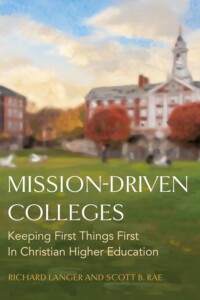
Mission-Driven Colleges: Keeping First Things First in Christian Higher Education
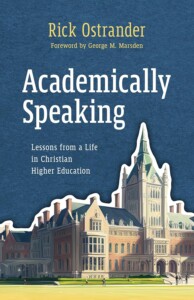
Academically Speaking: Lessons from a Life in Christian Higher Education
The Fearless Christian University
In this book, John Hawthorne is advocating for a fearless Christian university, which he defines as “an institution that understands its role in the higher education landscape, can articulate that position in meaningful ways, organize its people and programs in support of that mission, and become a laboratory for how people of faith engage the broader culture” (3). His central message is that fear of mission drift, public relations crises, demographic change, and culture wars prevent institutions from embracing their identity as academic institutions (xi). Hawthorne’s primary audience is those actively engaged in the work of Christian higher education.
As a sociologist with nearly four decades of experience in Christian higher education, John Hawthorne has served as both a faculty member and an academic administrator at five different Christian institutions: Olivet Nazarene (as a faculty member), Sterling College (as a vice president for nontraditional programs), Warner Pacific (as chief academic officer), Point Loma Nazarene (as provost) and Spring Arbor (as a faculty member). Hawthorne retired in 2020 and confesses that it would have been difficult to write this book if he were still employed at a Christian university as it likely would have resulted in what he describes as a “We just want to make sure you’re still on board with our mission” conversation (xi). In nine chapters and 164 pages, Hawthorne attempts to reimagine what Christian institutions might be able to accomplish if they were not so afraid.
Hawthorne begins by discussing “The Limits of Fear,” diving into the internal and external factors that contribute to this fear. He submits that “the heart of the distinction between Christian universities and secular schools is the fear of students losing their way” (11). This fear, he posits, can lead university leaders to “operate far too often out of a concern that a boundary will inadvertently be crossed, and as a result, that their institution’s reputation will be damaged, donations will dry up, and the school will be characterized as ‘going liberal’” (2). He argues that the “former oppositional stance” of Christian higher education is “no longer tenable” given a variety of internal and external shifts (3). These internal changes include faculty identity that has shifted from mission-focused to discipline-focused, disconnection of administrators from faculty resulting in faculty unaware of institutional direction, demographic pressures, increasing college costs and competition, a decline in denominational identity, and changing values of the traditional student population (e.g., perspectives towards race, injustice, poverty, and LGBTQ+). External factors include the reality of living in a social media world (with brand at risk), the changing religious landscape in America (a.k.a. the rise of the “nones”), political alignments which may alienate segments of Americans, and the general questioning of college’s value. Hawthorne proposes a new model where the educational process is central, while Christian identity is “a key component of the pedagogical mission” (14). Per Hawthorne, “a fearless approach emboldens faculty and students to engage ideas that seem foreign to the Christian worldview—not to dismiss them but first to understand them before any response is offered” (14). He specifically mentions that sensitive issues like evolution, race, LGBTQ+ rights, gender, and politics could be “managed by foregrounding the pedagogical commitments to pursue truth amid complexity” (15).
In “Reimagining the Christian University Mission,” Hawthorne examines the concept of university mission, noting the need for such statements to emphasize teaching and learning. He identified ten key themes (e.g., academic excellence, Christian community, faith and learning integration, denominational identity) from thirty mission statements of member institutions of the Council for Christian Colleges & Universities (CCCU). After this review, he concluded that university mission statements often reflect the tensions at play within institutions. He states:
Academic priorities lead in one direction, while denominational commitments or methods of biblical interpretation might lead in another. The focus on internal community and the development of faith and character can be hard to reconcile with engaging and affecting the broader culture. . . . The integration of faith and learning can lead to unsettling conclusions that denominational leaders might disagree with. (32)
Hawthorne advocates for centering teaching and learning at the heart of the fearless Christian university mission, shifting focus from protecting the institutional brand to emphasize what is happening with the students (24, 29).
The chapter “Preparing Students for the Future” challenges the conventional notion of teaching a Christian worldview, arguing that it often reflects a “distrust of the broader intellectual world” (33). Instead, he proposes an alternative pedagogy that “builds from the students’ experience, coursework, career dreams, and faith toward a coherent whole” (35). This pedagogy, Hawthorne describes, “should focus on preparing students for the ongoing and future challenges of deconstruction as opposed to maintaining institutionally defined worldviews” (40). Although other authors might define “deconstruction” differently, Hawthorne specifically defines deconstruction as “the process of dismantling one’s prior weaker cognitive framework in order to build a more robust one that reflects a true subjective understanding of faith and learning” (39).1
“On Not Fighting Culture Wars” addresses the tendency of Christian universities to engage in “culture wars.” Hawthorne is critical of institutions that litigate against government policies, citing the College of the Ozarks’ lawsuit against the Biden administration as an example of fear driving Christian higher education’s “default assumption that the government is taking an antagonistic stance” (47). Instead, he advocates for James Davison Hunter’s concept of “faithful presence” and emphasizes “culture making, not culture wars.”2 This shift, Hawthorne argues, requires a “stance of partnership with the broader culture rather than the previous oppositional identity” (59).
In “Faculty and Administration in Partnership,” Hawthorne focuses on improving relationships between administrators, trustees, and faculty with a goal to forge relationships and understanding such that the faculty scholar becomes, for the administrator, one to be defended rather than a challenge to be addressed (68). He critiques three “misleading analogies” for Christian liberal arts universities—college as church, college as factory, and college as store—which he argues can lead to administrators viewing faculty as “operational units to be managed” or reacting quickly to complaints to protect the brand (66). Instead, he proposes an analogy as the Christian university as “laboratory,” where contemporary issues are explored within the context of the university’s faith commitments (78).
The chapter “Expanding the Christian University Market” tackles the challenges of enrollment due to the “demographic cliff” and decreasing evangelical student populations. In response, Hawthorne argues that Christian institutions should reach out to students that have not traditionally been primary targets in the recruiting pool. He suggests that Generation Z, or “Zoomers,” despite their limited religious commitments, may be more aligned with the mission of Christian universities due to their strong sense of morality and interest in spiritual community (96–97). To broaden the recruitment pool, he recommends dropping faith requirements for student admission, being more open to key political and social issues, attracting and retaining students of color, and finding hospitality for LGBTQ+ students.
“Listening to the New Generation” emphasizes the need for administrators and trustees to engage with students as they are, acknowledging the increasing prevalence of issues like family discord, sexual abuse, physical and mental illness, and non-traditional sexual orientation and gender identity. He recommends that institutions accept that today’s students are not going to be the idealized versions of Christian college students that are often highlighted in our marketing materials. He posits that “being a supportive community is not only central to the institutional ethos but potentially a way to enhance the school’s financial strength” (111).
“The Christian University as a Mission Outpost” reframes the relationship between the Christian university and the church. Hawthorne contends that colleges should stop viewing themselves as a “Church” and instead as a “mission outpost” concerned with “the common good and not simply boundary maintenance” (123). This requires administrators and trustees to articulate this vision of “faithful presence” to external stakeholders and empower faculty and staff to address contemporary issues proactively. The defining motif of a fearless Christian university, he concludes, should recognize fear but act with courage (125).
A concluding section, “Envisioning the Fearless Christian University,” provides a fictional account of a fearless Christian university (Bartlett University). This university features a diverse student body that embraces students of color and welcomes LGBTQ+ individuals while maintaining institutional policies against premarital sex. The institution is led by a president who defends the college’s responsibility to engage questions the church is unable or unwilling to raise.
Academically Speaking: Lessons from a Life in Christian Higher Education
Rick Ostrander’s Academically Speaking: Lessons from a Life in Christian Higher Education presents a deeply personal and reflective “case study” of an American Christian as he strives to live out his faith with both heart and mind. He recognizes that what began as a “how-to manual on academic administration” transformed into his autobiography, his attempt to “make sense” of his life so far, and “live forward more wisely” (xi, xiii). Ostrander, who has served in various leadership roles at institutions like John Brown University, Cornerstone University, Westmont College, and the CCCU, currently serves as the Executive Director of the Michigan Christian Study Center. In Academically Speaking, Ostrander narrates his “personal odyssey” through the world of Christian higher education. Published as eight chapters and 216 pages, the book’s target audience is current or prospective Christian higher education professionals and “Christians attempting to love God with both heart and mind and faithfully live out their particular calling” (xii). The book is structured around Ostrander’s experiences at different types of institutions, offering insights gleaned from each. He recounts his undergraduate years at Moody Bible Institute in “Bible College Beginnings,” and credits Moody with a quality education through its “alternative, countercultural, residential community” where he was exposed to different perspectives and came in contact with professors who “asked good questions, modeled humble curiosity, and prodded [him] in the direction of a deeper, more nuanced Christian faith” (19).
“Academic Awakening” details his time at the University of Michigan, a public university that transitioned from Protestant origins to a secular and socially progressive institution. Despite this, Ostrander personally experienced little anti-Christian hostility and learned that “non-Christians can excel at ‘culture making’ . . . that expresses the goodness of creation” (28). Through his own experience, he identifies the profound impact teachers have on students and emphasizes the importance of taking responsibility for one’s learning, the intellectual virtue of empathy, the value of critical thinking, and the need to develop a love for ideas. While sharing these positive reflections of his time at the University of Michigan, he also confesses that his academic life was “largely separate” from his Christian faith during this period (33).
In “A Community of Scholars,” Ostrander describes his graduate studies at the University of Notre Dame, a Catholic university with a reputation for being hospitable to evangelical scholars. Here, he sought to make sense of his faith by exploring the history of American evangelicalism. Influenced by George Marsden and the Reformed tradition, he learned that scholarly excellence need not exist at the expense of spiritual devotion and developed a strong appreciation for the approach to integrating Christian faith and scholarship that emerges from Reformed Protestantism, particularly its creation-fall-redemption paradigm and emphasis on Christ’s lordship (55).
“Loosening the Bible Belt” recounts his experience at John Brown University (JBU), an evangelical university with fundamentalist origins. He describes JBU as a “test case in the ability of evangelical higher education to overcome the ‘scandal’ of anti-intellectualism” (67). While a faculty member at JBU, he was introduced to the topic of faith integration in teaching through a CCCU workshop, a concept that would assume growing importance in his career (73). After six years as a faculty member at JBU, Ostrander served another six years as an academic dean. As dean, he recounts experiencing criticism regarding his book on JBU history, particularly his description of JBU’s history with race relations, as well as concern with his emphasis on the liberal arts (85).
In “Academic Leadership,” Ostrander details his time as Provost at Cornerstone University, an institution of Christian higher education in the highly competitive market of Grand Rapids, Michigan. During this period, he faced the difficult task of eliminating faculty positions due to a scarcity of resources, a process he was committed to manage with transparency and respect. It was during this time that Ostrander experienced a deeply personal challenge when his son came out as gay, prompting him to question how to respond as both a father and a provost at an evangelical Christian university. Ostrander found himself learning to “live in microcosm the life of a Christian college—to affirm traditional values but also to maintain that relationship supersedes theology” (102). After six years as Provost, he moved from Cornerstone to the CCCU when the opportunity to serve as a vice-president in that organization was presented. Ostrander cited a variety of reasons for making the move, most of which could be attributed to a desire to ensure that he and Cornerstone shared a common vision and mission.
“Plot Twist” described Ostrander’s time with the CCCU as a vice president overseeing study abroad and professional development programs from 2009 to 2018. During this time, the CCCU was living through the controversial moments when some of its members began to take a less oppositional stance to homosexuality and the “Fairness For All” initiative was introduced. Eventually, Ostrander’s position at the CCCU was reassigned to a part-time role as vice president of research and scholarship that would later end.
In “Back in Business,” Ostrander describes the years post-CCCU that he spent cobbling together a variety of part-time ventures including academic consulting until he accepted a position at Westmont as assistant to the president for academic innovation and director of Westmont’s new downtown campus. In “The Long Way Home,” we are introduced to the concept of Christian study centers, organizations that aim to combine “the best of two educational worlds—the sense of Christian community and faith integration found at a Christian college, and the significant resources and cultural influence of a major university” (161). The title of this last chapter not only reflects the reality that Ostrander had returned to the state of Michigan, but also the sense that the author had identified a role that truly allowed him to live out his calling.
Footnotes
- For contrast, see Alisa Childers and Tim Barnett, The Deconstruction of Christianity: What It Is, Why It’s Destructive, and How to Respond (Tyndale House Publishers, 2024).
- James Davison Hunter, To Change the World: The Irony, Tragedy, and Possibility of Christianity in the Late Modern World (Oxford University Press, 2010).