
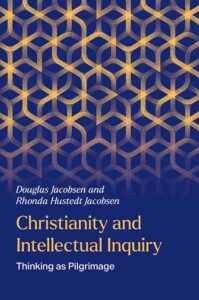
Christianity and Intellectual Inquiry: Thinking as Pilgrimage
We appreciate Professor Clair’s impassioned review of Christianity and Intellectual Inquiry: Thinking as Pilgrimage. At the beginning of his piece, he nicely summarizes the book, noting its historical awareness; its sensitivity to Orthodox, Catholic, Protestant, and Pentecostal perspectives; and its analysis of America’s evolving intellectual ecosystem. Clair identifies the notion of pilgrimage as a central theme (refracted through four pathways of intellectual journeying that we call attentiveness, contemplation, proclamation, and compassion), and he concludes that the book does “an extraordinary job of resisting the sacred and secular binary in American higher education.”
Bridging the sacred-secular binary in intellectual inquiry is indeed close to our hearts and central to this volume, and it has been a pivotal element in our own sense of vocation. We spent four decades teaching and learning within the Christian college world, first as students at Wheaton College and then as professors at Messiah University. During the past two decades we also visited hundreds of so-called “secular” institutions of higher learning, ranging from community colleges to R1 research universities and from small liberal arts colleges to America’s military academies, and we discovered that the sacred-secular divide in higher education is not as stark and impermeable as many presume.1 The core message of Christianity and Intellectual Inquiry is that scholars from both worlds can and should work together constructively.
After his opening paragraphs, Clair’s tone becomes more negative, and he says it is precisely our “noble aspiration to speak to a broader audience” that is problematic. Declaring our “natural readership” to be “evangelical institutions and thinkers,” Clair says the book should have had a different goal and purpose: developing “richer, more robustly Christ-centered accounts of the church-college relationship” that would help Christian schools articulate their unique educational calling and more clearly differentiate them from their secular competitors. Based on this redefinition of audience and purpose, Clair devotes the remainder of his review to describing the book he wishes we had written.
Clair is a scholar, and self-declared lover, of Augustine,2 so it is not surprising that he highlights Augustine as the key theorist of Christian higher education and bemoans what he describes as our glib “dismissal” of Augustine. However, we see our treatment of Augustine’s contributions as nuanced and fair, lauding the major role of his Confessions in the development of contemplative thinking but critiquing his advocacy of “terror, fear, and affliction” to coerce people in the ancient Roman Empire into professing proper Christian beliefs, a theo-political stance that cast a violent shadow over more than a thousand years of subsequent Western Christian history.
According to Clair, Christian thinkers and college professors should devote most of their energy to revising and updating “the tradition” of Christianity instead of focusing on scholarship more generally. There are two problems with this position. First, Christianity has never been a singular tradition. Faith in Jesus has always been handed down from generation to generation by different particular churches (in the plural) with their own emphases and interpretations. As the Christian movement becomes ever more global—two-thirds of the world’s Christians now live in Africa, Asia, and Latin America—the range of its diversity is expanding.
Second, updating and revising the Christian tradition is neither the aim of our book nor the primary task assigned to Christian scholars. Revising and updating the Christian faith is the task of churches (again, in the plural), and it involves all followers of Jesus, not just scholars. The two of us, as believers and church members, have at times participated in efforts to revise and update how faith is understood within our own Christian community,3 but the aim of this current book is more humble and far more specific: to provide language that enables scholars to work together more fruitfully with people of every sort without requiring anyone, including Christians, to set aside their religious or secular identities.
Clair’s review promotes and exemplifies proclamation, one of the four intellectual pathways described in Christianity and Intellectual Inquiry. Proclamation thinking develops arguments for interpreting reality in a specific way, which for Christians often means diving into theology and being explicit about one’s Christian convictions. We call this style of thinking “Christian scholarship,” and it has a critical role to play within the academy. It is not, however, the only way for Christians to live out their vocation as scholars. Many Christian scholars, including some of those who teach at evangelical colleges and universities, actively contribute to their fields of study without mentioning their own faith commitments. In contrast to producing “Christian scholarship,” they are “Christians doing scholarship.” They are intellectual pilgrims, trying to learn more, working with other scholars to improve and enlarge their own and humanity’s understanding of the world. This form of Christian intellectual activity is also valuable, and it can be as fully faith-infused and biblically resonant as any expression of “Christian scholarship.”
Clair worries that our notion of intellectual pilgrimage is “amorphous” and risks becoming “intellectual tourism—or worse, wasteland wandering.” He says that Christians need to know where they are going before embarking on their intellectual journeys. But that is not how intellectual inquiry works for anyone. Genuine intellectual inquiry, in contrast to apologetical argumentation, always entails the possibility of being surprised. As John Henry Newman, the great Catholic champion of higher education, once wrote, the road toward truth does not “always lie in the direction in which it terminates, nor are we able to see the end on starting.”4 Intellectual pilgrimage does not preclude anyone, including Christians, from leading lives of faith or from expressing their religious convictions, but it does require a willingness to consider new ideas and to think anew.
Arthur Holmes, the Wheaton philosopher who influenced Clair’s education as well as our own, would agree. Holmes said that the scholarly efforts of Christians, like those of everyone else, should be viewed as “exploratory rather than final.” Intellectual inquiry is “a human enterprise and bears the limitations of human thought,” and Christianity itself is “an open-ended tradition rather than a closed system.” He reminded Christian scholars that we “cannot dogmatize that one culture or one religion is all right and has all the truth. Rather, we must give meaning and purpose to the historical diversity within the Christian tradition, and to non-Christian religions and cultures.” Since Christian interpretations of the world are not error-proof, Christians should express their views “somewhat hypothetically and submit them to continual scrutiny.”5 Holmes’s vision of Christian intellectual pilgrimage is not at all amorphous nor does it wander in a wasteland. It is predicated on a confident belief in God’s providence and on a Bible-based recognition of human fallibility.
Holmes consistently reminded his students that “all truth is God’s truth, wherever it is found.” It is precisely this evangelical, Holmesian vision of the scholarly task that our book champions for use in the identity-oriented intellectual environment of contemporary America. The exemplars of academic work who represent our four pathways of pilgrimage thinking (Rachel Carson, Thomas Merton, James Cone, and Paul Farmer) are Americans who combined faith and learning to profoundly and positively shape their academic fields, even though none of them aimed at creating explicitly “Christian scholarship.” Their intellectual efforts functioned as salt and light in the academy as a whole and helped everyone, not just Christians, to see the world more accurately, more realistically, and ultimately more graciously.
The intellectual ethos of contemporary America is opening doors for fresh conversations about faith throughout the academic world. For Christians who are scholars, this new era of identity is not a time for retrenchment. Christ’s commandment to love God with our minds and to love and serve our neighbors as ourselves requires moving beyond the sectarianism of the familiar, choosing instead to seek truth, goodness, and beauty by working collegially alongside people of all faiths and identities. Christianity and Intellectual Inquiry offers a framework that increases the capacity of all scholars—whether biologists or poets, accountants or artists, nurses or philosophers—to recognize that faith intertwines with every aspect of their intellectual work. It conveys a message that should energize Christian scholars to participate in the broader academy with vigor and confidence. That confidence is not derived from a false sense of certitude but from believing that this is God’s world and that, by God’s grace, humans have the capacity to study and faithfully respond to both the grandeur and the present degradations of God’s creation.
Footnotes
- Our earlier reflections on faith, scholarship, and higher education can be found in Scholarship and Christian Faith: Enlarging the Conversation (Oxford University Press, 2004); The American University in a Postsecular Age (Oxford University Press, 2008); and No Longer Invisible: Religion in University Education (Oxford University Press, 2012).
- See, for example, Douglas Jacobsen and Rodney J. Sawatsky, Gracious Christianity: Living the Love We Profess (Baker Academic, 2006).
- See, for example, Douglas Jacobsen and Rodney J. Sawatsky, Gracious Christianity: Living the Love We Profess (Baker Academic, 2006).
- John Henry Newman, The Idea of a University (Yale University Press, 1996), 229.
- Arthur F. Holmes, Christian Philosophy in the Twentieth Century: An Essay in Philosophical Methodology (Craig, 1969), 4, 31, 222–226.