My wife and I recently returned from a visit to the Biltmore Estate in Asheville, North Carolina. George Vanderbilt, grandson of the famed shipping and railroad tycoon Cornelius Vanderbilt, envisioned and constructed his family’s palatial Southern Appalachian home in the late nineteenthcentury. Inspired by the Châteauesque architectural style of France and England, the 250-room Biltmore House remains today the largest private residence in the United States. Since the 1930s, the residence and its 8000-acre estate have been open to the public for their historic and cultural significance.1 For us, only a ninety-minute drive over the Blue Ridge Mountains, Biltmore is a picturesque getaway, especially when the grounds and home are decorated for Christmas.
This trip, there happened to be an exhibit on display at Biltmore’s convention center in Amherst at Deer Park: King Tutankhamun: His Tomb and His Treasures. Our first day in Asheville, we explored the exhibit, which, despite not being comprised of the actual artifacts of King Tut’s tomb, is a stunning collection of more than a thousand meticulously crafted replicas. If the Gilded Age Vanderbilts were exorbitantly wealthy, the Egyptian Pharaohs were pornographically rich. The grandiose scale and opulence of Tut’s tomb really is impossible to describe, so I won’t. Even when viewed as replicas, it baffles the mind. The exhibit’s attention to detail in recreating the vast hoard of treasures provides some sense of it, but you must be there to take it in, and even then, the exhibit’s facsimiles are dwarfed by the magnitude and diversity of relics unearthed in 1922 by archaeologist Howard Carter in the Valley of Kings.
Most people will recognize Tut’s famous golden sarcophagus, but what struck me—more than the immensity of accumulated wealth and ornately crafted objects—was the time and attention that went into shepherding the king into the afterlife. The Egyptian funerary practices, especially for kings, were a fetishization of immortality. Nearly every object, and every text, was purposed in some way to preserve Pharaoh’s life beyond this world. The Egyptian preoccupation with staving off death, taken to its (il)logical extreme by those who buried Tutankhamun and other pharaohs, was cultish in its devotion to protecting and preserving life, or at least some lives, ad infinitum. But it did so via containment.
For example, Tutankhamun’s burial chamber was designed to preserve the dead king by enclosing him within successive layers of protection. Upon entering the chamber, the body was first surrounded by four massive gilded wooden shrines, nested one inside the other and filling nearly the entire room, their surfaces covered with protective iconography and ritual texts meant to repel both physical intruders and hostile spiritual forces. At the center of these shrines stood a heavy quartzite sarcophagus, immovable and sealed, within which lay three nested anthropoid coffins—two made of gilded wood and the innermost fashioned from solid gold, a material associated with divine flesh and incorruptibility. Each layer repeated the same logic: sealing, guarding, and insulating the king from all external threats. Together, these objects formed a closed system in which survival in the afterlife depended on enclosure, redundancy, and defense, ensuring that nothing essential could escape and nothing foreign could enter.
In this way, King Tut’s tomb is an icon of Man’s pursuit of immortality, a limit case for what humans will do to avoid death via technique. Pharaoh’s immortality was predicated upon others being kept out—that is, upon control and containment. Tutankhamun’s wealth and his glory were meant to be his forevermore. This kind of eternal life is not merely a distortion of the Christian picture; it is its exact opposite.
The contrast becomes clearer as we consider the opening of the two tombs: Tutankhamun’s and Christ’s.
King Tut was a relatively minor figure in Egyptian history (at least as pharaohs go), but the reason his tomb is so famous is because it’s one of the few that survived almost entirely intact. Most other royal tombs excavated in the Valley of Kings were looted by grave robbers. Although there seemed to be an early intrusion into one of the outer chambers, perhaps by laborers who worked on the construction of the site, it resulted in minimal damage or theft. The main chambers remained sealed, and Tut’s tomb and treasures were left undisturbed for three-thousand years.
When Howard Carter and his team first breached Tutankhamun’s tomb in 1922 under the patronage of Lord Carnarvon, the discovery was quickly surrounded by an aura of dread that the popular press would soon sensationalize as “the curse of the pharaoh.” Early on, workers were unnerved by a series of incidents interpreted as ominous signs, the most widely reported being the death of Lord Carnarvon’s pet parrot, which was allegedly killed by a cobra—the very serpent symbol associated with royal protection and divine vengeance in ancient Egypt. The story circulated rapidly, lending to the sense that something meant to remain sealed had been violated. That unease deepened when Lord Carnarvon himself died only months later from an infected mosquito bite, followed in subsequent years by the deaths of several individuals connected to the excavation. Curse or no, the narrative took hold because it seemed to confirm an underlying intuition: opening a tomb designed to preserve life by exclusion and containment might unleash not renewal, but death.
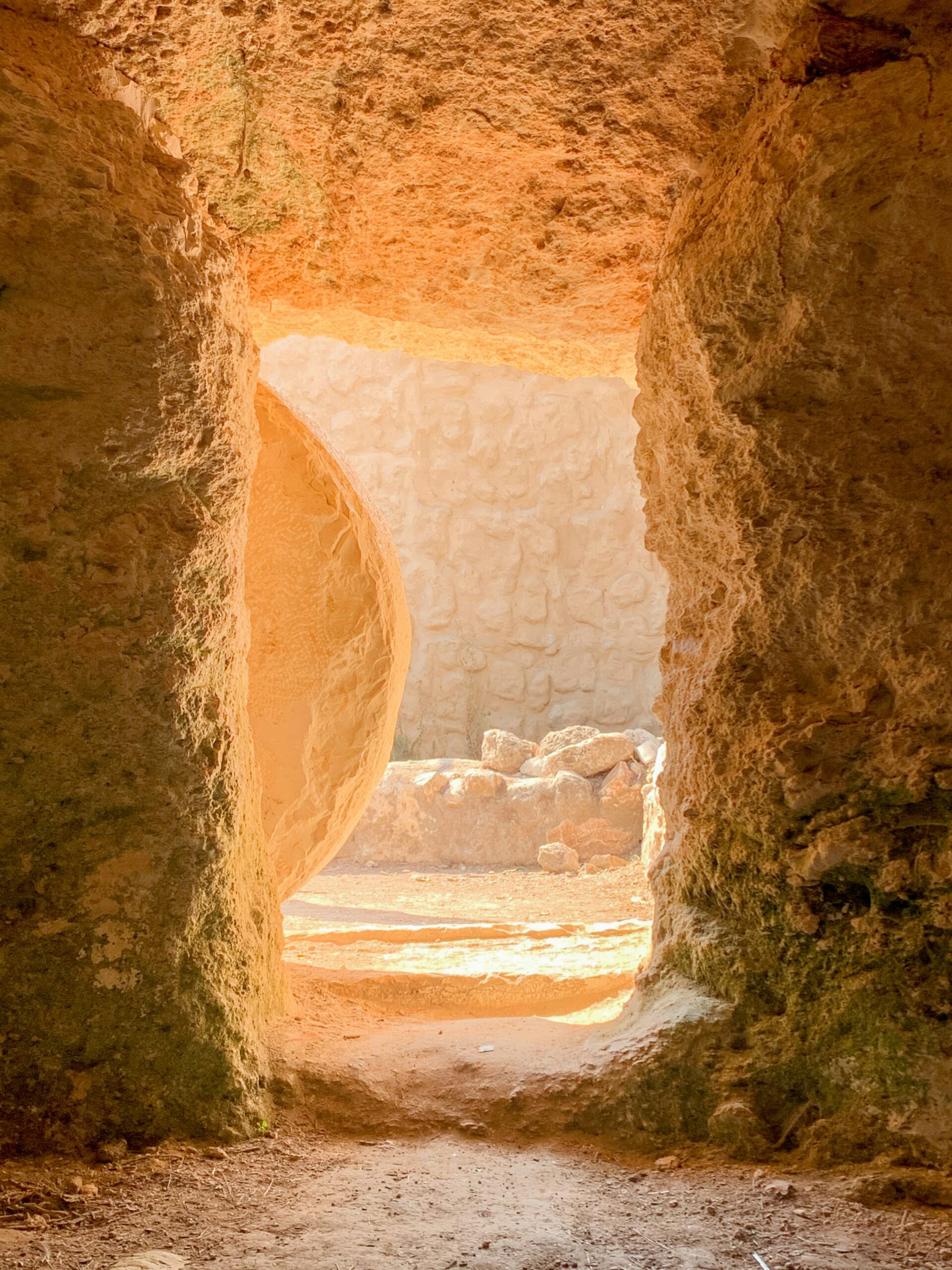
Christ’s tomb is the theological inversion of Tutankhamun’s, yet, interestingly, we can discern some resonances. Unlike Tutankhamun’s lavishly appointed resting place, Christ was laid in a simple tomb hewn from rock; yet it was indeed “a rich man’s tomb” (Matthew 27:57-60). Christ’s tomb was not made for him, but for another; similarly, archaeologists believe that Tut’s tomb was possibly originally slated as another royal’s burial site, but adjustments were made when the king died unexpectedly at a young age.2 Like Tut’s, Christ’s tomb was sealed to keep others out, but for a different kind of suspected grave robber (Matthew 27:62-66). When Tut’s was opened, Carter peeked through a slight shaft and, when asked what he saw in the dim light, replied, “wonderful things.”3; like Peter, who found Jesus’ discarded burial cloth and head wrapping (Luke 24:1-12; John 20:1-10). These symbolic parallels are baptized and reoriented by Jesus’ life, death, and resurrection.
When Christ’s tomb was opened—not three-thousand years but three days later—it brought not material wealth and death, but spiritual treasure and eternal life.
What is sealed, protected, and hoarded in fear decays; what is opened in humility and receptivity becomes the site of divine life. Christ’s tomb and Mary’s womb are caverns of consent. As St. Augustine put it in one of his sermons, “He who was carried in the womb was laid in the tomb; the womb bore life, the tomb restored it.”4 Whereas King Tut’s tomb is a fortress of control—life grasped, preserved, and entombed in gold, only to yield corruption when opened—in Christ’s we see that Life is not secured by preservation but received through surrender. Hans Urs von Balthasar observed, similarly, “Where being is grasped and secured, it collapses into possession; where being is received, it opens into love.”5
Silicon Valley Lords today speak of uploading their consciousness to the digital cloud to attain immortality; they engineer the afterlife with bits and bytes. In light of our apparent technological sophistication, moderns tend to look back at the Pharaohs’ efforts with a kind of patronizing grin: They made beautiful gold jewelry, and the pyramids are pretty incredible, but did they really think that mummification would work? Our hubris is naïve. We, too—Vanderbilts and Altmans and Mitchells—continue in vain pursuits of self-preservation and worldly legacy. We try to glorify ourselves by power and technique, forgetting that God saves by seduction and fiat.
Balthasar, again, on the graced order of salvation: “The sealed tomb becomes the place where all human strategies of preservation are rendered powerless, so that life may appear only as gift.”6
A final irony. Tutankhamun’s original name was Tutankhaten or Tutankhuaten, which means “living image of Aten.”7 His tomb door describes him as he “who spent his life fashioning images of the gods.”8 As our archaeological parable here shows, only by receiving the image of the Living God does one become God-like. King Tut’s method of fashioning images of gods is a dead end in the pursuit of godhood.
We should be students of history. God called his Son out of Egypt (Hosea 11:1), a mystery, a truly “wonderful thing” that we commemorate this time of the liturgical year.9
Footnotes
- Brooke Calton, “Biltmore House,” NCpedia (State Library of North Carolina; adapted from Encyclopedia of North Carolina, ed. William S. Powell [Chapel Hill: University of North Carolina Press, 2006]), accessed December 23, 2025.
- Nicholas Reeves, The Complete Tutankhamun: The King, the Tomb, the Royal Treasure (London: Thames & Hudson, 1990), 20-28.
- Howard Carter, The Tomb of Tutankhamen, vol. 1 (London: Cassell and Company, 1923), 90.
- Augustine of Hippo, Sermon 189, in The Works of Saint Augustine: A Translation for the 21st Century, Part III, vol. 6, Sermons (184–229Z), trans. Edmund Hill, O.P. (New Rochelle, NY: New City Press, 1993), 34-38.
- Hans Urs von Balthasar, Theo-Drama: Theological Dramatic Theory, vol. 5, The Last Act, trans. Graham Harrison (San Francisco: Ignatius Press, 1998), esp. 319-338.
- Hans Urs von Balthasar, Mysterium Paschale: The Mystery of Easter, trans. Aidan Nichols, O.P. (San Francisco: Ignatius Press, 1990), 148-173.
- Nicholas Reeves, The Complete Tutankhamun, 22-24.
- Erik Hornung, Idea into Image: Essays on Ancient Egyptian Thought, trans. Elizabeth Bredeck (New York: Timken Publishers, 1992), 111-113.
- The Feast of the Holy Family, celebrated within the Octave of Christmas, commemorates the hidden life of Christ and the Holy Family, including the Flight into Egypt (Matt. 2:13-15), traditionally observed on the Sunday after Christmas Day or on December 30.