

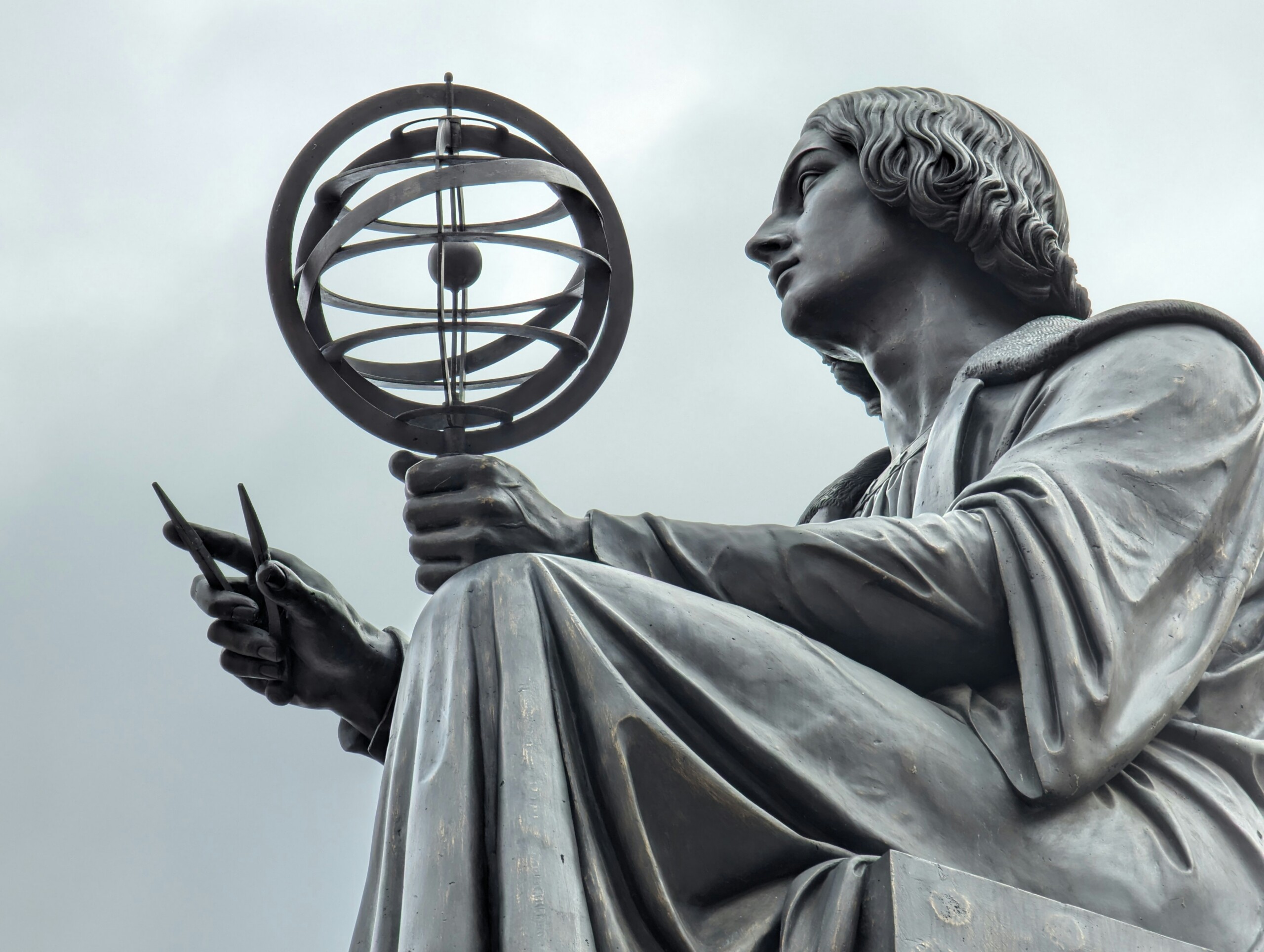
Was Nicolaus Copernicus a heretic? His heliocentric model, published in 1543 in his book De revolutionibus orbium coelestium (On the Revolutions of the Celestial Spheres), proposed that Earth rotates about its own axis and revolves around the sun, as do the planets.[1] The question of heresy seems pointless because heliocentrism is now the cosmological air that we breathe. But in Copernicus’s time, a geocentric cosmology held sway, bolstered by biblical statements[2] and the weight of theology.[3] The story of how Protestants embraced heliocentrism in spite of face-value discrepancies with the Bible is surprisingly relevant to modern evangelical disputes about origins—and by extension, relevant to Christian professors and students in higher education.
The story of Protestant acceptance of Copernicanism matters because many evangelicals are confused about science and how it relates to faith. This confusion frequently manifests itself in an overt discouragement of young people from entering science. One of my physics students related how members of the church his father pastored questioned the wisdom of letting his son study physics, even at a Christian college. A colleague at a similar institution to mine overheard students in a general education science class say how much they liked science in high school, but that they chose another field of study because they were told they might lose their faith. The confusion also manifests itself in a tendency to reflexively identify scientific theories as inherently anti-faith. At an evangelism workshop on my Council for Christian Colleges and Universities campus, a colleague observed students using big bang cosmology as shorthand for atheism. The anecdotes related here will not characterize all evangelical institutions, nor will they represent the experience of all Christian college students and teachers, but they will resonate with many.
The story of Protestant acceptance of Copernicanism also matters because many evangelicals are confused about faith and how it relates to science. Many adherents of scriptural innerrancy are unaware of how the doctrine was stated and framed by Charles Hodge, Archibald A. Hodge, and Benjamin B. Warfield, the nineteenth-century theologians most identified as its architects. Recovering how these nineteenth-century figures were able to simultaneously embrace Copernicanism and innerancy holds continuing lessons for how churches, seminaries, and Christian colleges and universities engage with science and help students integrate faith and science. The relevance extends to Christian faculty, in science or not, committed to inerrancy or not, or in a Christian institution of higher education or not.
The question of heresy might seem obscure because the details of Copernicus’s life and contributions are remote even though his name is familiar. Nicolaus Copernicus (1473–1543) was a canon, an expert in Roman Catholic church law who served a diocese in Warmia, now a part of Poland, but whose preoccupation was astronomy. His proposed heliocentric model differed sharply from the prevailing model of Claudius Ptolemy,[4] who had formalized the near-universal instinct that the sun, moon, and stars revolve around a fixed, central Earth, a conviction based on the immediate observation that the sun, moon, and stars move through the sky, together with the total lack of any sensation of Earth’s motion. However, Ptolemy’s system dealt with the subtleties of planetary motion by epicycles, a complex set of circles within circles, and to explain the motion of the “wandering” celestial objects—Mercury, Venus, Mars, Jupiter, Saturn—he had to displace many of the circles off center. Ptolemy’s system was computationally complex, sometimes inaccurate, and unable to explain other phenomena such as the varying brightness of planets. Copernicus found that his heliocentric model simplified the calculations of astronomical motions and resolved many Ptolemaic difficulties.[5] His heliocentric system is widely seen as the start of a revolution in science and thought.[6] It is anything but obscure.
The question of heresy might seem absurd because few are even aware of the potential for controversy. But Copernicus was acutely aware of the potential for theological controversy and delayed publishing for decades.[7] The first printed copy was presented to him on the day of his death in 1543.[8] Copernicus was not alone in concern about the potential for controversy. His student, G. Joachim Rheticus, had written a treatise (lost until 1973 and published in 1984) arguing that the motion of the earth did not contradict Holy Scripture.[9] And Andreas Osiander, the astronomer who supervised the printing of the book, sought to head off controversy by inserting an unsolicited note to the reader suggesting that the hypothesis of Earth’s double motion was a hypothesis for calculational purposes and not a claim of reality.[10] Although the unauthorized note was unwelcome to Copernicus and his circle, the fears that prompted it were well-founded; the idea that Earth revolves and rotates, and the sun is fixed seemed to contradict common sense and the Bible. After all, anyone can look up and see that the sun, moon, and stars move and sense that Earth is solid and unmoving. The Bible reflects the earth-bound observer’s point of view, referring to the motion of the sun (e.g., Psalm 19, Ecclesiastes 1:5, Joshua 10:12–14) and the immobility of Earth (e.g., 1 Chronicles 16:30, Psalm 93:1, Psalm 104:4). These cosmological instincts were bolstered by a plain reading of the Bible and by religious authority.[11] In 1543, it was Copernicus’ proposal that was absurd.
The gradual harmonization of the Copernican theory with the Bible holds hard-won theological conclusions that have largely been forgotten. Dorothy Stimson’s 1917 account, The Gradual Acceptance of the Copernican Theory of the Universe, suggested this line of investigation.[12] She traced Roman Catholic response to Copernicanism in detail but treated the road to Protestant acceptance briefly, in broad strokes, and somewhat inaccurately.[13] What comes through clearly is that the 16th and 17th century theological debates about Copernicanism parallel modern evangelical debates about scientific origins accounts. When and how the Protestant consensus for heliocentrism changed holds lessons for current evangelical controversies over origins. At the same time, the emotional temperature for heliocentrism is significantly lower, holding out the possibility for productive discourse.[14] The question, “Was Copernicus a heretic?” is highly relevant.
In what follows, I will show that the full acceptance of the Copernican theory by English-speaking Protestants was a gradual process that took approximately 300 years, 100 years longer than the scientific consensus, and came about by a body of comprehensive and coherent physical evidence coupled with a fitful, halting reevaluation of theological positions. The argument rests on three conclusions that emerge from tracing the scientific and theological process.
Scientific consensus came about by a chain of observational evidence in the early 17th century, which was unified by Newton’s laws of motion and universal gravitation, presented in his 1687 Philosophiae naturalis Principia Mathematica (The Mathematical Principles of Natural Philosophy).[15] In the Principia, Newton also showed that his laws of motion predicted that the earth bulges at the equator, rather than the poles as René Descartes had posited, a prediction confirmed in 1744, effectively ending scientific doubt about heliocentrism.
English-speaking Protestant acceptance of Copernicanism was widespread after the publication of Newton’s Principia (1687) but with residual theological uneasiness. Prior to Newton, Protestant reaction, like Catholic reaction, was mixed. Popular books on science and faith written in the eighteenth century by influential Protestant figures endorsed Copernicanism and contributed to near universal acceptance of Copernicanism. However, there was a lingering suspicion in the Christian public that the Bible and Copernicanism didn’t quite line up. The suspicion was due to Protestant unwillingness to follow the lead of Galileo and others in using the hermeneutical principles of accommodation and the two-book view of revelation (God’s word and works) to resolve the apparent contradictions, opting instead for literal readings of the Bible. Literal approaches to reconcile cosmological statements in the Bible with Copernicanism were strained, inconclusive, and unconvincing, contributing to the angst. There are direct indicators of this uneasiness from testimony and an indirect indicator in the absence of heliocentric illustrations in sermons through the middle of the nineteenth century.
This widespread but uneasy acceptance continued until the Princeton theologian Charles Hodge resolved the contradictions theologically in his 1857 article on inspiration by emphasizing authorial intent, the need to distinguish between the Bible’s teaching and the incidental reflection of the Biblical authors’ cosmological views.[16] By 1858, Protestant pastors, like Charles Spurgeon, began to use heliocentrism in sermon illustrations, suggesting that Hodge’s resolution ushered in an era of Protestant confidence that heliocentrism did not contradict the Bible.
Three methodological matters concerning language, scope, and intended audience require clarification. First, I will retrospectively refer to “science” and “religion” with a reminder that those categories are modern and will distort the historical situation if projected onto the historical context.[17] Conversely, quotes from the sixteenth to nineteenth centuries use “natural philosophy,” or simply “philosophy,” to signify “science,” but again, not exactly as we think of it today. Second, the focus is on English-speaking, theologically conservative Protestant engagement with Copernicanism. In particular, I pass over the Roman Catholic response, especially the Galileo affair,[18] but touch briefly on the Dutch Protestant response.[19] Third, although the focus is on Protestant response, professors and students of other Christian faith traditions will find some theological common ground and insight into the theological struggles that evangelical students experience in conflicts about origins.
Gradual Scientific Acceptance
The gradual scientific embrace of the Copernican theory is a demonstration of how the scientific process works, full of starts, stops, rabbit trails, errors, stunning successes, human genius, and human weakness. Narrating the chain of evidence demonstrates that skepticism was reasonable, shows that scientific acceptance was a process, and grounds modern acceptance on a little-known but firm empirical footing.[20]
A series of discoveries that upended long-held cosmological assumptions prepared the way for the embrace of the Copernican theory. In 1572, the Danish astronomer Tycho Brahe (1546–1601) observed a new star, what we now know was a supernova. Prior to this time, the “fixed stars” had been thought to be unchangeable. This discovery propelled Tycho into astronomy, and he made a decades-long, meticulous record of very precise measurements of the positions of the planets. Tycho rejected Copernicanism and proposed a hybrid geoheliocentric model, between the Ptolemaic and Copernican systems, in which the sun, moon and stars revolve around Earth while the other planets revolve around the sun. This allowed him to use the simpler calculations of the Copernican model for planetary motion while retaining the concept of a fixed, central Earth.
Then, in 1610, Galileo Galilei (1564–1642) turned his homemade telescope to the planets and reported three discoveries that gave significant support to the Copernican system. The first was the moons of Jupiter.[21] The lesser objects revolved around the greater and followed the planet in its course. Furthermore, the moons closer to the planet revolved faster than the moons farther away, just like the planets in Copernicus’s system. As Owen Gingerich put it, “Behold, a miniature Copernican system!”[22] The second was that Earth’s moon had features like mountains and valleys. This was significant because of a near-universal acceptance of Aristotle’s belief that heavenly objects were perfect spheres. The third was that Venus displayed a full range of phases like the moon, including the gibbous and full phases.[23] This ruled out the strictly geocentric Ptolemaic theory, for which only crescent phases were possible, but could not discriminate between the Copernican model and the hybrid geoheliocentric model proposed by Tycho Brahe.
Johannes Kepler (1571–1630), Tycho Brahe’s student, used Tycho’s astronomical measurements to argue for the Copernican system, but with important differences. Kepler showed that the orbits of the planets were ellipses rather than Copernicus’s perfect circles, with the sun at one focus of the ellipse.[24] He further articulated two laws that quantified how a planet moved faster when nearer to the sun and the relationship between the distance of a planet’s orbit from the sun and the time for a complete orbit.[25] Galileo’s books and heliocentrism were suppressed in Catholic countries,[26] but Copernicanism was an open debate among Protestants.
The major shift in acceptance of Copernicanism came when Newton (1642–1727) proposed a mathematical theory of planetary motion in 1687.[27] Newton formulated three laws of motion (which were previously known, but not systematized) and the law of universal gravitation to explain heliocentrism and planetary motion. The laws of motion explained common conundrums, like the complete lack of sensation of Earth’s motion, and his statement of the universal gravitational force supplied a force with a mathematical form (a force proportional to the masses and inversely proportional the square of the distance between their centers) to keep the planets in their orbits around the sun—or Jupiter’s moons in their “circumjovial orbits.” The crowning achievement was to show how Kepler’s laws of planetary motion were a mathematical consequence of the laws of motion and the gravitational force.[28]
It is difficult to grasp the impact of the Principia and the degree of authority that accompanied it, together with the near veneration of Newton, especially in England. Alexander Pope’s epitaph, “Nature and Nature’s laws lay hid in night; God said, ‘Let Newton be!’ and all was light,” captures the homage.[29] The French architect, Etienne-Louis Boullee, designed a cenotaph (never built) for Newton on a scale that would have rivaled the pyramids.[30] The book was a bombshell and its explanatory power for heliocentrism, and its calculational success for planetary motion were almost instantly embraced by those who could understand it, and for those that did not, Newton explainers became a cottage industry.[31] The fact that he was English seems to have simultaneously played a role in English acclamation and in a mixed French reaction.[32] A significant number of French scientists were convinced of René Descartes’s model of planetary motion, and the controversy fruitfully inspired the French expeditions to determine the “figure of the earth.”[33]
The alternative to Newton’s mathematical description of heliocentrism was a geocentric theory for planetary motion proposed by René Descartes (1596–1650) in his 1644 work, Principia philosophiae (Principles of Philosophy).[34] He postulated a circulating, space-filling “ether” between the celestial spheres on which the planets moved. He predicted that vortices in the ether squeezed Earth at the equator, causing a bulge at the poles, a shape called a prolate spheroid. In contrast, Newton specifically predicted in Philosophiae Naturalis Principia Mathematica (note the allusion to Descartes’s title) that Earth should bulge at the equator, the way a ball of dough bulges when spun, a shape called an oblate spheroid. The divergence of predictions provided a decisive empirical test to distinguish between the two theories. Measurements in the eighteenth century using pendulums indicated a weakening of the gravitational force of the earth near the equator, consistent with Newton’s oblate spheroid, but the effect was too small to be decisive.[35] If, however, the earth was not a perfect sphere, the length of a degree of latitude would vary between the equator and the poles. In particular, the length of a degree of latitude would be shorter near the equator for Newton’s oblate earth, but longer near the equator for a prolate earth.
To settle the matter, the French Institute of Science sent surveying expeditions to measure the length of a degree of latitude in France, Scandinavia, and near the equator at a location south of Quito in what was then the Vice Royalty of Peru. The French-Spanish expedition to the equator was particularly difficult and took a decade, but in 1744, a member of the expedition triumphantly reported their result for the length of a degree of latitude near the equator, a value decisively shorter than a degree of latitude in France or Scandinavia.[36] This date, almost exactly 200 years after Copernicus proposed the heliocentric system, marks scientific consensus on the Copernican system and Newtonian theory.
Over the next 100 years, a number of measurements and demonstrations confirmed the “double motion” of the earth. The first was James Bradley’s 1728 discovery of stellar aberration, an apparent shift in the position of stars due to the speed of the observer around the sun.[37] The second was the measurement of stellar parallax, the apparent shift in position of a star due to a change in location of the observer along Earth’s orbit. This long-anticipated effect—so small that early telescopes were unable to detect it—had been one of the main arguments advanced by opponents of the heliocentric system. Friedrich Bessel, Friedrich von Struve, and Thomas Henderson measured parallaxes for nearby stars,[38] which gave stellar distances between 4 and 10 light years, more than 100,000 times the earth-sun distance. This was direct evidence for the motion of the earth around the sun and the vast distances explained why parallax was not previously observed. The third was a public and dramatic demonstration of the rotation of the earth. In 1851, Leon Foucault suspended and set in motion a long pendulum, whose plane of oscillation rotated around a circle on the floor.[39] The apparent rotation of the pendulum is actually the motion of the floor—and the earth it is attached to—rotating from under the pendulum. It was a phenomenon that ordinary people could witness.[40] Foucault pendulums are now a standard feature in science museums.
To summarize, a mounting body of coherent evidence, together with Newton’s unifying theory of motion and gravity, brought about a widespread scientific consensus in both England and the European continent that Earth was a planet that rotated while orbiting the sun. Subsequent measurements and demonstrations from 1744 to 1851 confirmed the Copernican model, but they were icing on the cake. The scientific controversy was essentially settled by 1744, almost exactly 200 years after Copernicus published De revolutionibus. The theological implications of Copernicanism were still simmering.
Gradual Protestant Consensus
The gradual Protestant theological embrace of the Copernican theory is a demonstration of how the theological process works, full of starts, stops, rabbit trails, errors, stunning successes, human genius, and human weakness. Narrating the attempts to harmonize the biblical text with Copernicanism shows that theological acceptance was a process, and grounds modern Protestant acceptance on a forgotten theological footing.
Embrace of any new idea is affective as well as intellectual, and apparent discrepancies between Copernicanism and biblical texts were an obstacle to wholehearted acceptance. Full acceptance in English-speaking Protestantism lagged the scientific consensus by approximately 100 years. To be sure, the accumulation of evidence and Newton’s theoretical framework convinced many, even most. But for ordinary Protestant Christians, as for Catholic Christians, the struggle to accept Copernicanism was not only the apparent contradiction with physical perception but also the apparent contradictions with the Scriptures.[41]
Furthermore, the shift of most interest is public embrace by persons in the pew, not just assent by theologians and leaders. Consensus starts with assent by thinkers, and that is not difficult to trace from written records, which, by their nature, come down to us through intellectuals. Nevertheless, it is possible to make reasonable inferences for the receptivity of the heliocentric system by the Protestant public from the evidence of three kinds of written records. The first is popular devotional books about “natural philosophy,” an influential eighteenth-century phenomenon; the second is commentaries and theological works written for the Christian public; and the third is the use of heliocentrism as sermon illustrations, a particularly valuable barometer of receptivity by the Christian public.
Protestant receptivity prior to Newton
Protestant response to heliocentrism prior to Newton’s Principia Mathematica (1687) is spotty and largely negative, but not uniformly so. In 1546, three years after the publication of Copernicus’s de Revolutionibus, Martin Luther (1483–1546), shooting from the hip in response to a question at a dinner in 1546, said, “So it goes now. Whoever wants to be clever… must do something of his own. This is what that fellow does who wishes to turn the whole of astronomy upside down…. I believe the Holy Scriptures, for Joshua commanded the sun to stand still, and not the earth.“[42]
John Calvin’s (1509–1564) attitude to Copernicus is less clear, having never commented on Copernicus directly.[43] Owen Gingerich sums up the scanty evidence, saying, “So the jury is still out on Calvin’s opinion, if any, on Copernicus and his book.”[44]
In England, the Puritan response was mixed. William Gouge (1575–1658), chair of the Westminster Assembly that produced the Westminster Confession, inveighed against the Copernican theory in his commentary on Hebrews. Commenting on the phrase, “Thou hast laid the foundation thereof” in Hebrews 1:10, he wrote,[45]
[T]he earth is immovable. This inference is thus made upon this very phrase, “Who laid the foundations of the earth, that it should not be removed,” Ps. civ. 5. In these and other like respects is this metaphor foundation oft attributed to the earth, as Job xxxviii. 4 , Ps. lxxxii . 5. [. . .] It is a gross error of Aristarchus, Samius [sic—Aristarchus Samius, that is, Aristarchus of Samos], Copernicus, and other philosophers, who imagine that the earth continually moveth, and that the heaven and the host thereof do but seem to our sight to move, as the banks and trees thereon do to such as are in a boat rowed with oars, or in a ship under sail. This conceit cannot stand with the metaphor of a foundation, here and in other places applied to the earth.
However, there was a spectrum of Puritan responses,[46] which may be why the Westminster Confession is silent on the controversy, neither endorsing geocentrism nor denying heliocentrism, in spite of the condemnation of heliocentrism by an important figure in the Westminster Assembly.
Protestant receptivity after Newton
The tide of public opinion on Copernicanism for English-speaking Christians began to change in the eighteenth century with the appearance of popular books for the general public on science and faith. Cotton Mather in the American colonies published The Christian Philosopher in 1721,[47] and John Wesley in England published A survey of the wisdom of God in the creation: or A compendium of natural philosophy in 1763.[48] Both books, which were reprinted many times, gave a broad sweep of findings in “natural philosophy” to enhance devotional wonder and praise. Both endorsed the Copernican theory as a true representation of the world. For example, Wesley, in Chapter XIV of the Survey, entitled “Of the Copernican System; The Motion of the Earth about the Sun; and the Antipodes,” writes,
The most reasonable in itself, and what agrees best with the most accurate observations, is that system of the world proposed by Copernicus, who places the sun in the centre, the fixed stars at the circumference, and the earth and other planets in the intervening space; and who ascribes to the earth not only a diurnal motion around its axis, but an annual round the sun. This system is entirely simple, and best explains all the appearances of the planets, and their situations, whether processional, stationary, or retrograde.[49]
Though Wesley and Mather wholeheartedly embraced Copernicanism, they sidestepped the key question of how heliocentrism could be reconciled with specific geocentric allusions in the Bible. This lack created uneasiness in the pew even as public acceptance waxed.
Protestant theological response
Protestant theologians in the eighteenth and early nineteenth centuries had a well-known path to harmonize Copernicanism with the Bible, but were reluctant to follow that path. Scientists like Kepler,[50] in his 1609 introduction to A New Astronomy, and Galileo, in his watershed 1615 Letter to the Grand Duchess Christina, [51] relied heavily on the principle of divine accommodation and the two-book view of revelation to reconcile heliocentrism and biblical references to cosmology. Accommodation is the hermeneutical principle that God fitted the language of scripture to the understanding of common people, a principle with a long history.[52] It was a staple in Augustine’s thought and similarly employed by the Reformers, especially Calvin, in whose thought it was pervasive.[53] The two-book principle emphasized the unity of God’s word and works, each with authority in its realm, while recognizing that the subject matter, intent, and methodology in the two books differed. This meant that discrepancies arising from literal readings of the Bible are only apparent discrepancies. The two revelations ultimately would concur. However, Protestant theologians avoided Galileo’s principles of accommodation and the two-book principle, opting for literalism.[54]
One attempt at literal harmonization was a commentary[55] on cosmologically relevant passages by Samuel Pike (1717–1773), a minister of a London congregation in a Presbyterian denomination called the Sandemanians.[56] He set out, in his 1753 book, Philosophia Sacra: or The Principles of Natural Philosophy Extracted from Divine Revelation, to answer the question, “Does revelation speak exactly and philosophically true in natural things?”[57] He “could not be persuaded to believe that revelation was intended to contain philosophy in it,” until he had actually “found it there, to his great pleasure and satisfaction.” So, avoiding “allusion and accommodation to bare outward appearances,” he urged that the reader who wanted,
[. . .] to see the scripture evidence, should endeavour to cast aside those interpretations in this case, that are in their own nature allusive and allegorical, however obvious and natural they may seem, and see whether the strict literal sense be not philosophical and just; and if it be, no person can rationally prefer a figurative to a literal exposition.[58]
In a passage on his methodology, he addresses the objection that scriptural references to the foundations of the earth preclude a moving Earth.
We often read of God’s founding or laying the foundations of the earth; from whence some may inadvertently imagine, that the earth itself must stand still, as being fixed upon foundations. But we shall presently see; that this is a mistake: for ‘tis not the whole globe of the earth, that is said to have foundations, but only the earthy parts of the globe, which are placed upon the waters. This I learn from Psal. xxiv. 2. The earth is the Lord’s, &c. for he founded it upon the seas and machined [sic] it on the floods. Where the earth is evidently distinguished from the seas, and said to be founded upon them: so that in reality the waters are the foundations of the earth: which is confirmed by several other texts.[59]
Pike repudiates accommodation in favor of literalism and wants to find the ‘strict literal sense’ of the Bible. He is confident that it will be in accord with heliocentrism.
The lasting impression of the work is that Pike found what he wanted to find. His approach is linguistically flawed. His use of Hebrew is creative, to be generous. Discussing the extension of daytime in Joshua 10:12–14, he argues that the particular Hebrew words used in the passage for sun and moon, for which there are more than one, refer to their light, but not the actual bodies.[60] From these gymnastics, he claimed to resolve all interpretive and scientific struggles to explain the passage in a Copernican framework.[61]
Protestant distrust of accommodation and the commitment to literalism continued in the early nineteenth century. The Methodist scholar Adam Clarke (1762–1832) attempted to reconcile Copernicanism with the Bible in his influential 1817 Commentary on the Bible.[62] He identified the “heavens” of Genesis 1 with “the solar system,” reflecting a heliocentric cosmology, without mentioning Copernicus or giving any indication that a heliocentric system might be in conflict with the Bible.[63] His commentary on Psalm 19:5–6 (“Which is as a bridegroom coming out of his chamber, and rejoiceth as a strong man to run a race . . .”) assumed a Copernican cosmology, justifying it with an oblique appeal to accommodation, saying, “The apparent motion of the sun, in his diurnal and annual progress, are here both referred to. Yet both of these have been demonstrated to be mere appearances.”[64] But he rejected accommodation in favor of literalism in his commentary on Joshua 10:13 (“And the sun stood still, and the moon stayed, until the people had avenged themselves upon their enemies. [. . .] So the sun stood still in the midst of heaven, and hasted not to go down about a whole day.”) He treated the event as a miracle, endorsed heliocentrism in detailed terms, but denied a role for accommodation. He was candid about the difficulty of a literal reconciliation with scriptural language.
To account for this miracle, and to ascertain the manner in which it was wrought, has employed the pens of the ablest divines and astronomers, especially of the last two centuries. By their learned labors many difficulties have been removed from the account in general; but the very different and contradictory methods pursued by several, in their endeavors to explain the whole, and make the relation accord with the present acknowledged system of the universe, and the phenomena of nature, tend greatly to puzzle the plain, unphilosophical reader.”[65]
His subsequent propositions painted him into a proverbial corner. He affirmed the miraculous nature of the account, endorsed Copernicanism, and denied that accommodation can resolve the difficulties. His mutually contradictory boundaries left him as “puzzled” about the resolution as his “plain, unphilosophical” readers. Clarke concluded, saying, “[many] have spoken largely on this difficult subject, but in such a way as, I am obliged to confess, has given me little satisfaction, and which appears to me to leave the main difficulties unremoved.”[66] The interpretive impasse was inevitable given his literalism and rejection of accommodation.
So, what did the person in the eighteenth-century pew think about the Copernican theory? Samuel Pike summed up the situation for English-speaking Protestants: “[M]any common Christians to this day firmly believe that the earth really stands still, and that the sun moves all round the earth once a day: neither can they be easily persuaded out of this opinion, because they look upon themselves bound to believe what scripture asserts.”[67]
A similar situation prevailed in the Dutch Republic. Rienk Vermij observed that “[e]ven if there were no longer any anti-Copernican voices to be heard in the second half of the eighteenth century, people appear to have felt guilty about defending Copernicanism.” He described a published oration, given in the Hague in 1779, where the orator
. . . stated that the earth’s motion around the sun is so certain, ‘that presently nobody, who is gifted with some small part of sound reason, will not allow this opinion; although on the other hand, people are not wanting who are reluctant to accept a doctrine which seems to run counter to Holy Writ.’ . . . The work is . . . an attestation of the continuing worry people felt over the Copernican system. They asserted that it was true and did not contradict the Bible; however, they needed to be continually reassured that this was indeed the case.[68]
The uneasiness in the pew is hardly surprising. The Protestant acceptance of Copernicanism was gaining in the eighteenth century and all but complete by the early nineteenth century, but the theological dissonance is palpable. The source of the conundrum is the rejection of accommodation as an interpretive approach coupled with a commitment to absolute literalism.
The Princeton theologian Charles Hodge cut through this hermeneutical tangle by his careful articulation of the doctrine of inerrancy. Hodge was concerned by the unresolved harmonization of Copernicanism with the Bible because higher critics used it as grounds to deny the authority of scripture. Copernicanism was front and center as he defined inerrancy. Writing in 1857 in the Biblical Repertory and Princeton Review, Hodge said,
An inspired man could not, indeed, err in his instruction on any subject. He could not teach by inspiration that the earth is the centre of our system, or that the sun, moon, and stars are mere satellites of our globe, but such may have been his own conviction. Inspiration did not elevate him in secular knowledge above the age in which he lived; it only, so far as secular and scientific truths are concerned, preserved him from teaching error. The indications are abundant and conclusive that the sacred writers shared in all the current opinions of the generation to which they belonged. To them the heavens were solid, and the earth a plane; the sun moved from east to west over their heads. Whatever the ancient Hebrews thought of the constitution of the universe, of the laws and operations of nature, of the constitution of man, of the influence of unseen spirits, was no part of the faith of the sacred writers. The latter were not rendered by their inspiration one whit wiser than the former in relation to any such points. We may therefore hold that the Bible is in the strictest sense the word of God, and infallible in all its parts, and yet admit the ignorance and errors of the sacred writers as men. . . . [T]he scriptural doctrine of inspiration is perfectly consistent with the admission that the sacred writers shared in all the popular errors of their age and nation. It was only when acting as the organs of the Holy Ghost, that they were preserved from all mistakes. The failure to distinguish between infallibility as the result of divine guidance, and infallibility as the result of omniscience, or at least, of plenary knowledge, is the source of many of the popular objections to the doctrine of inspiration.[69]
Hodge acknowledged candidly that the biblical writers were geocentrists, but insisted that they were not teaching geocentrism, only incidentally revealing their flawed understanding of the world.[70]
Charles Hodge’s position was not an isolated opinion. His successors at Princeton, Archibald A. Hodge (his son) and Benjamin B. Warfield, writing on the same theme in 1881, concurred.
There is a vast difference between exactness of statement, which includes an exhaustive rendering of details, an absolute literalness, which the Scriptures never profess, and accuracy, on the other hand, which secures a correct statement of facts or principles intended to be affirmed. It is this accuracy, and this alone, as distinct from exactness, which the Church doctrine maintains of every affirmation in the original text of Scripture without exception. Every statement accurately corresponds to truth just as far forth as affirmed.[71]
Based on his framing of inerrancy, Charles Hodge went on in his 1871 Systematic Theology to rehabilitate for Protestants the hermeneutics that Galileo employed in his Letter to the Grand Duchess Christina. Hodge affirmed empiricism as a reliable way of knowing about the natural world.
1. Philosophy [i.e., science] and Theology occupy common ground. . . . 2. . . . [T]heir methods are essentially different. Philosophy seeks to attain knowledge by speculation and induction, or by the exercise of our own intellectual faculties. Theology relies upon authority, receiving as truth whatever God in his Word has revealed. 3. Both these methods are legitimate. Christians do not deny that our senses and reason are reliable informants; that they enable us to arrive at certainty as to what lies within their sphere.[72]
He also affirmed to the “two books” principle.
It is admitted that theologians are not infallible, in the interpretation of Scripture. It may, therefore, happen in the future, as it has in the past, that interpretations of the Bible, long confidently received, must be modified or abandoned, to bring revelation into harmony with what God teaches in his works. This change of view as to the true meaning of the Bible may be a painful trial to the Church, but it does not in the least impair the authority of the Scriptures. They remain infallible; we are merely convicted of having mistaken their meaning.[73]
Finally, Hodge reinstated the principle of accommodation.
Men instinctively form their language according to the apparent, and not absolute or scientific truth. They speak of the sun as rising and setting; of its running its course through the heavens, although they know that this is only apparently and not really true. The language of the Bible on this, as well as on all other subjects, is framed in accordance with the common usage of men.[74]
Hodge reconciled Copernicanism and the Bible theologically, rather than exegetically, using interpretive principles based on an understanding of biblical inerrancy that differentiated between the reflection of writers’ cosmological worldviews and what they were teaching under inspiration.
Did this resolve the issue for Protestants? There is indirect evidence for the subsequent embrace of Copernicanism in the Protestant pew from sermons (as opposed to writings) that used heliocentric illustrations. Sermons were meant for everyone, not just scholars, and good preachers avoid distracting congregations with controversial illustrations. For this reason, Copernican sermon illustrations suggest familiarity and the absence of controversy. It is noteworthy that I was unable to find heliocentric references in the sermons of Mather, Wesley, and other eighteenth and nineteenth century Protestants prior to 1857.[75]
The earliest evangelical homiletic uses of heliocentrism I could find were two sermons preached in 1858, the year after Charles Hodge’s article on inspiration. On Sunday, March 14, 1858, the London Baptist preacher Charles Spurgeon (1834–1892) delivered a sermon entitled, “The Solar Eclipse,” the day before an annular eclipse of the sun was to occur in London. He casually, without apology or hint of controversy, attributed the eclipse to a heliocentric solar system. “I suppose that it is impossible that the earth should revolve around the sun, and that the moon should spin continually round the earth, in the same plane of their orbit, without there being eclipses.”[76] Richard Storrs, preaching in New York during the 1858 revival, referenced the two-fold motion of the earth and planets with the sun at the center as something true, well known, and uncontroversial. “For GOD is the Supreme One! He turns the earth to the sun in the morning, and carries it through its swift revolution, bringing the shadow of evening in its season, with only a silent motion of his will. He holds the sun itself in its place, and yet bears it onward, with the planets around it, through the realms of the vast and unseen ether, from age to age, without one effort.”[77] The majority of Protestant Christians accepted heliocentrism before 1858, but these homiletic uses of heliocentrism mark the shift to confident theological embrace for Protestants.
There is no direct evidence that Spurgeon and Storrs were influenced by Hodge’s article on inspiration, but it would be surprising if this were not the case. The Biblical Repertory and Princeton Review in which it was published had a wide readership,[78] and Spurgeon knew Hodge’s works and recommended them to his students.[79] Furthermore, Storrs’s inclusion in the collection implies a collegial relationship with James W. Alexander, another New York pastor who edited the collection that included Storrs’s sermon. Alexander overlapped Charles Hodge at Princeton from 1849–1851 and was a regular contributor to the Biblical Repertory and Princeton Review.[80] There are many connecting threads between these sermons and Hodge’s 1857 article on inspiration.
Many contemporary evangelicals who hold to inerrancy (I do) will be astonished to hear how Hodge framed the doctrine of inerrancy (I was).[81] But Moisés Silva, then a professor of New Testament at Westminster Theological Seminary, insisted that Warfield (and the Hodges) were the doctrine’s “best exponents.”[82] Silva affirmed the need for interpreters who are committed to biblical inerrancy to “distinguish between official teaching and personal opinion” of the biblical authors. The Bible may “reflect,”[83] for example, erroneous geocentric views held by the human authors, but it does not teach those views. To do so would mean that the Bible taught error. Silva goes on to say that “[t]he marvel of inspiration resides precisely in the fact that the divine origin of Scripture ensures the preservation of both the divine truth being communicated and the unique personality of each writer.”[84]
There is a perceived danger that using accommodation and authorial intent to interpret the Scriptures opens the door to a subjectivity that would enable justifying almost anything. This is a slippery slope reaction. Davis Young documents modern evangelical avoidance of accommodation and lays out principles for its legitimate use, especially in relation to any Scripture statement “about the natural world that is clearly contrary to firmly established and empirically verified knowledge. This is particularly the case [. . .] where Scripture [refers] to beliefs [. . .] drawn from superficial observation of nature.”[85] On the issue of authorial intent, Silva acknowledges the danger, and also that some modern evangelicals reject it for this reason. He insists, however, that determining authorial intent is simultaneously essential and possible through the process of exegesis.[86] He concludes with an appeal to do the hard work to get the exegesis right.[87]
So, was Copernicus a heretic? No.
How did Protestants decide that Copernicus was not a heretic? To summarize, many Protestants initially rejected the Copernican theory as contradicting Scripture. After Newton’s Principia and the accumulation of evidence, they embraced it with residual theological uneasiness until Charles Hodge resolved the appearance of contradiction by a careful statement of the doctrine of inerrancy that differentiated between the teaching of Scripture and the reflection of erroneous cosmological views of its authors, and by reinstating the hermeneutic principles of the two-book view of revelation and accommodation. Contemporary Protestant, fundamentalist, and evangelical adherents to inerrancy have forgotten or marginalized Hodge’s hard-won resolution.
Telling the Story
The story of Protestant acceptance of Copernicanism matters because how Protestants reconciled Copernicanism with Scripture holds continuing lessons for how churches and Christian institutions engage with science. The little-known path they charted is relevant for student integration of faith and science, a burden for Christian faculty whether in or out of science.
Adherence to literalism to the exclusion of accommodation causes many evangelicals to dismiss scientific accounts of origins out-of-hand as contradictory to the Bible. This is not to deny that there are other reasons Christians might disagree with scientific consensus on origins, nor does it deny that the doctrinal implications of heliocentrism are less momentous than the doctrinal implications of other origins issues.[88] However, a rigid literalism leads to apparent contradictions between science and faith,[89] contradictions that cannot be resolved by denying the science or by dismissing the theological issues. The concern is the situation that prevails in many churches and Christian institutions where any exegetical method other than absolute literalism is summarily ruled out as “unbiblical.” Restoring a role for accommodation and rediscovering inerrancy as Charles Hodge framed it shows a better way.
Counterintuitively, Hodge’s doctrine of inerrancy led to diversity of thought on science and faith. He and B. B. Warfield famously diverged on their view of biological evolution, with Hodge rejecting Darwinism[90] and Warfield accepting it (with limitations),[91] but Warfield’s position did not result in an accusation that he didn’t believe in inerrancy. Too often, evangelicals who hold to an extreme literal version of inerrancy resort to this nuclear option, accusing proponents of other positions of not believing in inerrancy. Moisés Silva describes the diversity of opinion on the Westminster Theological Seminary faculty and argues that it was possible because of a shared commitment to inerrancy as articulated by its “best exponents.” He concludes, “[T]he hermeneutical flexibility that has found expression on the faculties of Old Princeton and Westminster has actually contributed to (instead of undermining) the influence these institutions have exerted with regard to the doctrine of biblical authority.”[92]
Recovering this hermeneutical flexibility should lead to a greater appreciation for the rich and faithful resources that have expanded the range of exegetical options for origin passages. John Walton’s The Lost World of Genesis 1[93] emphasizes the role of culture and worldview, showing how different a “literal” interpretation would have been for the original hearers. Michael LeFebvre’s The Liturgy of Creation: Understanding Biblical Calendars in Context[94] explores the festival calendars of the Torah and applies the principles he finds in them to Genesis 1. His interpretation, which resolves many of the difficulties of the approach that views the days of Genesis 1 as a framework, is unique because his hermeneutic flows out of the Torah’s calendar texts. Gregg Davidson and Kenneth Turner summarize multiple interpretive approaches to Genesis 1 (including Walton’s and LeFebvre’s contributions) in their book The Manifold Beauty of Genesis One: A Multi-Layered Approach.[95] C. John Collins brings his backgrounds in science and linguistics, together with the literary work of C. S. Lewis, to bear on Genesis in Reading Genesis Well: Navigating History, Poetry, Science, and Truth in Genesis 1–11.[96] I use these resources in the faith integration part of the physics capstone course. They embody Silva’s appeal to do the hard work to get the exegesis right.
For teachers of science, the gradual Protestant acceptance of Copernicanism is fruitful ground to teach the nature of science and to engage students to think theologically. For physics teachers in particular, it is helpful to emphasize the empirical evidence for heliocentrism and refocus the laws of motion and gravity as the framework that unifies the evidence for heliocentrism. Introductory physics texts still largely follow the order of topics in Newton’s Principia, but recent textbooks in introductory physics deemphasize heliocentrism and the characterization of Newtonian theory as its interpretive framework, most likely because there is no controversy. Restoring the emphasis on the gradual acceptance of Copernicanism is a gateway to discuss the nature of science and the legitimacy (and limits) of the empirical method. The theological history of Copernicanism is a safe context for students to wrestle with the theological issues.[97]
Finally, for teachers of theology, recovering the history of Copernicanism and Charles Hodge’s innerancy is a doorway to expand understanding of the doctrine of Scripture and engage origins issues. A quick survey of conservative evangelical systematic theology texts,[98] including some from my seminary studies, failed to uncover any discussion of how Protestants harmonized the Bible and Copernican theory. Furthermore, with the exception of Grudem’s book,[99] their presentations of the doctrine of inerrancy do not include the qualifications made by the Hodges and Warfield. Failure to nuance inerrancy[100] in theological education has wide-ranging downstream effects as theological students move into influential positions as youth pastors and pastors. Just as science students need to wrestle with theology, so theology students need to engage with science. The history of the Protestant acceptance of Copernicanism is a familiar context for theologians and pastors to learn how science and the Bible relate.
It is now over 150 years since Protestants decided that Copernicus was not a heretic. It still matters and it is still relevant.
[1]. Nicolaus Copernicus, De revolutionibus orbium coelestium, trans. Charles Glenn Wallis, in Great Books of the Western World. vol. 16, Ptolemy, Copernicus, Kepler, ed. Robert Maynard Hutchins (Encyclopedia Britannica, 1955), 505–844.
[2]. Jerome J. Langford, Galileo, Science and the Church (Desclee Company, 1966), 50–78.
[3]. Langford, Galileo, Science and the Church, 20, 57.
[4]. Claudius Ptolemaeus, Almagest, trans. Charles Glenn Wallis, in Great Books of the Western World, vol. 16, Ptolemy, Copernicus, Kepler, ed. Robert Maynard Hutchins (Encyclopedia Britannica, 1955), 1–478.
[5]. Owen Gingerich, The Book Nobody Read: Chasing the Revolutions of Nicolaus Copernicus (Walker, 2004), 54–58. Copernicus also employed epicycles (see chapter 4) to deal with the vagaries of planetary motion. However, his system and its calculations were simpler than Ptolemy’s system. The need for epicycles was removed when Kepler discovered that the orbit of Mars was elliptical with the sun at a focus; see Johannes Kepler, The New Astronomy, trans. William H. Donahue (Cambridge University Press, 1992).
[6]. Joyce Appleby, Lynn Hunt, and Margaret Jacob, Telling the Truth about History (W. W. Norton, 1994), 15–30. The authors detail the extent of the scientific revolution even as they bring nuance to earlier panegyric accounts.
[7]. Copernicus, De revolutionibus orbium coelestium, 506, in the preface and dedication to Pope Paul III.
[8]. Gingerich, The Book Nobody Read, vii.
[9]. R. Hooykaas, G. J. Rheticus’ Treatise on Holy Scripture and the Motion of the Earth (North-Holland, 1984).
[10]. Copernicus, De revolutionibus orbium coelestium, 505–506. See also Gingerich, The Book Nobody Read, 138–139.
[11]. Thomas Aquinas devoted significant attention to the Ptolemaic system in his theological works, which essentially defined Catholic orthodoxy. See Langford, Galileo, Science and the Church, 20, 57.
[12]. Dorothy Stimson, The Gradual Acceptance of the Copernican Theory of the Universe (Peter Smith, 1917, repr., 1972).
[13]. Edward Rosen, “Calvin’s Attitude Toward Copernicus,” Journal of the History of Ideas 21, no. 3 (1960): 431–441, https://www.jstor.org/stable/2708147.
[14]. Edward B. Davis, “Christianity, Science, and the History of Science: Some Thoughts on the Integration of Faith and Learning,” in Beyond Integration: Inter/Disciplinary Possibilities for the Future of Christian Higher Education, eds. Todd Ream, Jerry Pattengale, and David Riggs (Abilene Christian University Press, 2012).
[15]. Isaac Newton, The Principia: Mathematical principles of natural philosophy. preceded by a guide to Newton’s Principia, trans. I. Bernard Cohen and Anne Miller Whitman (Universtiy of California Press, 1999).
[16]. Charles Hodge, “The Inspiration of Holy Scripture, its Nature and Proof,” The Biblical Repertory and Princeton Review 29, no. 4 (1857): 660–698, https://archive.org/details/biblicalrepertor2941walk/page/668/mode/2up?view=theater. Hodge returned to the issue in his 1871 Systematic Theology, advocating for willingness to reconsider “long held” interpretations and proposed general principles of interpretation to reconcile scripture and science. See Charles Hodge, Systematic Theology (Eerdmans, 1871, repr., 1979).
[17]. Peter Harrison, The territories of science and religion (The University of Chicago Press, 2017). Harrison uses the metaphor of territories and modern nation states; the territories comprising modern Egypt and Israel existed in the Middle Ages but today’s independent nation states did not exist. Speaking of a conflict between ‘science’ and ‘religion’, prior to the rise of science as a recognized profession in the latter half of the nineteenth Century, is an anachronism like speaking of conflict between Egypt and Israel in the Middle Ages.
[18]. Langford, Galileo, Science and the Church. This is the most accurate account of Galileo’s interactions with the Roman Catholic church.
[19]. Rienk Vermij, The Calvinist Copernicans: The reception of the new astronomy in the Dutch Republic, 1575–1750 (Koninklijke Nederlandse Akademie van Wetenschappen, 2002).
[20]. In my physics classes, I ask students how they know that the earth rotates while revolving around the sun. Invariably, the answer is, “Because we were told.”
[21]. Galileo Galilei, Sidereus Nuncius, trans. Edward Stafford Carlos (1610, repr. Project Gutenberg, 2014), accessed Aug 8, 2024, https://www.gutenberg.org/ebooks/46036.
[22]. Owen Gingerich, “Truth in Science: Proof, Persuasion, and the Galileo Affair,” Perspectives on Science and the Christian Faith 55, no. 2 (2003): 84, https://www.asa3.org/ASA/PSCF/2003/PSCF6-03Gingerich.pdf.
[23]. Daniel Johnson, “See the Phases of Venus,” Sky & Telescope, May 18, 2020, https://skyandtelescope.org/astronomy-news/see-phases-venus/.
[24]. Johannes Kepler, A New Astronomy, 577–591 (Chapter 59).
[25]. Richard Wolfson, Essential University Physics, 4th ed., vol. 1 (Pearson Education, 2020), 134–139.
[26]. Langford, Galileo, Science and the Church, 79–104.
[27]. Newton, The Principia.
[28]. Newton, The Principia, 800, 805.
[29]. Appleby, Hunt, and Jacob, Telling the Truth about History, 19.
[30]. Adam Proctor and William Park, “The memorial to Newton that would have eclipsed the pyramids,” BBC, March 18, 2016,
[31]. Appleby, Hunt, and Jacob, Telling the Truth about History, 22.
[32]. John Wesley, A Survey of the Wisdom of God in the Creation: or A Compendium of Natural Philosophy (N. Bangs and T. Mason, 1763, repr., 1823). Wesley seems to mock the French for not believing Newton. In Chapter XV, on the rotation of the planets about their own axis, he says, “But all that the moderns have advanced in this respect, serves only to confirm to the ancients the glory of being the first discoverers. The moderns are in this to the ancients, as the French Philosophers are to Sir Isaac Newton, all whose labours and travels in visiting the poles and equator to determine the figure of the earth, serve only to confirm what Sir Isaac had thought of it, without so much as stirring from his closet.”
[33]. Larrie D. Ferreiro, Measure of the Earth: The Enlightenment Expedition That Reshaped Our World (Basic Books, 2011).
[34]. Ferreiro, Measure of the Earth, 8–10.
[35]. Ferreiro, Measure of the Earth, 6–10.
[36]. Ferreiro, Measure of the Earth, 247–250.
[37]. James Bradley, “IV. A letter from the Reverend Mr. James Bradley Savilian Professor of Astronomy at Oxford, and F. R. S. to Dr. Edmond Halley Astronom. Reg. &c. giving an account of a new discovered motion of the fix’d stars”, Philosophical Transactions of the Royal Society of London, 35, no. 406 (1728): 637–661, https://doi.org/10.1098/rstl.1727.0064.
[38]. Mark J. Reid and Karl M. Menten, “The first stellar parallaxes revisited,” Astronomiche Nachrichten 341 (2020): 860–869.
[39]. Haley McMonagle, “Buhl Planetarium’s pioneering past,” January 1, 2020, https://www.thenorthsidechronicle.com/2020/01/01/buhl-planetariums-pioneering-past/.
[40]. The rotation is clear but the angle through which the pendulum rotates in 24 hours depends on the latitude. At the poles, the pendulum would rotate in a complete circle in 24 hours, while at the equator there would be no rotation. In Paris, at a latitude of 48.9o N, the rotation is approximately ¾ of a full circle in 24 hours. See John R. Taylor, Classical Mechanics (University Science Books, 2005), 354–357.
[41]. Langford, Galileo, Science and the Church, 50–78.
[42]. Owen Gingerich, “Did the Reformers Reject Copernicus?” Christian History (Christianity Today International), 21 (2002): 22–23, https://www.christianitytoday.com/history/issues/issue-76/did-reformers-reject-copernicus.html.
[43]. Rosen, “Calvin’s Attitude Toward Copernicus”; Christopher B. Kaiser, “Calvin, Copernicus, and Castellio,” Calvin Theological Journal 21, no. 1 (1986): 5–31; Keith Sewell, “Calvin and the Stars, Kuyper and the Fossils: Some Historiographical Reflections,” Pro Rege 32, no. 1 (2003): 10–22.
[44]. Gingerich, “Did the Reformers Reject Copernicus?”
[45]. William Gouge, Commentary on the Whole Epistle to the Hebrews, in Nicol’s Series of Commentaries, ed. Thomas Smith (James Nichol, 1655, repr., 1866) 73, https://play.google.com/books/reader?id=t5EXAAAAYAAJ&pg=GBS.PR16&hl=en.
[46]. Reijer Hooykaas, Religion and the Rise of Modern Science, (Regent College Publishing, 1972, repr. 2000), 135–149.
[47]. Cotton Mather, The Christian Philosopher (University of Illinois Press, 1721, repub., 1994).
[48]. Wesley, A Survey of the Wisdom of God in the Creation.
[49]. Wesley, A Survey of the Wisdom of God in the Creation, Chapter XIV, 394.
[50]. See the author’s introduction in Kepler, A New Astronomy, 59–66. A note from the translator states that Kepler’s “arguments on the interpretation of scripture were to become the most widely read of Kepler’s writings.”
[51]. Galileo Galilei, Letter to the Grand Duchess Christina (1615), in Stillman Drake, Discoveries and Opinions of Galileo, trans. Stillman Drake, (Doubleday, 1957), 173–216. I am indebted to an anonymous reviewer for emphasizing the central importance of Galileo’s Letter to the Grand Duchess Christina to all subsequent attempts to reconcile Copernicanism and scripture. See also T. H. Leith, “Galileo and the Church: Tensions with a Message for Today,” Journal of the American Scientific Affiliation 25 (1973): 21–24, 64–66, 111–113, 154–157; Edward B. Davis and Elizabeth Chmielewski, “Galileo and the Garden of Eden: Historical Reflections on Creationist Hermeneutics,” in Nature and Scripture in the Abrahamic Religions: 1700-Present, vol. 2, ed. Jitse M. van der Meer and Scott H. Mandelbrote (Brill, 2008), 437–64.
[52]. Stephen Benin, Footprints of God: Divine Accommodation in Jewish and Christian Thought (State University of New York Press, 1993). See also the discussion on Rheticus’s use of accommodation to defend Copernicanism from the charge of contradicting Holy Scripture in Hooykaas, G. J. Rheticus’ Treatise on Holy Scripture and the Motion of the Earth, 33–35.
[53]. Ford Lewis Battles, “God Was Accommodating Himself to Human Capacity,” Interpretation, 31 (1977): 19–38; Davis Young, John Calvin and the Natural World (University Press of America, 2007), 161–188. Young’s details on 20th century Protestant neglect of accommodation mirror pre-Hodge Protestant positions.
[54]. Young, John Calvin and the Natural World, 210–230. For an exception, see John Pye-Smith, On the Relation between the Holy Scriptures and some parts of Geological Science, (Jackson and Walford, 1840), 238–265, https://books.google.com/books?id=BOYDAAAAQAAJ&pg=PR3&source=gbs_selected_pages&cad=1#v=onepage&q&f=false.
[55]. Samuel Pike, Philosophia Sacra: or The Principles of Natural Philosophy Extracted from Divine Revelation (J. Buckland, 1753), https://www.google.com/books/edition/Philosophia_Sacra/PvUqAAAAYAAJ?hl=en&gbpv=1&dq=philosophia+sacra.
[56]. The Sandemanians were English Presbyterians. See “Glasite,” Wikimedia Foundation, last modified September 18, 2025, 18:54 (UTC), https://en.wikipedia.org/wiki/Glasite.
[57]. Pike, Philosophia Sacra, iii.
[58]. Pike, Philosophia Sacra, iii-v.
[59]. Pike, Philosophia Sacra, 115.
[60]. Pike, Philosophia Sacra, 43–48.
[61]. Pike’s work may have influenced the physicist and fellow Sandemanian, Michael Faraday (1791–1867), who lived a generation or more after Pike. Faraday made groundbreaking discoveries in electromagnetism, was president of the Royal Society, and gave annual Christmas lectures (to children!) on a wide range of subjects, including a heliocentric understanding of the planetary system. See “History of the Christmas Lectures,” The Royal Institution, https://www.rigb.org/christmas-lectures/history-christmas-lectures. While any direct influence of the minister Samuel Pike’s book on the church-member Michael Faraday is unclear, Faraday’s denominational connection did not prevent him from thriving as a scientist.
[62]. Adam Clarke, Commentary on the Bible, vol. 1, Genesis to Deuteronomy (G. Lane & P. P. Sandford, 1817, repr., 1843), https://archive.org/details/the-holy-bible-commentary-and-critical-notes-adam-clarke-new-york-1843-volume-01-genesis-deuteronomy/The%20Holy%20Bible%2C%20Commentary%20and%20Critical%20Notes-%20Adam%20Clarke%2C%20New%20York%2C%201843-%20Volume%2001%20%28Genesis-Deuteronomy%29/page/28/mode/2up.
[63]. Clarke, Commentary on the Bible, vol. 1 (1843), 28.
[64]. Adam Clarke, Commentary on the Bible, vol. 3, Job to Solomon’s Song (G. Lane & P. P. Sandford, 1817, repr., 1843), 279–291, https://archive.org/details/the-holy-bible-commentary-and-critical-notes-adam-clarke-new-york-1843-volume-01-genesis-deuteronomy/The%20Holy%20Bible%2C%20Commentary%20and%20Critical%20Notes-%20Adam%20Clarke%2C%20New%20York%2C%201843-%20Volume%2003%20%28Job-%20Song%20of%20Solomon%29/page/280/mode/2up.
[65]. Adam Clarke, Commentary on the Bible, vol. 1, Genesis to Deuteronomy (N. Bangs and J. Emory, 1817, repr., 1825), 886–887, italics original, https://www.google.com/books/edition/The_Holy_Bible_Containing_the_Old_and_Ne/Lds8AAAAYAAJ?hl=en&gbpv=1&dq=adam+clarke+commentary+on+the+bible&printsec=frontcover.
[66]. Clarke, Commentary on the Bible, vol. 1 (1825), 889.
[67]. Pike, Philosophia Sacra, 42–43.
[68]. Vermij, The Calvinist Copernicans, 371.
[69]. Hodge, “The Inspiration of Holy Scripture, its Nature and Proof,” 669–670.
[70]. See also Bradley J. Gundlach, Process and Providence: The Evolution Question at Princeton, 1845–1929 (Eerdmans, 2013), note 34, page 92. Quoting Hodge, “The Scriptures teach no error in religion, morals, history, geography, anthropology, or any other department of knowledge. If any man however asserts that the Bible teaches that the earth is a plane round which the sun revolves, because for five thousand years men understood the Bible so to teach, he degrades the Word of God & does all he can to undermine its authority.”
[71]. Archibald A. Hodge and Benjamin B. Warfield, “Inspiration,” Presbyterian Review 2, no. 6 (1881): 236–238, https://archive.org/details/presbyterianrevi2618unse/page/224/mode/2up?ui=embed&view=theater. See also Archibald A. Hodge and Benjamin B. Warfield, Inspiration (Presbyterian Board of Publication and Sabbath-School Work, 1881), 25–29, https://archive.org/details/inspiration00hodg/mode/2up?q=science, reprinted from the Presbyterian Review.
[72]. Hodge, Systematic Theology, 56.
[73]. Hodge, Systematic Theology, 59.
[74]. Hodge, Systematic Theology, 569.
[75]. This is not a claim that no such sermon references exist. Finding pre-1857 uses of Copernicanism in Protestant sermons would further illuminate the historical situation.
[76]. Charles Spurgeon, “The Solar Eclipse,” in New Park Street Pulpit, Vol. IV (London, March 14, 1858), 320, https://www.spurgeon.org/collection/new-park-street-pulpit-volume-4.
[77]. Richard S. Storrs, “Men to be Reconciled to God, Through Christ,” in The New York Pulpit in the Revival of 1858: A memorial volume of sermons, ed. James W. Alexander (Sheldon, Blakeman & Co, 1858), 210, https://archive.org/details/newyorkpulpitin00alex/page/210/mode/2up.
[78]. See the introduction by the editors in Charles Hodge, What is Darwinism? And other writings on science and religion, eds. Mark Noll and David Livingstone (Baker Books, 1994), 16–22.
[79]. Charles H. Spurgeon, Commenting and Commentaries (Sheldon & Company, 1876), 243, 247. “Hodge’s method and matter make him doubly useful in commenting. He is singularly clear, and a great promoter of thought.” 243. “The more we use [Charles] Hodge, the more we value him. This applies to all his commentaries.” 247. My thanks to Dr. Geoff Chang, curator of the Spurgeon Library, for alerting me to Spurgeon’s awareness of Charles Hodge’s writings.
[80]. See the list of contributors in “Authors of Articles in The Biblical Repertory and Princeton Review,” ed. Wayne Sparkman (PCA Historical Center, 2007), https://www.pcahistory.org/HCLibrary/indexes/BRPR.pdf.
[81]. See Young, John Calvin and the Natural World, 181, 186, for a similar reaction.
[82]. Moisés Silva, “Old Princeton, Westminster, and Inerrancy,” in Inerrancy and Hermeneutic: A Tradition, A Challenge, A Debate, ed. Harvey M. Conn (Baker Book House, 1988), 68.
[83]. Silva, “Old Princeton, Westminster, and Inerrancy,” 71.
[84]. Silva, “Old Princeton, Westminster, and Inerrancy,” 71.
[85]. Young, John Calvin and the Natural World, 230.
[86]. Silva, “Old Princeton, Westminster, and Inerrancy,” 70.
[87]. Silva, “Old Princeton, Westminster, and Inerrancy,” 80.
[88]. Davis, “Christianity, Science, and the History of Science,” 153.
[89]. For an extreme literalist cosmology, see Orlando Ferguson, Map of the square and stationary earth (pub. By author, 1893), https://www.loc.gov/item/2011594831/.
[90]. Charles Hodge, What is Darwinism? (Scribner, Armstrong, and Company, 1874), https://archive.org/details/whatisdarwinism00hodg/page/n5/mode/2up. See also the introduction by Mark Noll and David Livingstone in Hodge, What is Darwinism, 11–48. Hodge opposed Darwin’s rejection of teleology, not the possibility of mutable species.
[91]. Gundlach, Process and Providence, 255–262.
[92]. Gundlach, “Old Princeton, Westminster, and Inerrancy,” 80.
[93]. John Walton, The Lost World of Genesis One: Ancient Cosmology and the Origins Debate (IVP Academic, 2009).
[94]. Michael LeFebvre, The Liturgy of Creation: Understanding Biblical Calendars in Context (IVP Academic, 2019).
[95]. Gregg Davidson and Kenneth Turner, The Manifold Beauty of Genesis One: A Multi-Layered Approach (Kregel Academic, 2021).
[96]. C. John Collins, Reading Genesis Well: Navigating History, Poetry, Science, and Truth in Genesis 1–11 (Zondervan, 2018).
[97]. Davis, “Christianity, Science, and the History of Science,” 141–164. Davis made the same point, with concrete suggestions for student engagement, in the context of Galileo’s Letter to the Grand Duchess Christina.
[98]. L. Berkhof, Systematic Theology, 4th ed. (Eeerdmans, 1941, repr., 1988); John Frame, Systematic Theology: An Introduction to Christian Belief, (P&R Publishing, 2013); Wayne Grudem, Systematic Theology: An Introduction to Biblical Doctrine, 2nd ed. (Zondervan Academic, 2020); Robert L. Reymond, A New Systematic Theology of the Christian Faith (Thomas Nelson, 1998).
[99]. Grudem, Systematic Theology, 74–76. Grudem does treat inerrancy in the context of Copernicanism and embraces some of Hodge’s principles, but does not cite or reference Charles Hodge.
[100]. “The Chicago Statement on Biblical Inerrancy,” (1978), https://etsjets.org/wp-content/uploads/2010/03/files_documents_Chicago_Statement.pdf, which is part of the Evangelical Theological Society’s statement of faith (“ETS Constitution,” [December 28, 1949, rev., 2008], https://etsjets.org/membership_requirements/), nuances the doctrine in the spirit of Hodge, but not as directly. A discussion of this important document is beyond the scope of this article.

















One Comment