
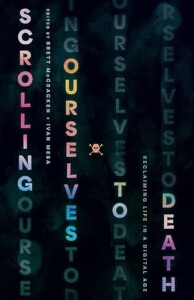
Scrolling Ourselves to Death: Reclaiming Life in a Digital Age
Scrolling Ourselves to Death is a project of the Gospel Coalition, harnessing the arguments of Neil Postman’s 1985 book, Amusing Ourselves to Death,[1] to take on post-millennial media. This compilation of essays applies Postman’s logic and insights about the social and spiritual impact of television to the 2025 world of social media and other digital communication technologies.
After a brief introduction by one of the editors, Brett McCracken, the book is divided into three parts, each containing four or five essays by different authors. Part 1, “Postman’s Insights, Then and Now,” contains five chapters that collectively seek to summarize Postman’s views regarding the impact of television and to recast them for the digital media world of today. Part 1 opens with an essay by pastor, author, and podcaster, Patrick Miller, “From Amusement to Addiction: Introducing Dopamine Media.” In his essay, Miller contrasts the neurological impacts of television with those of social media, highlighting the chemically addictive design of platforms like TikTok. He also notes the increase in availability of media from the household television set to the ever-present smartphone as a contributor to social media addiction: “Your phone is a digital syringe” (21). The Gospel Coalition’s Joe Carter digs deeper into the impact of smartphones in his chapter, “From the Clock to the Smartphone: A Brief History of Belief-Changing Technologies.” Carter lays out a very brief history of technological development and seeks to demonstrate how it has changed both modern man’s theology and epistemology. With respect to communication technologies, he notes a trend of popular messaging becoming shorter and less intellectual, from one-hour television programs to 30-second sound bites. He further claims that this evolution has undermined Christians’ understanding of the gospel message and contributed to a form of consumer Christianity.
The only female essayist in the book, author Jen Pollack Michel, argues that the technological evolution from Postman’s 1985 book to 2025 has also contributed to an increased focus on, and reimagining of, the self. Social media use, she contends, leads to a performative variety of individuation and a decline in community, particularly the Christian community, and she admonishes Christian media users to give preference to their church communities over their social media relationships. Theologian Hans Madueme’s essay, “The Origins and Implications of a Post-Truth World,” identifies the shift from television to social media as one of the factors leading society into a “post-truth age” (62). Madueme claims this shift is particularly pernicious for Christians, who must continue to identify with a God of truth and a Bible that delivers truth. Author and Crossway editor Samuel James closes out Part 1 with his essay, “Striving for Seasonableness in a ‘Now . . . This’ World.” “Now . . . This” refers to one of Postman’s chapters in Amusing Ourselves to Death in which he claims that the phrase, so often deployed by television news anchors, is an acknowledgment that public communication no longer contains a logical or narrative arc. Postman argued that dis-jointed communication itself reflected a world of non-sequitur events with no underlying meta-narrative. James suggests that the speed and breadth of social media communication has exacerbated this effect and created a worldview in which global events are seen as a borderless ocean of chaos. He maintains that an approach of “seasonableness” can reframe the world, although it will require discipline to think more, scroll less, and substitute direct communication with others for posting our digital thumbprints.
Part 2, “Practical Challenges Facing Christian Communicators,” is composed of four chapters. It opens with an essay from the Gospel Coalition’s Collin Hansen entitled, “How the Medium Shapes the Message for Preachers.” Hansen suggests that digital media can be used to support preaching but must not be used to replace it. While he distinguishes the roles of preachers and influencers, Hansen, a digital creator himself, notes that evangelical Christians have historically used new media as opportunities to spread the gospel.
Professors Keith Plummer and Thaddeus Williams are both less sanguine about the use of new media for evangelism. In their respective chapters, “Apologetics in a Post-Logic World” and “Telling the Truth about Jesus in an Age of Incoherence,” they argue that the short messages delivered through social media platforms are unsuited for communicating deep, theological truths. They offer that the loss of coherence in storytelling generally that is inherent in social media threatens people’s ability to grasp the coherence of the Biblical metanarrative.
Author, pastor, and professor Nathan Finn completes Part 2 with his essay, “ ‘Unfit to Remember’: The Theological Crisis of Digital-Age Memory Loss.” Finn is not arguing that the abundance of information readily available on the internet has replaced mankind’s need to remember many things. He is rather arguing that social media platforms in particular render users incapable of remembering because they are designed to keep us fixated on the present. Relying on Nicholas Carr’s book The Shallows,[2] Finn claims that the neurological changes wrought by social media use have rendered people unable to remember even their own past, much less the biblical accounts upon which Christian faith must rest.
The prescriptive turn in the book comes in Part 3, “How the Church can be Life in a ‘Scrolling to Death’ World,” containing five chapters. Part 3 opens with an acknowledgment of the utility of video in ministry by G. Shane Morris of the Colson Center. His essay, entitled “Use New Media Creatively but Cautiously: Video as Case Study,” follows the previous authors in decrying the impact that social media has had on users’ neurology and on the church. Rather than abandoning the technology, however, Morris recommends Christians redeem it and offers extant positive examples such as the video series The Bible Project and drama series The Chosen.
The book’s co-editor, Brett McCracken, and Wheaton professor Read Mercer Schuchardt, both argue for a reconnection of people’s actions with their available information in chapters respectively titled, “Reconnect Information with Action: How to Stay Sane in an Overstimulated Age” and “Embrace Your Mission: Tangible Participation, Not Digital Spectating.” Both authors argue that the abundance of digital news from around the world has disconnected what people know from what they can readily impact. This disconnect, they claim, has led to isolation and passivity, even in the face of disasters. Schuchardt recommends curtailing one’s digital life and living out one’s faith in one’s immediate surroundings where it can be most impactful. He holds up the Amish, selective adopters of new technology, as a positive example of people who are “quietly and meekly not losing their way” (183). McCracken adds advice for both individual Christians and pastors that would include limiting one’s screentime, and praying over the news we cannot otherwise impact, both individually and collectively.
Essays by Jay Kim, pastor and author, and Gospel Coalition editor, Andrew Spencer, finish out Part 3 of the volume. Kim’s chapter, “Cling to Embodiment in a Virtual World,” warns that the church must not be transformed from a gathering of the faithful into an audience. He opines that meeting as a church over Zoom during the 2020 lockdown was a good thing but continuing to meet that way in 2025 demonstrates a lack of commitment. Spencer’s chapter, “Heed Huxley’s Warning,” refers to Postman’s speculation that the future will look more like Aldous Huxley’s Brave New World than George Orwell’s 1984.[3] Spencer argues that there is a reflection of Huxley’s view of the future in the neurological addiction that can result from social media use. Like Schuchardt, he cites the Amish community as an example of thoughtful technological adoption to avoid this dystopian end.
The book ends with an Epilogue by co-editor Ivan Mesa. Mesa acknowledges that Postman’s 1985 volume is reactionary in form. While Postman suggested society return to a pre-television life of reading to engage the world, the trend of the essayists in Scrolling Ourselves to Death is to call for a similar rejection of some or all of the digital platforms now available to believers. Like hope emerging last from Pandora’s Box, Mesa’s argument is that in any world, beset by any technology, the Lord will continue to reign and humankind will still need Him. He insists that God will continue to guide His people, even in a dystopian future in which truth is no longer a relevant category and distraction has replaced analysis and understanding.
Scrolling Ourselves to Death is well organized, and the essays form a continuous argument that one rarely sees in a compilation from multiple authors. This cohesion may be a result of the Gospel Coalition’s superintending the project and deploying many of its employees and friends as essayists. If it is, good on them! It also includes some helpful elements for study purposes, such as discussion questions following each chapter and both general and scriptural indexes. It is also a timely book. Evidence of negative impacts of social media on individuals and society, particularly young people, have advanced past the research and publication stage such that thoughtful Christians, particularly parents and ministers, should be prepared to address the proven harms.
The book has some important limitations. Many of the essays are too short and under-referenced to adequately prove their arguments. In this way, they succumb to the same shortcoming of which many of the authors accuse social media content. The messages are too short and too shallow to allow for true academic engagement. Many of the essays are also one-sided, failing to recognize or adequately connect with those holding opposing viewpoints. If the compilation had included some pro-digital media enthusiasts, it might provide a more dialectic function. As it stands, it again mimics the limits of the social media world, an example of one-sided content that may find its approvers but fails to do more than antagonize its opponents.
The message of Scrolling Ourselves to Death requires some nuance. If interpreted simply as a reactionary response to digital media and a call to return to older communication strategies, many of the authors in this compilation could be cited as disingenuous. While decrying the risks and harms posed by digital communication, they are themselves deeply engaged in presiding over podcasts, developing online content, or otherwise relying on digital media to spread their message. No singular prescription emerges from the text. Unlike Postman’s Amusing Ourselves to Death, Scrolling Ourselves to Death is not ready to chart a future to avoid or mitigate the harms of our digital age. Perhaps the book is premature. Hopefully, it is more of a stepping stone on the way to clearer direction.
Because of the breadth of topics covered in the book, it could be a valuable resource for academics in the communication field looking for succinct course readings that clearly articulate some of the issues digital media raise. The text as a whole would be valuable for pastors struggling to lead their congregations into the digital future. Given the timing of its publication, during the phase when digital media is continuing to rapidly evolve, it may not have the staying power of Postman’s 1985 classic. Scrolling Ourselves to Death, however, will provide a foundation for future publications on this topic, seeking to allow for post-modern contextualization while defending the Gospel once and forever delivered to the saints.
[1]. Neil Postman, Amusing Ourselves to Death: Public Discourse in the Age of Show Business (Viking Penguin, 1985).
[2]. Nicholas Carr, The Shallows: What the Internet is Doing to Our Brains (Norton, 2010).
[3]. Aldous Huxley, Brave New World (Chatto & Windus, 1932); George Orwell, 1984 (Secker & Warburg, 1949).