Editor’s note: Images Courtesy of St. Michael’s College School
“Why speak of muscular Christianity?” asked an academic to a presenting colleague at a sports history conference I recently attended. The questioner made it clear that, in his opinion, sport historians have no need for religion in their field of study. The statement sounded sensible, as if he was clarifying theoretical categories, but the frankness with which it was stated still surprised me.
My first thought took me to how influential Christianity was in the advent of modern sports. This movement, often referred to as muscular Christianity, originated in mid-nineteenth-century England and sought to shape modern sports in accordance with Christian ideals.
Christian Involvement in Modern Sports
At the time of industrialization, there was an increase in educational standards, leisure time, and modes of transportation. These factors made modern sports possible. Many folk games became organized through formal rules, sporting and educational bodies institutionalized games into sports, and sports teams competed against opponents in different towns and cities. With an expansive British Empire, the tendency to modernize games spread quickly to all corners of the world, assisted by enthusiastic clergy, educators, the YMCA, soldiers, and others. The history of early modern sports cannot be told without reference to Christianity.
However, some scholars argue that the changes in sports were primarily a matter of class, gender, and race, rather than any connection to religion. As the above questioner exemplified, some thinkers discount the interpretive value of muscular Christianity.
Other scholars hold that religion is an integral part of the complex reality of sports. Hugh McLeod, author of Religion & the Rise of Sport in England, surveys what he sees as the “fluctuating nature of the relationship between religion and sport in England” (15). Paul Putz’s The Spirit of the Game: American Christianity and Big-Time Sports explains how American Protestants created a burgeoning faith-based subculture within major U.S. sports by the end of the twentieth century. There is a tangible link between sports and religion, but how does this connection aid in understanding sports?
As a Christian and a father of three sporting children, I find it both insightful and interesting to understand why and how Christians have historically engaged in sports. Why did many Christians want their young involved in modern sports? How did they understand sports as a vice and/or virtue? What inspired them to play games in the first place? How are these and other questions important for grasping the depth of sports?
The Story of the Hockey Priest
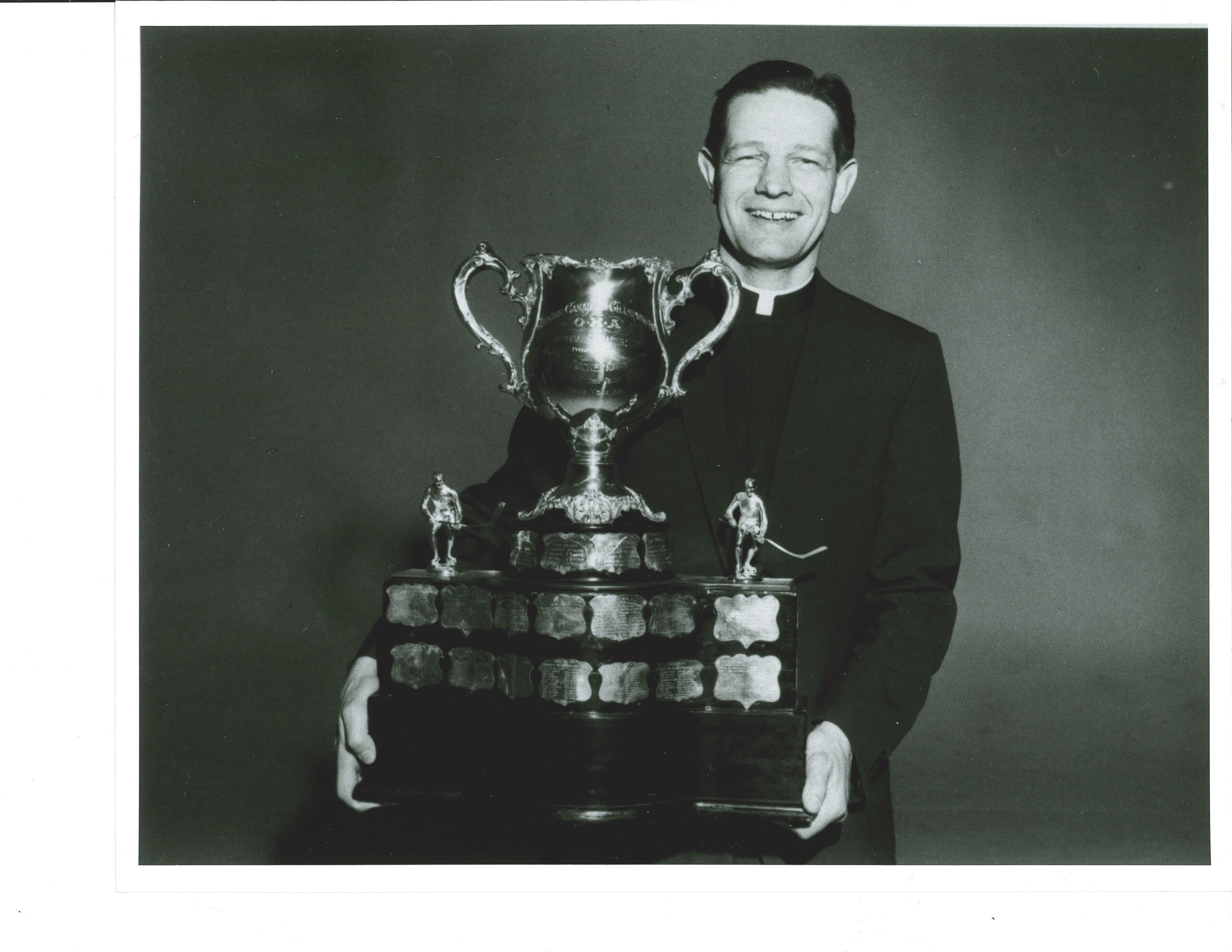
I became particularly interested in the story of Father David Bauer (1924-1988), a Canadian pioneer in ice hockey. So much so that I recently published a book about him, titled Hockey Priest: Father David Bauer and the Spirit of the Canadian Game. I wanted to understand why a clergyman would dedicate his life to the crash-and-bang game of hockey. His thought and influence are important for understanding the sport, even if one is not a religious person.
 Bauer won national junior hockey championships both as a player and a coach–he had a serious hockey pedigree–but was primarily motivated by the positive impact sports could have on young people. He prioritized the educational value of sports over the money and fame that could be gained from sports involvement. He explained later in life, “There must be something more meaningful I can do in my life than chase a puck.”
Bauer soon went on to establish Canada’s first-ever National Team in men’s hockey (94-99). The best young amateurs could compete and represent the nation, earning their university degree while playing in international tournaments. Bauer became the face of Canada’s national hockey program and would remain an important international figure into the 1980s. One commentator noted that Bauer addressed the country’s largest congregation: those who read newspaper sports pages. He was posthumously inducted into the Hockey Hall of Fame in 1989.
Bauer’s Central Beliefs for Sports
While Bauer’s life story is one-of-a-kind, what I found most interesting about this pastor was his understanding of sports and their role in society. In his speeches and written documents, he expressed central beliefs about sports that remain valuable today. His Christian humanistic stance challenged negative influences in sport, such as materialism, violence, over-commercialization, and excessive individualism. For instance, two of his core beliefs were: 1) that the human person should be placed at the center of sports, and 2) that the human person is a unity of body and spirit.
Taking these beliefs from the heart of the Christian tradition, Bauer spoke accessibly to an audience of hockey players, coaches, and fans:
-
Keep the human person at the center of sports. Bauer had a motto that he often said to others: “Make use of technique, but let the spirit prevail.” He supported scientific advancements in sports (e.g., improved training techniques and game strategies), but he was concerned that the impulse to improve skills did not necessarily help players grow as people. Know-how was not a replacement for human values (228). A deeper purpose in sports was too often neglected.
Instead, Bauer believed that sports should be viewed primarily as a means to develop the human person. When the personality of each individual is placed at the center of sports, sporting involvement can bring out the best in people, whether on or off the field of play (142). His own on- and off-ice coaching techniques consider the physical, social, emotional, and intellectual dimensions of the human personality (170). He believed that something as simple as a game of hockey could be profoundly important to the reinvigoration of a generation (101): at their best, sports could enable people to get in touch with what is most important for the human spirit.
- Recognize the human person as a unity of body and spirit. Bauer liked to discuss the meaning of life with others, while drawing upon different philosophical ideas. From his philosophy training, he spoke about Aristotle having taught that “we become what we know.” Bauer applied this teaching to his times, believing that people everywhere were becoming materialists; he observed “the despiritualization of all” (210). He thought the world was becoming out of balance. Sports were becoming engrossed in their material ends to the detriment of the spiritual side of the human person.
Instead of caring only about the material means of sports, he asked people to consider higher ideals. For instance, what values hold together the hockey community? When sportspeople reflected on their shared human nature and human culture, he believed they could find an ultimate meaning for human living (196). Bauer sought to make room for reflection and thoughtfulness. He consistently promoted the coming together of the mind and the body, endorsing the unity of the human person.
Seeking a Higher Human Purpose
As a father with children in youth sports, I find Bauer’s practical wisdom most helpful. His words are not black-and-white directives but act as guidelines that call to mind higher purposes of human living. These beliefs are vital for parents trying to make good decisions for their sporting children. He tried to show an alternative way to look at sports, developing a vocabulary for defending higher ideals in competitive play.
In Hockey Priest, I document Bauer’s life in sports as a player, coach, manager, philosopher, and priest. He is among many people of faith who have shaped sports through their ideals and beliefs. He offers another credible example of why sports historians should pay close attention to religious figures, while also asking Christians themselves to think more carefully about their own engagement in sports.