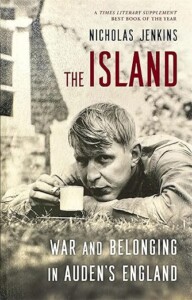
The Island: War and Belonging in Auden’s England
Nicholas Jenkins’s recent book, The Island: War and Belonging in Auden’s England, assesses English poet W. H. Auden’s artistic engagement with his country, offering a reading of Auden’s interwar period as a political project, one in which the poet would attempt to cultivate the formation of an English people from the ruins of their recent history, from out of what Karl Marx described as the crushing nightmare of the “tradition of the dead generations.”[1] By merging the mantle of the artist with the office of the nationalist, Jenkins proposes, Auden would attempt to define an English identity through a nationalist poetry constructed from what Jenkins calls “lyrical belonging” (5).
For Jenkins, Auden’s nationalist project corrects commonplace associations of the poet and his work with radical, left-leaning politics. Auden was drawn towards the nation, perhaps even mystified by its possibilities, for, as Jenkins notes at the end of his book, “Auden did have messianic fantasies about his ability to act as the ‘indifferent redeemer’ of English culture, as the poet, albeit with a tendency to ‘National Socialism,’ whose surroundings and emotional symbols were ‘national emblems’ ” (532–533). The poet-as-messiah construes the distinction between the artist and the patriot, and it implies that art can somehow save a people, that art can wake us from the nightmare of our history, that the artist can cultivate a garden from a waste land.
The idea of the poet as cultivator is evident in the book’s structure. The book’s eight chapters (excluding the prologue and epilogue, the titles of which are inversions of one another: “Caliban’s Island” versus “The Island’s Caliban) periodize the poet by dividing the first part of his career into three botanically named sections: “Marsh,” “Moor,” and “Garden.” Each conjures both Auden’s own development and his role in cultivating an English culture in the years leading to the Second Great War. By depicting Auden as a cultivator of a landscape, Jenkins elevates the blooming poetic mind to the status of a producer, a tenderer of a people.
Auden’s cultivating role begins with his own cultivation, so Jenkins begins by providing a brief biographical account of Auden’s childhood development, attending to the cultural and familial influences on the poet’s life, the function of which is to demonstrate how these influences manifest themselves in his English poetics. The opening invites the reader to consider the relationship between the forces of Auden’s youth—the liturgical and musical appreciation of his mother, his sense of estrangement from his father, and his early homosexual desires, among others—and his poetic sensibilities, especially as they pertain to his Englishness. Little is surprising in this account, but Jenkins justifies this background by consistently referencing it. Jenkins is always appealing backwards, as if history—personal and collective—vitalizes its own future, a view consistent with history-as-nightmare.
The most pervasive specter of this history is the First World War. Jenkins demonstrates how Auden conceived of his nation’s open, war-torn wounds. He writes, “With its mythic status, the war became for young writers like Auden and Isherwood a way of camouflaging, or alluding indirectly to, other subjects” (155). This gloom of war and its relationship with the broader political and social culture becomes the methodology through which Jenkins reads Auden’s career. His point constructs Auden as a displaced person, never quite feeling the emotional affection for homeland as one would expect. And it is this disaffection that leads the poet to the prospect of cultivation. This allows his reader to anticipate how this sense of displacement will pervade into the poet’s nationalist project. As the poet would come of age, the influence of the Great War would increasingly mortify his consciousness. Out of the ruins of history and the inevitable sense of death, what comes next? For Auden, reinventing Englishness and, by implication, the meaning of an individual’s relationship with his nation, became a central point in answering this question.
The second methodological concession Jenkins makes is a commitment to avoiding the critical purview of anachronism. He proposes that we read the interwar Auden as “the only Auden we knew” (32), so Jenkins encourages readers to concede to the limits of his study. While there is a virtue to such a critical horizon—by such self-imposed readings, Jenkins highlights to a greater extent the disparity between early Auden and later Auden—the same methodology disavows Jenkins’s ability to push the boundaries of his thesis: instead of speculating on the possible reasons as to why Auden would forego his nationalist tendencies, Jenkins leaves the problem suspended, and it is left to his readers to fill this gap. Jenkins, at the very end of his prologue, only postulates that Auden came to see “the limits of the beautiful fantasy that a poet can remake the world” (35).
The epilogue imagines an Auden distraught with himself, working hard to distance himself from the poet of previous years, but simultaneously afraid of his remaining years as a poet, about which there would be more to come. He experiences an anxiety of his own influence, in which his poetic imagination only regurgitates, as pastiche, its younger self. But Auden’s obsession with distinguishing himself from himself was not a matter of finding new imagery suitable to incite the same ideas; rather, it reveals a poet disillusioned with the content of his national identity. Jenkins reads Auden’s 1936 collection Look, Stranger![2] as a book concerning “the dissolution of a whole poetic vision of the world” (515–516). Jenkins concludes his study by suggesting that Auden’s decisive emigration to America just prior to the beginning of World War II was an effort “to continue being a Caliban within English culture, a figure whose actions provoked, and provoke, outrage, bafflement, fascination, censoriousness, admiration, dismissal, and even calls for retribution” (536). For Jenkins, Auden’s emigration was a self-exilic but self-assuring commitment to his artistry, a rejection of the artist-as-messiah complex, and a final denial that the poet and the nationalist could be one and the same. Given the twentieth century’s great totalitarian regimes—Nazi Germany, Stalinist Russia, Mussolini’s Italy—Auden would turn from the nation and tear asunder the two offices—the poet and the nationalist—he thought he could reconcile, believing that the purity of his art demanded his rejection of his fascist tendencies.
But exile does not only connote political misgivings; it also implies spiritual ones. I would argue that Jenkins’s book, from its self-imposed critical limitations—chiefly, its rejection of anachronism—does not fully and adequately account for Auden’s shifting attitude toward the role of the poet as it relates to the nation. Even as Auden abandoned his nationalism, he never abandoned his interest in and desire for human solidarity—what we might otherwise describe as the bringing together of a people, implicit in the project for an English identity. This is why, for example, he would end his great religious sequence, Horae Canonicae (1951–1955) with an imperative to “join the dance / As it moves in perichoresis,”[3] an imperative followed by the communal hymn “Lauds.” To have communion with the Trinitarian God as an act of faith initiates a new solidarity, one within a new community, giving its practitioners a new sense of spiritual, otherworldly belonging.
Whether anachronism belongs in critical discourse is worth continued pressure, but Jenkin’s self-imposed window does offer a unique perspective on the poet, correcting the backwards reading to which many are susceptible. Yet the weakness of rejecting anachronism is that it limits the extent to which we can witness a career in its totality, and it seems Auden’s conversion, which would follow his self-exile, might help us better understand the complexity of the two offices that Auden tried to hold. But even with its chronological shortcoming, Jenkins’s book gives proper attention to a gap in the discourse surrounding Auden and brings to the limelight one of art’s sharpest precipices, the relationship between the artist and the nation. The attractiveness of Jenkins’s study pervades through its being larger than itself. This problem only seems increasingly important to political dissidents, patriots and expatriates, or believers who anticipate the eschaton. Why Auden forsook his early nationalism gives rise to a host of questions about how any intellectual or artist ought to respond to his or her nation and its history, and so it is with great perception that Jenkins reads Auden’s contemplation of such difficulties, carving for us a path on which to contemplate our own perplexing [insert nation]-ness. As Auden would write in the penultimate poem of Look, Stranger!, “And all sway forward on the dangerous flood / Of history, that never sleeps or dies, / And, held one moment, burns the hand.”[4] Although Auden would cringe at history’s heat, we are all left to decide our own response.
[1]. Karl Marx, The Eighteenth Brumaire of Louis Bonaparte, in The Political Writings, trans. Ben Fawkes (Verso Books, 2019), 480.
[2]. W. H. Auden, Look, Stranger! (Faber & Faber, 1936).
[3]. W. H. Auden. Horae Canonicae, in Poems, vol. 2, ed. Edward Mendelson (Princeton University Press, 2022), 443.
[4]. W. H. Auden, “XXX,” in Poems, vol. 1, ed. Edward Mendelson (Princeton University Press, 2022), 216.