
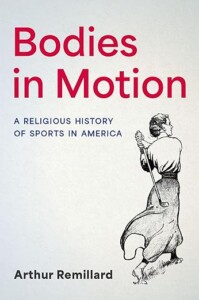
Bodies in Motion: A Religious History of Sports in America
It is an indication of how far the field has come that Oxford University Press recently published not one but two excellent books on the historical relationship between religion and sports in the United States, each work taking a different approach to the subject. Paul Putz’s The Spirit of the Game[1] explains how deepening connections between Protestant Christianity and organized sports produced an evangelical subculture that he refers to as the “Christian athlete movement.” By contrast, Art Remillard’s goal for Bodies in Motion is “to explore how people throughout America’s history”—Christian and not—“have employed religious language, imagery, and assorted other references to make sense of the realm of sports.” Remillard now refrains from describing sport as a religion itself, a modern-day alternative to Christianity and other ancient faiths. But he helps us to see how Americans have detected what David Chidester calls “traces of transcendence, the sacred, and the ultimate” in their interpretations of “the raw material of sports . . . bodies in motion, bodies that strive, struggle, sweat” (3–4).
While the more traditionally religious have roles to play in his narrative, as both athletes and interpreters of athletics, Remillard takes care not to privilege the stories or voices of the United States’s Christian majority. The first athletes named are Jewish baseball players (Sandy Koufax and Hank Greenberg), and Remillard later recounts Muhammad Ali’s conversion to Islam and considers the influence of Zen Buddhism on golf writer Michael Murphy and basketball coach Phil Jackson. The first two chapters in Bodies in Motion examine sports played by indigenous peoples of the Western Hemisphere, such as batey (a ball game popular around the Caribbean that originated with the Mayans) and lacrosse, which European missionaries took as evidence either of superstitious primitivism or the natural athletic aptitude of the “Noble Savage.”
Centuries later, the Hawaiian sport of surfing nearly died at the hands of American missionaries who saw baseball and volleyball as better suited to their “Christianizing” project. But surfing was reborn due to the popularity of Duke Kahanamoku, who was treated like “a literal savior” and even described in Christ-like terms (129–30). Like his contemporaries Babe Ruth and Joe Louis, Kahanamoku embodies the first of Remillard’s organizing themes: heroism.
Just as the Homeric heroes of antiquity existed as “demigods in the uneasy space between eternity and the infinite,” athletic heroes in United States history have had “their likenesses represented in statues, their deeds remembered and revered through sacred stories—mythologies—in their lifetime and after” (5). Carrying “sacred undertones as the person or group representing their sport and more” (171–72), many a sport hero broke new ground as “an athletic standard-bearer of a marginalized group” (141); in addition to the familiar stories of Jackie Robinson and Babe Didrikson, we learn of less famous pioneers like bowler Louise Fulton and high jumper Alice Coachman, Black women who broke glass ceilings in their sports. Other athletes entered sports mythology as martyrs, such as runner Steve Prefontaine (d. 1975), victim of a car accident, and shortstop Ray Chapman (d. 1920), the only major league player to die from being hit by a pitch. Artist Michael Guccione likened Chapman to St. Stephen in a 2018 icon, while Remillard’s last chapter explores how more recent heroes like Michael Jordan and Tiger Woods have become figurative “icons” of global capitalism—even as disgraced bicyclist Lance Armstrong became a kind of broken icon for having “shattered the magic of his sport—the something of his sport” (187).
Emotion, the second theme of Bodies in Motion, serves well to illustrate Remillard’s recurring pattern of “bodies in motion” experiencing a Newtonian tension between opposing forces. His own experiences as both a competitive runner and a devoted Penn State football fan lead Remillard to ask if sport is “a positive moral force, or does its power to incite the passions lead us into dark and unproductive places?” (190). The latter concern helps explain why New England Puritans disapproved of wrestling, horse racing, cockfighting, and other sports that signaled “social and spiritual disorder, facilitated by the senses that channeled the sin of unbridled passion into the bodies of participants” (26). On the other hand, sports have also evoked G. W. F. Hegel’s view of “passion as being the very thing that ignited the human spirit and guided it toward liberation,” since “a spirited contest is purposeful, with goal-directed behavior adding value to society and giving greater meaning to life” (6). So argued early advocates of “muscular Christianity” like the British author Thomas Hughes. While other Victorians fretted over the moral hazards of sports, Hughes urged Christian men to use such physical activities to train their bodies for “the protection of the weak, the advancement of all righteous causes, and the subduing of the earth.” Whether the “muscular Christians” could actually “conserve the good and eliminate the evil” in sports was an “unsolved problem” to a Chicago newspaper in 1867 (71)—and perhaps remains an open question to this day. But by laying bare such tensions, sports have helped Americans to make “decisions about what it means to be human, to live in community, and to live a moral life” (7).
Community, then, is Remillard’s third theme. Not only do individual bodies move together in the joint effort of team competition, but sport can sweep up participants and observers into a collective, ecstatic experience that “can then serve as a foundation for community to form and be sustained” (6). Remillard’s project for Bodies in Motion started with his earlier study of civil religion after the Civil War, when some racing enthusiasts believed that horse “owners, breeders, and racetracks were the building blocks for the creation of a new America, one defined by both diversity and unity, coexisting in relative harmony” (60). Since the turn of the twentieth century, observers as varied as a Russian Jewish immigrant and two Catholic intellectuals have identified baseball as a kind of civil religion for the American people, with New York University president John Sexton celebrating the National Pastime’s “capacity to elevate and transform, that it has a power to bring people together in expanding levels of relationship” (160). At the same time, Remillard is attentive to Americans who have been excluded from, marginalized within, or critical of such sporting civil religions, like the Black jockeys who “were gradually erased from horse racing” as it helped to reconcile White Americans after 1865 (61) and the Olympic runners whose Black Power protest at the 1968 Games in Mexico City showed their commitment to what sociologist Harry Edwards called a “counter-creed” of human equality (162–63).
In part because it tackles topics like race and gender, Remillard’s book would be a good option for a variety of college history courses. Not just seminars focused on religious or sports history, but United States history surveys could use Bodies in Motion to offer students a unique, sometimes surprising perspective on the national past. For example, a unit on the sectional crisis before the Civil War could integrate Remillard’s coverage of the antebellum sport known as “gander pulling,” in which horse riders charged at a live goose and attempted to decapitate it. One of Remillard’s many attempts to go beyond the “holy trinity” of baseball, basketball, and football, it is a fascinating example of how interpretations of sports’ higher meaning cut across predictable lines. For many northerners, “gander pulling depicted a perceived state of southern rural degeneracy at every level of society,” and some “expressly tethered what they saw as a morally disordered sport to the institution of slavery.” Yet in his memoir of escaping from slavery in Kentucky, the Black abolitionist William Wells Brown described the same competition “as a festive and unifying event . . . an opportunity to witness excellence and create a sense of communal belonging” (47–49).
Even in the disturbing case of gander pulling, Remillard strives to take the past on its own terms, leaving moral judgments to the Christian preachers he quotes as condemning sports’ associations with gambling, violence, and sabbath-breaking. Indeed, he explains that his growing aversion to describing sport as an alternative religion stems in part from those “in power using ‘religion’ to classify people and cultures to make unfavorable moral and social distinctions about their subjects” (3).
But for all its many merits, Remillard’s approach does leave open some important questions. Since its author “stresses what people do, rather than what they might or might not believe,” Bodies in Motion primarily asks, “how people have cared about sports,” not “why people care about sports” (191)—let alone whether they ought to have done so then or continue to do so now. It’s no criticism of his admirable work answering the question of how, but Christian students and teachers more interested in the why and ought of religion and sports will want to pair Remillard’s history with theological reflection and cultural criticism related to sports and play by authors like Robert Ellis, Shirl Hoffman, Robert K. Johnston, Jürgen Moltmann, and James K. A. Smith.[2]
[1]. Paul Emory Putz, The Spirit of the Game: American Christianity and Big-Time Sports (Oxford University Press, 2024).
[2]. See, for example, Robert Ellis, The Games People Play: Theology, Religion, and Sport (Wipf & Stock, 2014); Shirl James Hoffman, Good Game: Christianity and the Culture of Sports (Baylor University Press, 2010); Robert K. Johnston, The Christian at Play (Eerdmans, 1984); Jürgen Moltmann, Theology of Play, trans. Reinhard Ulrich (Harper & Row, 1972); and James K. A. Smith, Desiring the Kingdom: Worship, Worldview, and Cultural Formation (Baker Academic, 2009), especially ch. 3.