Becoming the Pastor’s Wife: How Marriage Replaced Ordination as a Woman’s Path to Ministry
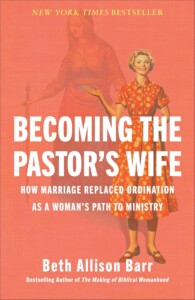
Becoming the Pastor’s Wife gets interesting immediately, with its subtitle: How Marriage Replaced Ordination as a Woman’s Path to Ministry. When was ordination ever a common path for women? Hasn’t “pastor’s wife” always been the Christian ideal?
Beth Allison Barr, professor of history at Baylor University, delves into the intrigue evoked by the book’s cover and title. The book is well-researched, though its main purpose is to cast a vision, not to report scholarly findings. The vision is a church that affirms both pastors’ wives and female pastors, a church in which women can fully exercise their gifts, including leadership gifts.
The book is organized into nine chapters, which flow mostly historically. In a two-thousand-year sweep of Christian history, Barr shows how for hundreds of years, women’s ministry as ordained priests was a normal part of Christianity. She describes a trip to the Catacombs of Priscilla, a burial site for early Christians in Rome. The catacombs contain many images of women, some dressed in liturgical garb, holding scrolls, and making speech gestures. Barr uses this example and others to draw the conclusion that full inclusion of women in ministry does not require alteration of a fundamental, historical, biblical message of male authority:
. . . the evidence for women’s leadership roles in the early church is all around us. We have textual evidence, archaeological evidence, and hostile evidence—such as Pliny’s early second-century letter to the emperor Trajan complaining about Christians and identifying two female deacons.
The evidence is there.
We just need to learn to see it. (32)
Barr connects dots in thoughtful and surprising ways, beginning with a historical claim that grounds the book: when medieval church leaders began requiring celibacy for priests, this pushed women out of sacramental power. Earlier, ordination was a status that granted both women and men the right to serve in the church. By the 13th century, the role of priest was elevated and made more exclusive. Only the celibate male body could perform sacraments. This sacred role required separation from female sexuality, and women became more distant from both priests and the priesthood.
Hundreds of years later, Protestants developed the role of “pastor’s wife” for women. In the second half of the twentieth century, evangelicalism cultivated a version of this role that relied on a notion of “biblical womanhood.” Biblical womanhood uplifts women’s roles as wife and mother. When a “biblical woman” marries a pastor, this cultural ideal not only allows, but often requires, ministry alongside her husband. Barr’s personal illustration makes the point clear. In her role as history professor, no one cares or asks whether Barr’s husband types her manuscripts, reads her drafts, or tends the household in a manner making it possible for her to devote more energy to her studies. But in her husband’s role as a pastor, there was great interest and pressure on Barr to support both her husband and his ministry in ways visible to the church. Her unpaid labor—labor that was physical, emotional, and spiritual—was vital to his success. (Barr’s husband is still a pastor, but she no longer serves the pastor’s wife role in the way she once did. She tells this story in her best-selling book The Making of Biblical Womanhood).1
Biblical womanhood is not the only Christian notion of womanhood, of course. American Christianity is diverse in theologies regarding women, and diverse across denominations and regions as well. Biblical womanhood is only one cultural ideal, but it is a dominant and pervasive one, a point Barr makes with reference to well over a hundred pastor’s wife books published over the last century.
Readers from Southern Baptist, other Baptist, historically Black, evangelical, and nondenominational churches, and perhaps those from the South, may quickly resonate with the book’s depiction of gender relations in the church. Christians from other social groups, regions, and denominations may not feel themselves part of the “we” designated by Barr’s invitational grammar. For example, one paragraph written entirely in the first-person plural, describes how “we” have forgotten to remember women pastors from the past; instead, “we remember John Piper’s warning . . .” (48). Readers may enjoy Barr’s generous tone, but at the same time ebb and flow in connecting their own memories and experiences with those in the book. Some readers may feel they are over the gender question or have relocated to a denomination or local church that respects women’s full inclusion. Others, of course, are embedded in and committed to churches that allow only men in full leadership. Still others may be examining their beliefs. There is something here for all these readers, but the authorial tone of instruction and caring support, and the author’s life experience with the Southern Baptist Convention, will click more readily with some than with others.
The book’s structure is historical, but it is not a history book. Each chapter includes personal narrative, but it is not a memoir. The author and her research assistants conducted qualitative analysis of “pastor’s wife” books from recent decades, but it is not a qualitative research report. The book centers on the persuasive pitch for women’s full inclusion in ministry, and it toggles between types of evidence—personal, historical, qualitative—in making that point. Some readers will find this engaging, as it makes scholarly research more accessible. Others—academics, in particular—may find it more challenging. The critical engagement one brings to historical argument, for example, isn’t the right frame of mind for appreciating memoir. It’s difficult to weigh appeals to personal experience, historical evidence, and the results of content analysis when they are jumbled together.
The qualitative research in the book is based on analysis of 150 pastor’s wife books. An appendix explains how the list of books was generated, along with a list of the books. Like the citations for historical material, this list will support professors and students engaging the book for scholarly purposes. The analysis of pastor’s wife books could have been strengthened with a description of how they were analyzed, or with reference to a scholarly article that reports the results of this research.
Becoming the Pastor’s Wife will surely extend Barr’s service as a public intellectual, both to the church and to American society. It will be of interest to anyone who has followed evangelical debate over biblical equality versus biblical manhood and womanhood over the last forty years. The book will be useful for group discussion, with a group reading a chapter or two at a time. It will also be valuable in college and seminary courses on church history and gender. An inspired student whose church is significantly different may extend Barr’s line of thought, and search church history, denominational history, and personal experience to explore how their own denomination developed gendered ideals for marriage and ministry since the Protestant Reformation.
Spoiler alert: pastor’s wife hasn’t always been the ideal way for a Christian woman to serve in ministry. Exploring the history of women’s roles in the church and how they changed over time can help us see how projection of current beliefs into the past serves to legitimate and bolster beliefs and their usefulness at present. Views of history have power when they are believed and relied upon, regardless of whether they are accurate. Barr’s book leaves the reader with a responsibility: to reflect upon the reasons why illusion can seem more alluring and even necessary than reality.