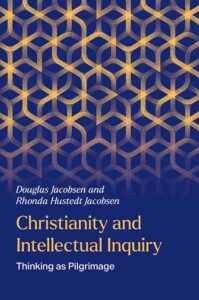
Christianity and Intellectual Inquiry: Thinking as Pilgrimage
In their latest installment chronicling the relationship between religion and American higher education, Douglas Jacobsen and Rhonda Hustedt Jacobsen turn to the constructive task of offering a novel and hopeful model of faith and learning suited to the present moment. Rather than remain entrenched in the enclosed ghettos of polarizing and identity-constrained thinking, “pilgrim thinking” is an invitation beyond narrow silos and into an open-ended journey toward knowledge of reality and selfhood. Rooted in the ancient Christian metaphor of pilgrimage, the learner is invited on a fourfold path: attentiveness to reality, contemplation (knowledge of oneself), proclamation (interpretation of reality), and compassion (transformation of the world according to a vision of wholeness). The authors summarize their aim this way:
The four pathways of pilgrimage thinking obviously do not include all the ways that human beings can and do reflect on themselves and the rest of reality, but they represent the kinds of intellectual endeavors that have been and remain central to Christianity and to American higher education. Utilizing the proposed framework of four pilgrimage pathways enables all people to engage in meaningful intellectual conversations without needing either to foreground their identities or to jettison them in advance. Identities will often be revealed as inquiry proceeds, and identities may change during the process. (134)
This winsome, dialogical vision demonstrates how faith—understood as one’s explicit and implicit commitments about ultimate matters—necessarily bears on intellectual life. It is also a vision of vulnerability and transformation, calling the learner to submit to the process of becoming. The Jacobsens seek a model of faith and learning that honors identity while inviting us into the unfinished task of learning about ourselves, the world, and the wholeness at the heart of things.
The authors do an extraordinary job resisting the sacred and secular binary in American higher education, translating the Christian intellectual tradition for a broader audience—even revealing the implicit academic “faith” that undergirds American universities. Here, faith refers to the implicit or explicit questions of value, purpose, and meaning that are always entangled with university life (125).
The book unfolds in three parts. Part one offers a flyover of Christianity’s relationship to intellectual life, including a typology of Catholic, Orthodox, Protestant, and Pentecostal approaches to faith and learning. Part two narrates the evolution of the American intellectual ecosystem—from Enlightenment confidence in objective truth to cognitive pluralism and, finally, to today’s identity-shaped thinking. Part three—the heart of the book—maps the four pilgrim pathways, exemplified through four key figures: Rachel Carson (Attention), Thomas Merton (Contemplation), James Cone (Proclamation), and Paul Farmer (Compassion). The authors show how each path emerges from the Christian tradition and how it can be practiced in higher education today.
The book is vast in scope, drawing from a wide range of disciplines (perhaps made possible by the disciplinary differences of this academic couple). It deserves praise for updating the faith and learning conversation in light of late twentieth- and early twenty-first-century developments—such as expressive individualism, the rise of technology, and the shift from the liberal arts to professional education. It builds on the work of Arthur Holmes, Mark Noll, George Marsden, and others, yet updates the conversation for the unique challenges of the present moment.
Still, despite the authors’ noble aspirations to speak to a broader audience, the most natural readership will be the evangelical institutions and thinkers shaped by faith and learning discourse. Given the urgent cultural, financial, and spiritual challenges facing Christian higher education, it is to our own models that we most desperately need to turn. Rather than seeking broad translation for secular institutions, we need richer, more robustly Christ-centered accounts of the church-college relationship, ones that can address our intellectual and demographic moment. The metaphor of pilgrimage has the potential to offer just such a vision—but the Jacobsens’ critical rejection of key figures and texts in the tradition leaves their model underdeveloped.
In seeking to distance themselves from closed-minded, culture-warring expressions of faith and learning, the Jacobsens (unnecessarily, in my view) dismiss significant figures like Augustine, Aquinas, and Calvin. They characterize them as too top-down, imperialistic, or doctrinaire to be useful. Yet ironically, this contradicts their own principle of proclamation—listening carefully to voices with whom we disagree until we can speak in their voice with understanding (181). Their rejection stands in noticeable tension with their own pilgrim model.
The book’s historical overview (part one) is weakened by these dismissals. Consider, for instance, their treatment of Aquinas, who is accused of being unable to “let reality speak for itself,” and of “shoehorn[ing] empirical observation into preexisting Christian conceptual categories” (147). This contrasts unfavorably with Hildegard of Bingen, offered as an alternative hero. Yet Aquinas’s intellectual shortcomings are not unknown—and dismissing him so summarily ignores the profound ways he has shaped Christian thought. Even Thomas Merton, one of the Jacobsens’ heroes, was deeply influenced by Jacques Maritain, the foremost twentieth-century interpreter of Aquinas (155). Such inconsistencies point to a deeper need: the tradition must be revised and updated, but with more charity and attentiveness than this book sometimes demonstrates.
The complexity of Augustine, for example, can be quickly glimpsed in Robert Wilken’s The Spirit of Early Christian Thought or Rowan Williams’s On Augustine.1 Far from being a proto-fundamentalist, Augustine emerges as a pilgrim thinker who traversed intellectual boundaries in his pursuit of truth and selfhood. To dismiss his “faith seeking understanding” epistemology merely as justification for coercion and persecution, as the authors do, is to misrepresent his contribution (21). More curiously, the Jacobsens do not engage James K. A. Smith’s Desiring the Kingdom, which offers both a critical and charitable retrieval of Augustine and a vital update to the worldview model of faith integration.2
I don’t defend Augustine merely because I love him (though I do). Rather, I highlight his significance because he was the first to develop the pilgrimage metaphor as a vision of Christian intellectual life. By accessing the resources of his thought, the authors could have significantly strengthened their own model of faith and learning to meet the magnitude of the challenges facing Christian higher education today. For Augustine, the metaphor of pilgrimage provides an account of the individual pilgrim’s relationship to the wider community as well as a sense of our real need for rootedness even as we tarry on the pilgrim way.
Drawing from biblical images of exodus, exile, festal journeys, and prodigal return, Augustine casts the entire Christian life—including its intellectual dimension—as peregrinatio, a pilgrimage toward a definite end.3 Unlike the Jacobsens’ somewhat amorphous goal of knowledge about reality and self, Augustine ties pilgrimage to becoming oneself in Christ, within a pilgrim community ordered toward the heavenly Jerusalem. Without such a sacred end, the pilgrim journey risks becoming intellectual tourism—or worse, wasteland wandering. Intellectual pilgrimage, for Augustine, involves both the joys of spiritually motivated voyage and the pangs of exile and alienation from the homeland. Without a Scripturally robust account of the place toward which we are sojourning, intellectual pilgrimage is susceptible to the privileged fantasies and intellectual idols that Augustine says beset his own career as a liberal arts student and educator.4
For Augustine, the journey must be thoroughly communal. The Jacobsens acknowledge that their model is oriented toward individuals rather than institutions, which makes sense given their modern and evangelical context (ix–x). I appreciate the authors’ open-ended, non-sectarian sense of pilgrimage as an ad hoc association of fellow intellectual travelers—and the ways our identities can expand and be reshaped in such learning communities. But I think that picture of learning is insufficient to provide a Christ-centered and redemptive view of higher education. I think this individualism weakens their use of the pilgrimage metaphor overall. For Augustine, there are no solo pilgrims—only a pilgrim city. And it is only within this moveable, Christ-centered community that we journey faithfully. It is only by the moveable city’s relational practices of accountability, truth-telling, confession, mutual correction, and dependence that intellectual life is stretched out toward maturity and authentic selfhood in Christ.
Christian faith is not merely “ultimate concern” or answers to life’s big questions (76). For Augustine, it is the surrender of one’s intellect and self to the Lordship of Jesus Christ. This kind of faith is deeply personal but also doctrinally grounded, requiring content to sustain its existential trust. A vague or symbolic God is not enough. The community’s shared proclamation—rooted in Scripture, expressed in creeds, and embodied in ecclesial tradition—provides the map and meaning for the journey. What if the world was created by an abusive, malevolent demon and intellectual life is about transcending the material world at all costs through ascetic self-purgation? That presents a different kind of intellectual pilgrimage—one developed by the Platonist Porphyry in the later Roman Empire and one that Augustine rejects in Book 10 of The City of God. The conversation between Christian faith and learning necessarily must give an account of faith as a communal response to the authoritative self-revelation of God found in Scripture as the beginning and end of the journey.
Christian faith, in Augustine’s view, is intellectual obedience to the Word of God and humble submission to God as author and master of all reality. The way in which the authority of God’s Word is expressed in Scripture, made flesh in the Incarnation, and mediated through the Holy Spirit to the church is the site of great mystery and accounts for many of the denominational distinctions that characterize the church today. Nevertheless, without getting into all the weeds of canon, creeds, and ecumenical councils in early Christianity, it is important to note the role that creed-like statements of faith still play at many evangelical colleges—guiding the interpretation of Scripture and providing the reference point for the institutional dialogue of faith and learning.
Augustine’s account of the pilgrimage metaphor also entails a need for institutional rootedness. Augustine uses Jeremiah’s vision of exile (“build houses, plant gardens . . .”) to suggest that pilgrimage requires tending, not just traveling.5 Gardens imply stability, presence, and fruitfulness—qualities often at odds with intellectual mobility. The metaphor warns us against rootless exploration and invites institutional commitment and identity over time. Such commitments require forms of intellectual patience and accountability that are inseparable from the work of formation. We are always on pilgrimage from one site of formation toward another. Without planting gardens, we risk forgetting the virtues of institutional stability that sustain Christian education.6
My own pilgrimage of faith and learning began at Wheaton College, after transferring from a public university. There, professors like Robert Webber, Arthur Holmes, and Roger Lundin opened my mind and rescued my faith from both secular skepticism and fortress-like rigidity. I encountered a liberating vision of inquiry that was rigorous, biblical, and humble. This kind of education requires a fragile but essential truce between church and college, rooted in mutual trust and appreciation of the fullness of the gifts and needs of the whole body of Christ. The polarization of our current moment makes that harder than ever.
To be a Christian is to submit one’s individual identity to the shared identity of the body of Christ. In an age rightly wary of religious abuse, it is harder than ever to entrust oneself to a community. Yet this is what authentic faith requires. Without it, we risk losing both our understanding of faith and learning and the institutions that have embodied it for centuries. The Jacobsens’ vision, while noble, feels like an ode to a post-Protestant spirituality of meaning still lurking in the halls of higher education. What we need now is something deeper: a richly Christ-centered vision of intellectual pilgrimage—one that can reinvigorate the Christian imagination and remind us why education has been central to Christian witness and the church’s distinctive mission for two thousand years.
Cite this article
Footnotes
- Robert Louis Wilken, The Spirit of Early Christian Thought (Yale University, 2003); Rowan Williams, On Augustine (Bloomsbury, 2016).
- James K. A. Smith, Desiring the Kingdom: Worship, Worldview, and Cultural Formation (Baker Academic, 2009). See pages 41–42 and 61 of Christianity and Intellectual Inquiry for the authors’ critical assessment of the concept of worldview as model for faith integration.
- For the full development of Augustine’s thinking on pilgrimage and the Christian life see Sarah Stewart-Kroeker, Pilgrimage as Moral and Aesthetic Formation in Augustine’s Thought (Oxford University Press, 2017).
- On this point, see in particular Augustine’s account of the Incarnation and critique of Platonism in Book 7 of his Confessions.
- Jeremiah 29:5,7; Augustine, The City of God, 19.26.
- For a helpful approach to faith and learning that brings the biblical metaphors of pilgrimage, gardening, and building together, see David I. Smith and Susan M. Felch’s Teaching and Christian Imagination (Eerdmans, 2016).