

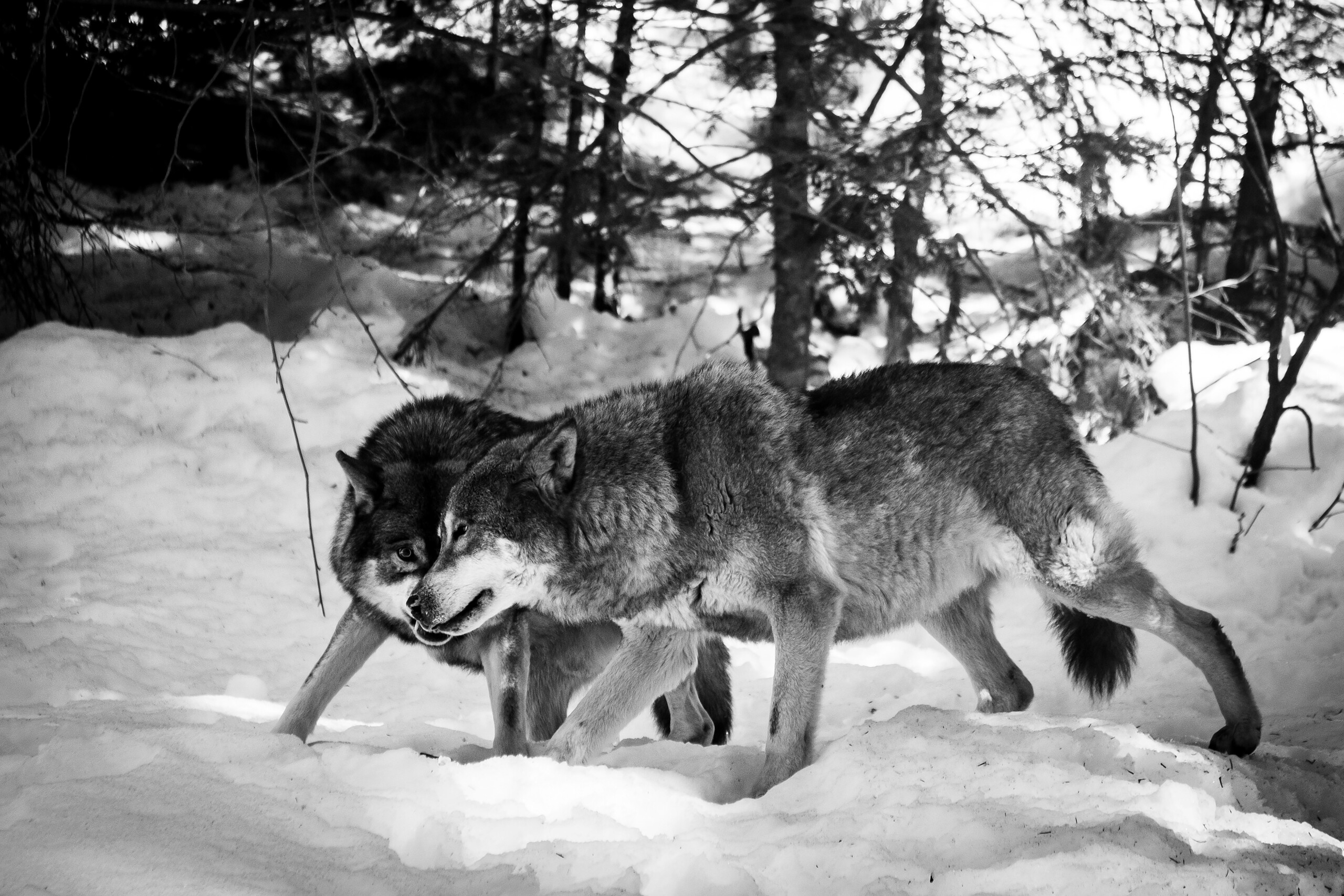
I was driving north from Edmonton to a Canadian farm family on the 54th parallel. Soon, I would be stopping for tea with them. As I approached Neerlandia, the name of their community, I was startled by a Timber Wolf crossing the road in front of me. A few minutes later, I was even more startled by their answer to my anxious question, “Do you have Timber Wolves around here?” Their reply was an excited “Yes!” This Christian family treasured the Timber Wolf as God’s creature, to be kept along with the rest of the land they held in trust for their Creator.
I walked with him from house to barn, conversing about the wolves he said he held in trust. Then, past farrowing pens and rooms of pigs and piglets, we came to an outdoor fold where sows rested on billows of sweet fresh hay. For this farmer of Neerlandia, worship was a way of life. While worship with the congregation was vitally important to the fabric of this Alberta farm, so too was how the hogs and wild creatures were kept, how the family was nourished through Scripture and prayer, how minds were fed with wisdom preserved in books of science and theology. Here was a farmer who published in land and in life. Weaker piglets were nurtured and allowed to live a full life in their own pens. And all pens were designed with good drainage, and the straw was changed regularly. “Pigs are naturally very clean creatures,” he told me. “They only stink because people feed them garbage and leave them in their filth.”
Taking seriously the biblical admonition not to add house to house and field to field (Isaiah 5:8), he gave the moose their own 40 acres and, with his family, planted his house in a native garden of forest creatures preserved from the plow. Life on this farm was a psalm to the Lord, Creator of Heaven and Earth. Life here was lived as full-orbed worship. Equally startling was finding that he allowed their barley fields to lie fallow every second year, providing rest for the land. Their reason? “The Bible requires it.” The land must not be relentlessly pressed.
On a neighboring farm, that evening, I shared dinner with still another worshiping family. Their lives of gratitude and praise included three summer weekends singing psalms and hymns as they backpacked in the Canadian Rockies. On their farm, they delighted in Holsteins, but also in the coyotes under their care. On these farms, as elsewhere, Christian worship connects with Creation, and for good reason. God’s power to save through Jesus Christ and God’s power to inspire through the Holy Spirit derive from the divinity and power of the Creator of all things. Only the One who has the power and wisdom to create the world has the power to save it.
The Maker, forming the world with marvelous integrity, saving the world through divine love, is the One from whom all blessings flow. In response, we and all creatures return our praise. Living becomes worship; life becomes a worth-full publication of praise to God. Lavishing blessings to land and life, God waters the earth and cares for the creatures, even for carnivores “who seek their food from God” (Psalm 104). Delighting in his creatures, God sharpens our eyes to see their integrity and beauty, even of behemoth, in its massive body, amazing skeletal strength, and fearless behavior, all of which are wonderfully harmonized into its challenging wetland habitat (Job 40:15-24). All Creation returns its psalms of praise: “fruitful trees and cedars, every hill and mountain high, creeping things and beasts and cattle, birds that in the heavens fly… So do aged men and children small” (Psalm 148; Psalter Hymnal, 188).
Creation matters. It matters not only because it is created and sustained by God. It matters not only because of its outpouring of praise. It also matters because God becomes flesh for our sakes. Expressing all-embracing love for the world, God affirms the material through Christ’s incarnation. Birthed in the flesh and cradled in a feeding box for animals, he uses lilies and sparrows to illustrate as He teaches in the field. Christ enters as a material person in a material world, God with us. And, expressing God’s love for the cosmos, He dies in the flesh and returns in the flesh to be taken by Mary to be the gardener, God incarnate. And through all of this, He brings the promise of human salvation and resurrection in material flesh. Material Creation is affirmed by the incarnation; it is vindicated by Christ’s resurrection.
Heaven and nature sing!
In our own weekly Sabbath observance, we learn its value for recuperation, rejuvenation, and restoration, a time to get off the treadmill and pull everything together again. Its value is similar for the land, and the Bible requires it. There is a long-standing rabbinical dictum, “Turn it about, turn it about, for everything you need to know is in it.” In applying this to the land’s Sabbath, as we turn things over in our minds and ponder them deeply. We ask, “Is the land just the soil? Does it include the earthworms, birds, and other creatures?” Such “turning it about” will show that “land” as the Bible uses this term refers to a fully operating part of God’s Creation; it includes all the creatures in it. The land and its creatures must be given their Sabbath rests. Our “turning it about” will also bring us to consider sabbaths for non-agricultural parts of Creation, such as rivers, ponds, and marshes; it will also bring us to make proper preparations for the land’s Sabbaths. Pondering on God’s requirement for a Sabbath for the land, as for the Sabbath day, is fertile ground for deep and continuing thought and discussion.
But didn’t that Neerlandian farm family let their land rest every second year, instead of every seventh? I asked the farmer about this, of course, and was directed to the New Testament. “You remember Christ’s teaching about how the Sabbath of the week is made for people, and not the other way around? Well, the same is true for the land. The Sabbath is made for the land, and not the land for the Sabbath.” To which I replied, “But why every second year?” His answer? “Because that is what the land needs.” What he was telling me was that with limited rainfall and this high latitude, the land would be degraded if it were forced to produce more often. He explained that Jesus Christ revealed the principle of the Sabbath, while avoiding legalism. Later, I read a New York Times story reporting how a modern farmer in Israel sold the land to an Arab every seventh year and bought it back the following year in order not to violate the Bible’s legal requirement. It brought me to a deeper meaning of Christ’s teaching.
Walking from the house to the barn, and finding that this farmer loved the wolves, doxology broke forth in my heart. I heard the praise ascending to God from that Neerlandian farmer; I heard the praise ascending to God from creatures who dwell with us here on Earth below, whom we embrace, as God does, with love and care.

















Dr. DeWitt
Thanks for your reminder of our ecological connections, the incarnation and how the Sabbath connects this weekly for all of us. Keep writing. Very useful.
Duane Covrig