

FEATURED PEER-REVIEWED JOURNAL ARTICLE

Filter

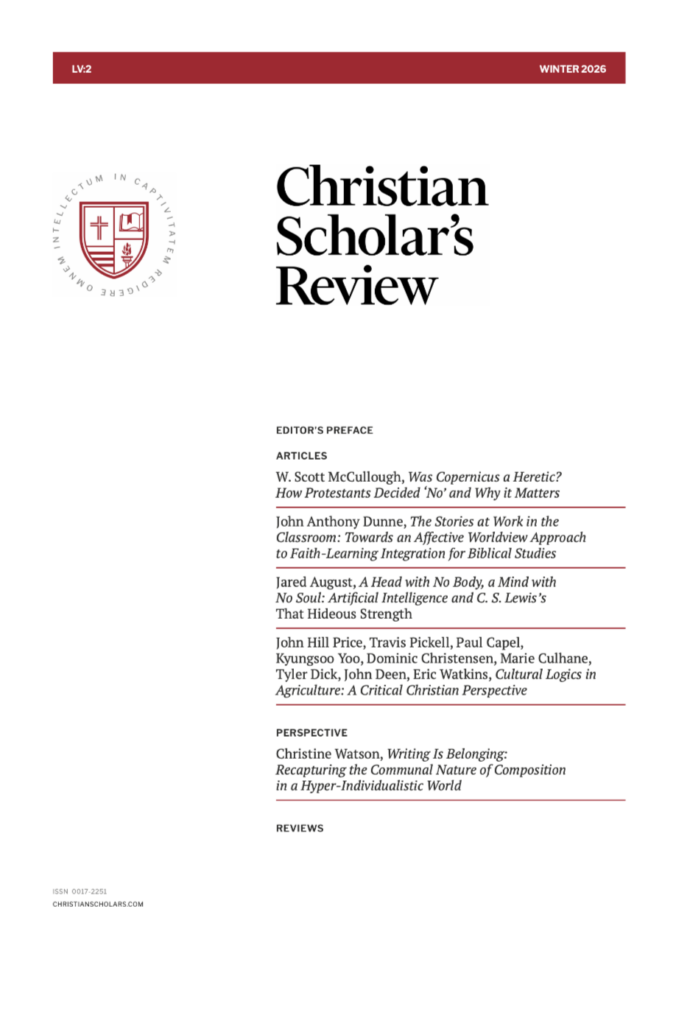
Was Copernicus a Heretic? How Protestants Decided “No” and Why it Matters

March 23, 2026
Was Nicolaus Copernicus a heretic? His heliocentric model, published in 1543 in his book De revolutionibus orbium coelestium (On the Revolutions of the Celestial Spheres), proposed that Earth rotates about its own axis and revolves around the sun, as do the planets. The question of heresy seems pointless because heliocentrism is now the cosmological air…

LATEST BLOG ARTICLE

Blog

Designing Learning: Placing the Work of Faculty in the Christian Story

Teachers Matter. And what matters most about teachers is whether they are learners.  I’ve been unable to track the original source of this quote, but it’s one that I used to present to my pre-service teachers on the opening day of PSY 351 Psychology Applied to Teaching. I wanted them to grab onto the fact…

LATEST EPISODE

Saturdays at Seven Conversation Series

“Discussion and Common Discernment” ft. Gonzaga University’s Katia Passerini I Saturdays at Seven – Season Three, Episode Twenty-Seven

In the twenty-seventh episode of the third season of the “Saturdays at Seven” conversation series, Todd Ream talks with Katia Passerini, the President of Gonzaga University. Passerini begins by drawing upon her expertise as an information system management scholar, thinking through academe’s successes and failures to date in relation to online learning. While such opportunities…
Article
March 23, 2026

The Stories at Work in the Classroom: Towards an Affective Worldview Approach to Faith-Learning Integration for Biblical Studies

Faith-learning integration is a well-worn pedagogical topic, especially at many Christian institutions, but the discussion is surprisingly underdeveloped in the field of biblical studies. Yet even where the conversation is taking place with the most energy, it is complicated by uncertain terminology and is often mired in an over-emphasis on the cerebral. Despite these circumstances,…

Article
March 23, 2026

A Head with No Body, a Mind with No Soul: Artificial Intelligence and C. S. Lewis’s That Hideous Strength

Christians who want to think critically about artificial intelligence (AI) may benefit significantly from C. S. Lewis’s writings. Lewis is well known for his various novels and works on Christian thought. His novel That Hideous Strength: A Modern Fairy-Tale for Grown-Ups provides helpful guidance for technology, grounded as it is with biblical-theological assumptions. About the “Space”…
Article
March 23, 2026

Cultural Logics in Agriculture: A Critical Christian Perspective

Imagine a precocious, driven, and empathetic undergraduate student. She has discovered a passion and a talent for biochemistry, and wants to apply to graduate school to pursue agronomy, with the goal of returning to her rural community home after graduation. She loves science and nature; she is also a committed Christian. She has a vague…
ArticleFeatured
March 23, 2026

Was Copernicus a Heretic? How Protestants Decided “No” and Why it Matters

Was Nicolaus Copernicus a heretic? His heliocentric model, published in 1543 in his book De revolutionibus orbium coelestium (On the Revolutions of the Celestial Spheres), proposed that Earth rotates about its own axis and revolves around the sun, as do the planets. The question of heresy seems pointless because heliocentrism is now the cosmological air…
Article
December 8, 2025

The View from Here: Facilitating Perspective-­Taking Through Art

In 1890, not long before his apparent suicide, Vincent van Gogh painted a picture of a church. Van Gogh had recently moved to the town of Uver from san-­remy-­de-­provence, where he had been in a mental institution. In Uver, van Gogh hoped to receive help from Paul Gachet, a doctor known for his compassion toward…
Article
December 8, 2025

What Good is Perspective-Taking if No One Changes Their Perspective?

The speakers stood in the free speech quad and were accompanied by towering ten-­foot signs. The signs condemned homosexuality with Bible passages—painted in crimson red—as support. At a progressive public university, they immediately attracted a crowd looking for a verbal fight. The confrontation happened right outside the communication building where I was starting my master’s…

Latest from The Christ Animated Learning Blog

The CSR blog is published daily with contributions from over 30 experienced scholars and practitioners discuss how Christ animates learning across a broad range of fields. The CSR blog provides a forum that both creates and curates interdisciplinary conversations about faith and learning in a way that draws and informs leading Christian scholars and practitioners from around the world.

Blog
March 23, 2026

Designing Learning: Placing the Work of Faculty in the Christian Story

Teachers Matter. And what matters most about teachers is whether they are learners.  I’ve been unable to track the original source of this quote, but it’s one that I used to present to my pre-service teachers on the opening day of PSY 351 Psychology Applied to Teaching. I wanted them to grab onto the fact…
Blog
March 20, 2026

Don’t Idolize Empathy

Until reading Professor Hiebert's blog post, I was not aware of any "war on empathy," which apparently is just the latest in a long line of heinous offenses by today's “political, religious, racial, cishet, conservative coalition.” Goodness. Perry Glanzer wrote a lucid response pointing out that empathy, while an important capacity, is not a virtue,…
Blog
March 19, 2026

Thinking and Teaching Christianly Part II

How do we place our discipline and our teaching within the Christian narrative? What does it mean, as an academic professor, to submit my subject material to the Word of God as Glanzer suggests? Having already discussed an academic meta-theory and how to redeem it in a Christian context, I want to look more concretely…
Blog
March 18, 2026

Thinking and Teaching Christianly Part I

I love thinking about the big picture. So it was with a great deal of excitement and hope that I read Glanzer’s post earlier this year on “Christ-Animated Analysis of Academic Theories. In the hubbub of day-to-day teaching it’s easy to focus on the individual notes we have to play and miss the direction of…
Blog
March 17, 2026

“To Feel and Carry One Another’s Pain”: Reflections on Neighbor Love (Part II) 

In the second part of this blog post, Paul Kim continues to share insights from his colleagues Katie Douglass (practical theologian) and Brittany Tausen (social psychologist) about their co-authored book, Love Your Neighbor: How Psychology Can Enliven Faith and Transform Community. PK: In a recent Christian Scholar’s Review article, you have written compellingly and thoughtfully…
Blog
March 16, 2026

“To Feel and Carry One Another’s Pain”: Reflections on Neighbor Love (Part I) 

In this two-part blog post, I (Paul Kim) am excited to feature insights from my colleagues Katie Douglass (practical theologian) and Brittany Tausen (social psychologist) about their co-authored book, Love Your Neighbor: How Psychology Can Enliven Faith and Transform Community. This book explores how to love others better through the lens of both psychology and…

Subscribe

for new content notifications, access to video and audio conversations with our writers, and invitations to our events.

TRENDING

MOST READ

AROUND THE WEB

Explore The Christian Scholar’s Review

Established in 1970, Christian Scholar’s Review is a medium for communication among Christians who have been called to an academic vocation. Its primary objective is the publication of peer-reviewed scholarship and research, within and across the disciplines, that advances the integration of faith and learning and contributes to a broader and more unified understanding of the nature of creation, culture, and vocation and the responsibilities of those whom God has created. It also provides a forum for discussion of pedagogical and theoretical issues related to Christian higher education. It invites contributions from Christian scholars of all historic traditions, and from others sympathetic to the task of religiously-informed scholarship, that advance the work of Christian academic communities and enhance mutual understanding with other religious and academic communities.

Read the Current Issue