


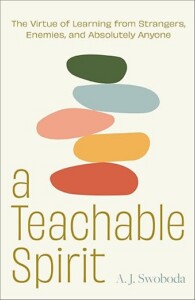
A Teachable Spirit: The Virtue of Learning from Strangers, Enemies, and Absolutely Anyone
This is a marvelous book teaching a core virtue: teachableness, an eagerness to learn from others. This is a perfect read at the beginning of a school year for Christian scholars/teachers who must first be learners if we hope to facilitate the learning of others. I loved this book. It used biblical theology to show that welcoming truth is welcoming God, built on the pedagogical belief that we can all learn from each other, and presented learning strategies for doing so.
Swoboda is a biblical theologian and podcaster known for his Slow Theology work,[1] and serves as associate professor of Bible and theology at Bushnell University in Oregon. This book fits nicely into his extensive work on spiritual formation. He launches the reader into this biblical exploration of teachableness through his own struggle to learn Spanish (introduction) and what a Phillips screwdriver is (chapter 1). “Becoming teachable has a painful but profound way of exposing our most embarrassing insecurities, fears and idols” (11), but teachableness is also the only way to erase learning deficiencies. The prophet Jeremiah’s claim to be “too young”—likely a statement of his limited learning in Jeremiah 1—seems sidestepped by God likely because ignorance is not a barrier to fulfilling our mission when we stay teachable. Teachableness opens doors to learning. It is the core virtue in what Carol Dweck popularized as a “growth mindset.”[2] It also ushers us into the deeper joy of experiencing “a life under the tutelage of the Holy Spirit [that] treats nothing as extracurricular. If life is the curriculum, nothing remains secular” (3).
After framing teachableness and unteachableness within biblical and historical perspectives on learning (chapter 1), Swoboda then invites us to learn from specific groups: experts (chapter 2), strangers (chapter 3), the dead (i.e., past authors, chapter 4), children (chapter 5), parents (chapter 6), secular culture (chapter 7), and our enemies (chapter 8).
Swoboda makes a big deal about experts in chapter two, talking up the role of libraries, schools, training, research, and writing in fueling teachableness into competency. “Through hard work, study and perseverance” we gain “authority in a particular domain of knowledge or activity” (37). He showcases Luke as an example of a person whose training positioned with teachableness propels him to be the single biggest contributor to the New Testament (27.5%). Swoboda also uses Roger Kneeborn’s classic, Expert, to explore how deeply experts “not just master their knowledge; they are mastered by it” (38).[3]
In chapter 3, he uses the biblical vision of welcoming strangers (Abraham in Genesis 18:2–11; the good Samaritan in Luke 10:25–27; receiving angels in Hebrews 13:2, 16) to coax the reader past our xenophobic defensiveness to learn from strangers God sends into our path. Coming close to strangers in welcoming conversations positions us to learn new ways of thinking about the world and living. Feasting with strangers is not just about tasting new types of food but about deeper learning. I resonate deeply with this truth. As a member of the most ethnically diverse religion in the United States (Adventism) and one who spent 17 years teaching diverse students, as a white male, in one of the most internationally diverse campuses in the United States (Andrews University), I can testify that I learned more from international students than they learned from me.
Learning from the dead is not a chapter about necromancy but about fighting presentism by reading past authors. “Presentism is subtle and toxic. It forms arrogant people who believe their culture, moment, and outlook will inevitably be proved superior,” or what C. S. Lewis labeled “chronological snobbery” (80). To overcome this recency bias, the recommendation is that for every one to three books you read by living authors, you read one book by a past author. This might be easier for theologians than electrical engineers, but his point is that “when we only swim in the thoughts of the living, we place too much pressure on those whose stories have yet to fully resolve” (84). We miss out on letting the “church of two thousand years behind us” become a force that “scrutinizes us so we may be sanctified into faithfulness” (86).
In the chapters on learning from children (chapter 5) and parents (chapter 6), Swoboda positions teachableness into the close quarters of our intimate relationships. His reflections about Jesus on children connect being child-like to teachableness: “unless you change and become like children, you will not enter the kingdom of heaven” (Luke 18:2).[4] We are to see children as the unlikely “prophets of a community” (105). Likewise, the biblical command to honor parents is essentially reminding us to be teachable as sons and daughters (Exodus 20:2, Ephesians 6:2, 3). In these two chapters he gives poignant examples of his work as a father, teacher, and son. His stories of being humbled in front of his students will be especially insightful to us who use the title of teachers: “The teacher’s desire to save face or guard power lures them to double down [against student’s sharing of truth] . . . or worse, [to fear] they are being robbed of their hard-earned authority. But these fears deceive us, and they must be confronted” (103). Swoboda sees this same temptation at work in us who are younger as we resist learning from the older, even our aging parents, or our teachers. We must fight against the “lurking temptation to believe that once we have moved on from our childhood, we have nothing more to learn from those who brought us into this world” (125).
In the last two chapters, learning from secular culture (chapter 7) and our enemies (chapter 8), Swoboda moves teachableness into the public square. If we can be trained to be teachable in intimate spaces with children, students, relatives, and strangers, we can also do so in the marketplace of ideas and ideologies. Here Swoboda’s theology is nuanced, insightful, and invitingly civic and civil. He argues, “God has two voices: an ‘outside voice’ that everyone can ‘hear’—what we can know about God from culture, intellect, experience, creation, sunrises and sunsets, a scientific reading of the universe—and an ‘inside voice’ . . . Scripture.” (148). When we posture ourselves to learn from others, we tacitly or intentionally acknowledge that “they” may be hearing one or both of these voices of God in ways better than “we” are. This allows God to amplify His will and teachings to us through them. Jesus is even more scandalous in stating this truth in His audacious assessment that “the children of darkness are wiser than the children of light” (Luke 16:8). Those “in the dark” may have light He desperately wants to get to us.
Throughout the book, teachableness is often connected with books and reading. Swoboda makes this point when he speaks of five types of books we all should be reading: “acquaintances, neighbors, friends, lovers, and enemies.” Acquaintances are books you pick up “but discover just as quickly you can put down” (164). Neighbors are books you are supposed to read in your discipline or assigned by courses at your institutions. Friends are books we enjoy reading (I felt that way about this book). “And a lover—well, that’s the book or author you return to over and over to shape you” (165). In my areas of expertise, Christian ethics, spiritual formation, and education, these would be authors like Lewis B. Smedes, Brennan Manning, and Perry Glanzer. But it is in the last area, enemies, that Swoboda’s invitation to be teachable turns uncomfortable. He challenges us to learn from “the other side.” To be able to finish this book review, I had to acknowledge this insight—be teachable—and go out and buy two books from a publisher I likely disagree with. Now I must read them! Being teachable is not for the faint-hearted.
So what? Who cares?[5] What is the gift this little book is trying to give us? I finished this book with several key “aha” moments and applications. One thread woven throughout this book was his caution not to associate teachableness with gullibility. Swoboda believes in boundaries. He cautions against two extremes in dealing with experts: the populist penchant to “reject expert advice in its entirety” out of contrarian nonsense or the equal extreme to “uncritically accept everything experts say” (34). He also cautions about stranger learning. “Not every stranger should be listened to. Without boundaries, we set ourselves up to be greatly harmed” (62–63). Even Jesus continued to use the label “enemies” likely as a reminder that there are real enemies—packs of wolves—who require the wisdom of serpents (Matthew 10:16).
Another insight that emerges slowly in this book, worthy of application, relates to the intentionality needed in learning. At first, I felt pulled along by teachableness’s spontaneity and a serendipity of discovery. How quaint! Swoboda is inviting us to be willing to learn from any person at any moment on any number of possible things. Teachableness is such a sweet virtue. But at some point in the book, as conflict and discomfort show up, one feels the call of grist and grit needed in teachableness. We don’t know it all. We really don’t. We could hurt ourselves or others with our gaping ignorance. We could even now be drifting into our own echo chambers on social media or in our expertise and not recognizing that decay is already setting in on what we think we already know. At its core, this book unsettles us to take more seriously our role, obligation, and responsibility to be active learners by taking every tidbit of truth God is dropping into us through others—many different types of others—and co-create toward our own development. Teachableness is not “always learning” in some quaint journey of discovery and “never able to come to the knowledge of the truth” (2 Timothy 3:7). No, it is too intentional and too demanding to let us drift from one insight to the next or decay within our own narrow specialties and well-rehearsed ruts. Learning is too dynamic and demanding to let that happen. “Evil people and impostors” will be drifting and decaying and “will proceed from bad to worse, deceiving and being deceived” (2 Timothy 3:13). But that is not the destiny God has for us. We, however, are called to “continue in the things you have learned and become convinced of, knowing from whom you have learned them” (2 Timothy 3:14). We are called to actively steward learning moments all around us so that every “man or woman of God may be fully capable, equipped for every good work” (2 Timothy 3:17). There is a drive and a delight that can work together to sustain our learning to show the glory of God as the one who teaches us all things.
I can’t think of a better truth to experience for ourselves and to showcase to our students.
[1]. A. J. Swoboda and Nijay Gupta, hosts, Slow Theology: Simple Faith for Chaotic Times, podcast, https://ajswoboda.com/slow-theology-podcast/.
[2]. Carol S. Dweck, Growth Mindset: A New Psychology of Success, rev. ed. (Ballantine, 2016).
[3]. Roger Kneebone, Expert: Understanding the Path to Mastery (Viking, 2020).
[4]. All Scripture references from the NASB, unless otherwise noted.
[5]. I worked alongside a Jewish statistician, Isadore Newman, for decades on dissertations. He would repeatedly ask this same question of young researchers. He asked it in the first conversation when they tried to articulate their interest. He would ask them when they defended their proposal and at the defense. It now burns in me every time I am interested in a book or topic or read someone’s hard-earned scholarship.

















2 Comments