
They claim to be eyewitnesses to eternity, spectators to the supernatural. “I’ve seen Heaven” is their audacious claim. “I met God there.” “I’m no longer afraid to die because I know there’s life after death, and it’s more real than real life!” One even described the experience like this: “If you took the one-thousand best things in your life and multiplied by a million, maybe you could get close to this feeling.”1
Whatever you might think of so-called “near-death experiences” (NDEs), it’s worth taking a closer look. Collectively, the thousands of reports across geography and generations make an increasingly credible argument for consciousness surviving physical death. And it’s a data-driven argument, an empirical case that I detail in my recent book, Evidence for Heaven: Near-Death Experiences and the Mounting Case for the Afterlife.2
In fact, there are at least seven lines of evidence for their veracity, including the evidence from throughout history, from their consistent phenomenology, from their corroborated facts, and from the radical transformation of those who return. The takeaway is halting: The last 50 years of NDE evidence may ultimately settle centuries of debate about whether there is life after death.
It’s also shaken up the salvation debate among Christians, adding data to the dogma of who’s in and who’s out of a paradisaical afterlife. You’ve perhaps heard the revelatory (in some circles), inflammatory (in other circles) findings of NDE research. Some NDEs are distressing and even hellish, but the vast majority, reported by people of every culture and worldview, entail a tunneled transit, painlessness and serenity, a supreme being of light and unconditional love, a panoramic life review, joyful reunions with deceased relatives, celestial landscapes—the very quintessence of bliss.
If these people were indeed in Heaven or on their way to Heaven (a contested question we’ll broach below), where does this emerging evidence-based theory of salvation fit within the broad spectrum of Christian theories?
Where NDEs Fit within Christian Theories of Salvation
Table 1 presents my attempt to describe that “broad spectrum.” Again, this is limited to “Christian” theories of salvation, meaning each one claims that salvation is through Jesus Christ, the only begotten Son of God. I’ve ordered them from the fewest saved to the most saved. As interpretive anchors, I’ve also included advocates for each position (recognizing that not every advocate listed would necessarily affirm every aspect verbatim).
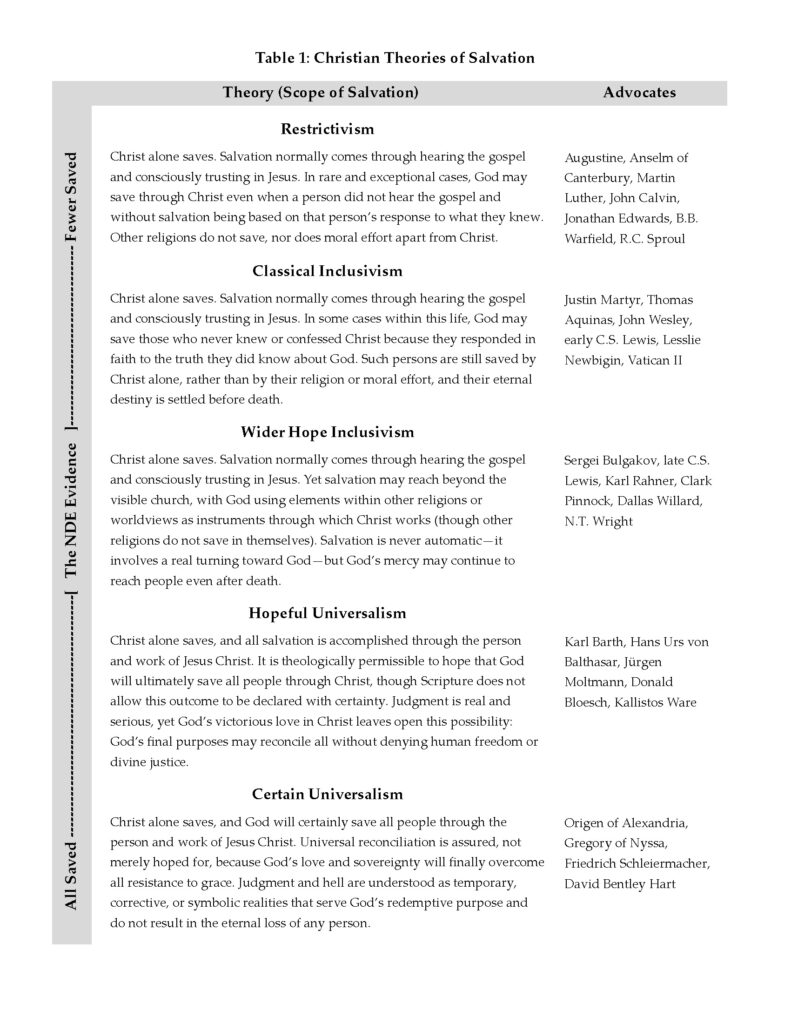
Surely the taxonomy can be improved, but I hope it captures the schools of thought well enough to make this juxtaposition meaningful: Where does the NDE evidence fit on this “scope of salvation” continuum?
Some would argue, and rightfully so in this respect, that it does not align with any point on the continuum because the totality of NDE evidence does not yet confirm that “Christ alone saves,” a cornerstone element of each Christian theory. That indeed is true. “Jesus” is mentioned in only about one-third of Western NDE accounts that include a divine being, and non-Western accounts include even fewer mentions of someone the experiencer called “Jesus.”3
However, that objection focuses on the way of salvation. Our inquiry here—and the key distinctive across the five categories in this taxonomy—involves the scope of salvation. Does the NDE evidence enrich that debate? Where is it most closely aligned with these five Christian theories?
Seemingly not at the top or the bottom of this continuum. The NDE evidence does not fit suitably with Restrictivism, given the many heavenly accounts from those outside the Christian faith, or with either form of Universalism, given the many hellish accounts, estimated at 15 to 20 percent of all NDE reports.4 Instead, the eyewitness accounts—again, the totality of them—appear more comparable to the inclusivist camps.
Here’s why. Stories abound of people who were not followers of Jesus but were still welcomed into a heavenly realm—sometimes by Jesus himself (whom they certainly did not expect to see), sometimes by what they describe as a supreme being of light who expressed nothing but unconditional love and acceptance. One of the leading NDE researchers of the past three decades summarized the field’s findings like this:
People of every religious affiliation have reported NDEs, including Buddhists, Christians of all denominations, Hindus, indigenous religious adherents, Jews, and Muslims. Religious non-adherents have also reported NDEs, including agnostics, atheists, and people who describe themselves as spiritual but not affiliated with an organized religion. … Several researchers have found no relationship between NDErs’ religious affiliation or non-affiliation prior to their NDEs and either the incidence, contents, or depth of their NDE.5
Varying worldviews, similar blissful content. It comports with the inclusive versions of Christian soteriology, but we can drill down even further. There are also copious “postmortem conversion” stories—reports of people crying out to God or Jesus in the midst of a distressing NDE and then being rescued and apparently redeemed through their thief-on-the-cross faith. If such tales are true, then NDEs appear to align more closely with Wider Hope Inclusivism than Classical Inclusivism.
That’s where I’ve landed in this thought experiment. After four years of mining these data, a circuitous journey from skeptic to surprise, my preliminary conclusion is the NDE evidence parallels the Wider Hope scope of salvation better than it does the other Christian models.
But that’s if and only if several conditions are satisfied.
What Must Be True for NDEs to Illuminate Theology?
These are the critical caveats. For near-death experiences to speak into the mystery of salvation, several conditions must hold. Otherwise, NDEs will remain pastorally provocative but theologically irrelevant.
First, NDEs must be genuine encounters with a supernatural realm rather than dreams, hallucinations, drug effects, or products of a dying brain. And second, those reporting NDEs must be reliable witnesses, accurately recounting their experience.
Based on a half-century of interdisciplinary research, the cumulative evidence increasingly supports both these conditions. Most probatively, hundreds of “corroborated” cases—where people returned with information, later verified, they could not have gained or inferred through normal sensory means—continue to resist materialist explanation. At a minimum, such cases (technically known as “veridical” accounts) make it “more likely than not” that some NDEs represent real encounters with another realm, and that many reports are substantially reliable.
A third condition has less evidential support: NDEs must reflect a person’s final eternal destiny, rather than a provisional possibility. Critics typically claim that even if real, NDEs do not indicate a person’s standing before God or where they will spend eternity, offering at least two reasons: (1) Hebrews 9:27 says “people are destined to die once, and after that to face judgment,” so if someone came back, they never died, they were not judged, and they could not have seen an afterlife, and (2) Scripture warns of satanic deception, including Satan’s ability to masquerade as an angel of light (2 Cor. 11:14), raising the prospect that some of these euphoric encounters mislead people into a false sense of eternal security.
The counterarguments are also compelling: (1) the Hebrews passage need not be interpreted so woodenly, particularly when juxtaposed with the many stories in Scripture where people died and were raised again to a physical life, and (2) the Satan hypothesis is biblically viable but conjectural, as there is no evidence for it in the NDE data. Plus, there is this empirical finding suggesting NDEs may reflect one’s future, final destiny: Few blissful NDEs include any kind of “change or else” divine mandate, which one would expect if these were mere glimpses of what could be.
Despite the spirited joust, from an evidential standpoint this third condition remains unresolved and, in fact, may be unknowable.
There is also a fourth condition, resurrecting millennia of debate: Experience (like NDEs) can inform theology. Proponents argue that human experience—scientific discoveries, pain and suffering, spiritual practices, awe at a sunset, etc.—has always played a role in doctrinal development, refining theology and preventing it from becoming detached from reality (think Galileo). Critics counter that human experience is subjective, fallen, and culturally conditioned, and therefore must never function normatively. We can, however, dovetail the truths in these two positions: The more widespread and phenomenologically consistent NDEs become, the stronger the case that they may responsibly inform—though not govern—questions about life after death.
Overall, then, these “four conditions” for NDEs to illuminate theology appear largely but incompletely satisfied. As such, they do not offer fatal ambiguities in the case, but arguably probable cause to continue the conversation.
The Church Can Lead This Conversation with Familiarity, Not Fear
So where does all that leave us? Can near-death experiences enrich the salvation debate?
I think they can, with circumspection, just as they’ve shaped afterlife discourse across societies for centuries. 6 Moreover, given what is at stake theologically, it is long-overdue for the church to engage this debate.
The mounting NDE evidence, as argued above, gestures toward a more expansive vision of God’s saving reach than Restrictivism allows, without flattening into any form of Universalism. The data fit most comfortably within a “Wider Hope Inclusivism” framework—one that leaves room for God’s mercy to encounter persons beyond the visible boundaries of the church, possibly even at eternity’s threshold. That said, it is premature to recalibrate Christian soteriology because of NDEs. The evidence is not yet conclusive; the verdict is not yet in.
At the same time, the evidential trajectory is increasingly difficult to ignore. Near-death experiences are no longer a fringe curiosity but a global phenomenon, estimated in the hundreds of millions worldwide.7 and marked by cross-cultural consistency and growing scientific scrutiny, including controlled experiments. With each decade of analysis, we inch closer to beyond-a-reasonable-doubt evidence of their supernatural authenticity—and to all the profound, eschatological implications that entails.
As this trajectory persists, the church must lean in, inclining toward investigation of NDEs instead of summary dismissal. Ultimately, familiarity with the empirical evidence, not fear of it, will preserve church leadership on questions of life after death.
Footnotes
- Kenneth Ring, “Foreword,” in The Handbook of Near-Death Experiences: Thirty Years of Investigation,eds. Janice Miner Holden, Bruce Greyson, and Debbie James (Praeger, 2009), vii (emphasis in original).
- Michael Zigarelli, Evidence for Heaven: Near-Death Experiences and the Mounting Case for the Afterlife (Baker Books, 2026).
- For the statistic of one-third, see Bruce Greyson, After: A Doctor Explores What Near-Death Experiences Reveal About Life and Beyond (St. Martin’s, 2021), 153. Greyson, a University of Virginia School of Medicine psychiatrist, bases his conclusion on forty-five years of data collection, amassing more than one thousand subjects in his primarily Western dataset.
- See, for example, Nancy Evans Bush, “Distressing Western Near-Death Experiences,” in Holden, Greyson, and James, Handbook of Near-Death Experiences, 81. Moreover, Bush reveals, distressing NDEs unfold in a similar pattern to blissful NDEs: “A sense of movement, possibly an out-of-body experience, intense emotions, ineffability, light or darkness, encounter with non-material beings, life-changing messages.”
- Janice Miner Holden, Jeffrey Long, and B. Jason MacLurg, “Characteristics of Western Near-Death Experiencers,” in Holden, Greyson, and James, Handbook of Near-Death Experiences, 118.
- See, for example, Gregory Shushan, Near-Death Experiences in Ancient Civilizations: The Origins of the World’s Afterlife Beliefs (Inner Traditions, 2025). For an article-length treatment of the subject that includes a broad sampling of global NDE reports, see Gregory Shushan, “Diversity and Similarity of Near-Death Experiences Across Cultures and History: Implications for the Survival Hypothesis,” International Review of Psychiatry 37, no. 2 (February–March 2025): 95–101.
- See, for example, Pim van Lommel, “Dutch Prospective Research on Near-Death Experiences During Cardiac Arrest,” in The Science of Near Death Experiences, ed. John C. Hagan (University of Missouri Press, 2017), 40, citing work from the Gallup organization and the University of Konstanz in Germany; and Greyson, “Incidence of Near-Death Experiences,” Medicine and Psychiatry 1 (December 1998): 92–99.