
Last week, Margaret Diddams discussed the important mission that guides Christian Scholar’s Review (CSR)—the “why.” As someone who studies Christian higher education, I also find that faithful institutions have theologically rich and informed mission statements. Unfortunately, many Christian institutions with great mission statements do not consistently demonstrate the operationalization of that mission in all they do. That’s where CSR can help.
CSR provides numerous resources that can help Christian institutions think through and imagine what it means to undertake all of learning in light of the Christian story. For example, in my studies, evangelical Christian institutions do an excellent job of providing basic biblical and theological education. The two major evangelical partnerships in higher education are the Council of Christian Colleges and Universities (CCCU) and the International Association of Christian Education (IACE). The institutions with each of these partnerships (and there is some crossover) all require a considerable number of required Bible courses. CCCU institutions average 3.6 courses of Bible/theology, and IACE institutions average four. That is a clear operationalization of the Christian mission.
The challenge, however, is helping faculty, administrators, staff, and students integrate those components with the whole university and all of their lives. If one looks at the general education course descriptions of courses outside of Bible and theology, one finds less evidence of what we call Christ-animated learning. For example, 35% of CCCU institutions do not include Christian language in any non-Bible/Theology gen ed course description. Another 21% include it in only one course. Similarly, 45% of IACE institutions do not include Christian language in any non-Bible/Theology gen ed course description. Another 17% include it in only one course.
What that means is half of these Christian institutions show little to no sign of operationalizing their Christian identity outside of non-Bible/Theology courses. As a result, students in these institutional settings may encounter a two-sphere view of biblical knowledge and general education knowledge (granted a course description does not summarize a whole course).
That is not consistent with their mission or vision statements. The CCCU claims “the value of integrating the Bible—divinely inspired, true, and authoritative—throughout all curricular…aspects of the educational experience.” IACE’s mission “is to unify, synergize, and strengthen collective conviction around biblical orthodoxy and orthopraxy, cultural witness, scholarship, professional excellence, and resourcing of Christian education at all levels.”
This is where what we do can help. We currently provide multiple avenues and resources for helping the Christian academic community think through how Christ can animate every aspect of the university, in areas such as general education, education within one’s discipline, the co-curricular, and administration. We support this aim in several ways.
First, our historical role has always been supporting a high-quality, peer-reviewed print journal that advances interdisciplinary Christian scholarship. CSR has been doing that for over fifty years. In my own experience, I found CSR to be an outlet for thinking through how to integrate Christianity into all aspects of the curriculum.
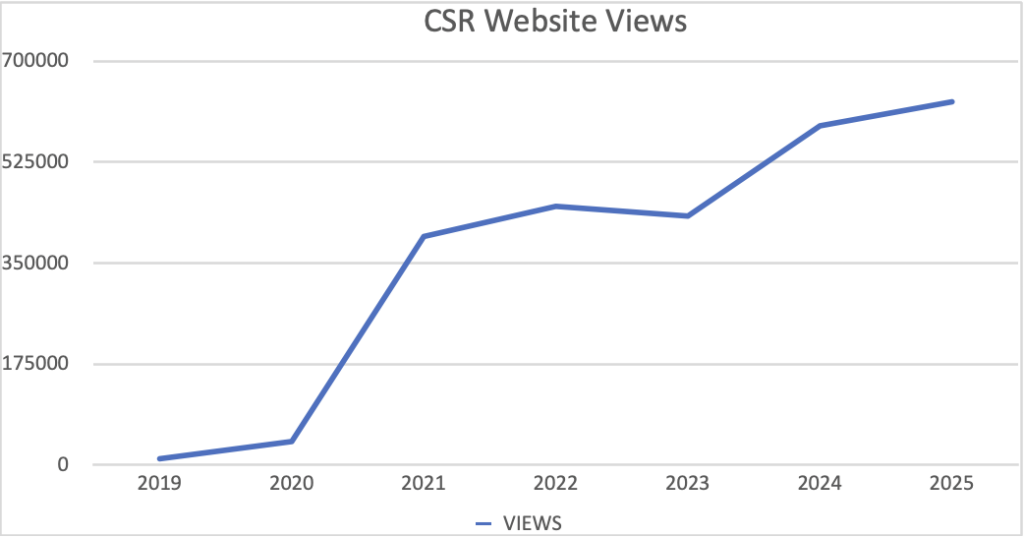
Second, we expanded our web presence significantly starting in 2019. As a result, the viewership on our website has expanded from 10,564 in 2019 to 630,018 in 2025. In fact, this past year, we once again reached a record number of views per year.
Third, as part of our website, we began offering blog posts five days a week in the Fall of 2020. As mentioned in our description of the Christ Animating Learning Blog page, we view the blog as a platform for cross-disciplinary conversations about how Christ can animate learning. These conversations could include any of the following:
- Write about a recent class experience where something came up regarding how Christ can animate learning.
- Critique a current theory in your discipline from a Christian perspective.
- Edited excerpts of a past or forthcoming book
- Share a brief e-mail interview with an author of a book or article (they want publicity for their book)
- A short e-mail interview with a Christian in your field about his/her work
- Share your own thoughts about trends in your discipline as interpreted through faith.
- Link to a podcast you conduct with a brief overview of content (e.g., timestamps for topic transitions/content headers)
- Other imaginative musings on Christ and learning….Fun Fact: Our top overall post from last year was by a chemist about the origins of a Christian hymn—Ben McFarland’s June 26, 2024, post, https://christianscholars.com/the-true-story-of-the-love-of-god-is-greater-far/.
The blog has increased our web traffic tremendously. As a result, in the past year, we had sixty-five blog posts that received over 1,000 views. We also have a great interdisciplinary team of twenty-seven regular blog contributors and a steady stream of other contributors. That being said, we could use more regular contributions from scientists and health professionals.
Fourth, in addition to the blog, Todd Ream started the Saturdays at Seven conversation series in the fall of 2023. Since that time, he has hosted almost 150 conversations with key Christian faculty, administrators, and leaders in various fields. If you know of others who you think would like to receive our weekly blog and podcast e-mails, please feel free to send us their name and e-mail address.
Finally, the website also has pages devoted to various resources, such as a bibliography of the top Christ-animating learning books (please feel free to send us suggested additions). Our resource pages also include listings of various Christian professional societies and Christian disciplinary journals. We also have listings of centers and institutes at Christian colleges and universities that address Christ-animated learning, as well as Christian Study Centers located adjacent to secular universities.
Our editors undertake all of this work for CSR voluntarily without any compensation. Thus, all of the funding from CSR’s sponsoring institutions goes to supporting the website and the print journal. This spring, we received a $10,000 matching gift to extend the work of the journal. With your matching gift support, the journal can continue to serve as a conduit for Christian scholars to live out their vocation. We invite you to partner with us through a tax-deductible donation. Thanks for your support.