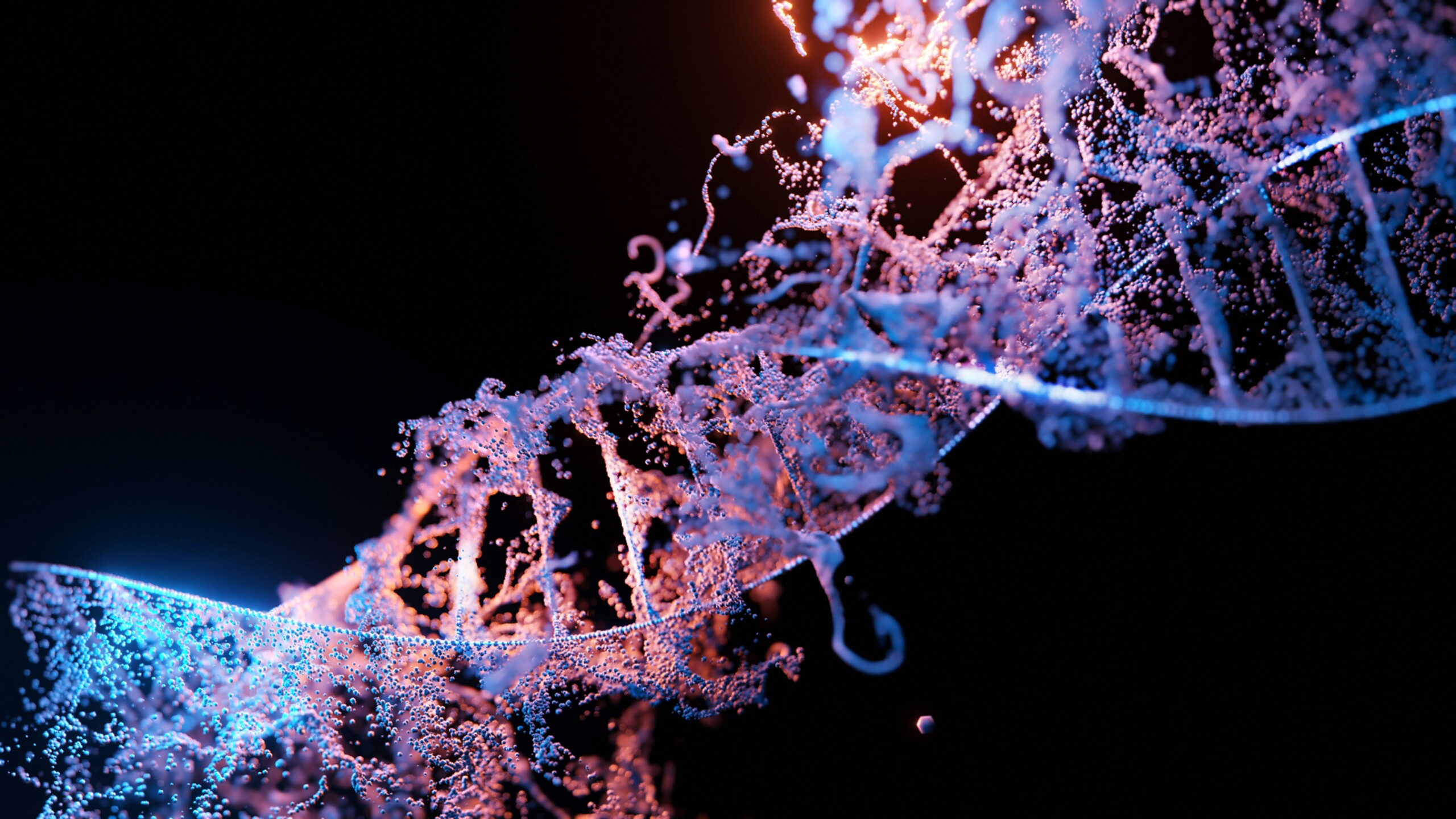
After a good conversation on genetics with a dear colleague, I started pondering the following question: Isn’t it interesting how one’s training and worldview make such a vast difference in an approach to a topic? One thought led to another, and this is where I landed…
Even though the idea about differing worldviews can be applied to almost every topic in our world and our lives, I want to zero in on human genetics. That is, to consider the long sections of DNA that reside between segments of DNA directly related to specific genetic traits such as eye color, height, etc. Years ago, after a good bit of research on DNA, these long sections didn’t seem to carry any function except to take up space on the chromosomes. Unsurprisingly, these sections were named “junk DNA.” Richard Dawkins captured this idea with, “The greater part (95 percent in the case of humans) of the genome might as well not be there, for all the difference it makes.”1
When I first heard the term “junk DNA,” the farm girl and soil scientist in me perked up her ears to see the application of this thought. Since my research interests focus on manure, soil health, and water quality, I really like opportunities to see new ways to apply the ideas of “one man’s trash is another man’s treasure.”
Upon further learning about “junk DNA” and research associated with it, I think the principle of seeing “treasure,” not “trash,” is spot-on for those genetic material segments with their yet undiscovered potential. And I’m not alone in that sentiment. Much of the current research focus in genetics is targeted to “junk DNA” sections in the speculation that they act as on/off switches for many chronic illnesses and cancer. Hence, they can truly be considered as “one man’s treasure” to combat disease progression and devastation in the lives of patients with chronic illness(es) or cancer.
As a scientist living with multiple chronic illnesses and cancer, I’m all about research into “junk DNA.” The research might not be of direct help to me now, but it could be life-giving to generations yet to be diagnosed or their children yet to be born. That next piece of info gained from research could be key to progress in treatment or a cure. With this mindset, we can see all parts of our DNA as important and necessary, whether we understand them or not. Years ago, King David alluded to this idea with You made all the delicate, inner parts of my body and knit them together in my mother’s womb. Thank you for making me so wonderfully complex! Your workmanship is marvelous—how well I know it (Psalm 139:13-14 NLT)2 Or in the words of Ethel Waters, “I am somebody because God don’t make no junk!”3
Obviously, neither David nor Ethel had the technology or training to know or understand much of anything about “junk DNA” (or PCR or CRISPR or …). Yet they both had the devoted hearts and minds that God and others valued and noted as being special (see 1 Samuel 13:14).
And their kind of heart is what I hope God sees in my life, whether I can begin to understand geology, genetics, or His goodness (or not.). But I do know this deep in the soil of my soul – only God can take what others consider as “faulty” or “disabled” in me and use it for His glory and the good of His people (see Romans 8:28). Only God can use what I wish wasn’t there or didn’t happen, for much good, including the saving of many lives (see Genesis 50:20). Only God wasn’t limited by genetics, geography, or generational sin when He took my sin and exchanged it for His righteousness with His only beloved Son’s death and resurrection (see 2 Corinthians 5:21 and John 3:16).4
To return to the idea of differing worldviews and approaches to life, Ethel Waters, a devout Christian and talented Gospel singer, saw the good, the beauty, the wonder in God’s forming of her (and everyone else). In contrast, Richard Dawkins, devout atheist and trained scientist and philosopher, only saw the mechanics, the usefulness for now, the leftovers from what randomness and natural selection alone lifted from a watery goo to walking-around people.
As research and technology have advanced, the dichotomy of these two viewpoints is especially interesting to me as a Christian and as a scientist. Because what once was rejected as “junk” is now the focus of millions of dollars and countless hours spent trying to unlock the hidden keys in these strings of seemingly useless genetic materials.
Yet as the writer of Ecclesiastes tells us, there is nothing new under the sun (Ecclesiastes 1:9 ESV). And nothing new includes ideas and inclinations, viewpoints and vision, people and points of reference for our everyday lives (Ecclesiastes 1:9 ESV). There have been over two millennia full of folks striving to understand the parts, particles, and processes of the creation around and in us. Despite many successes and struggles in science, no one has fully achieved the answers to the beyond understanding innate beauty in even one person, process, or particle, much less the plethora of knowledge essential for just one day to proceed.
All the while, our Good God continues to sustain His creation, one minute, one ecosystem, and one organism at a time. Not only did He not “make no junk,” God didn’t just leave His creations to survive on their own with hopes that natural selection and randomness would give the necessary good results for life, growth, and the next generation.
God made, and God stayed.
And God remains now in the providing so that we lack nothing and can experience a fullness to life that comes only from Him, even in the ravages of chronic illness and cancer (see Psalm 23:1 CEB and John 10:10).
I think it’s especially appropriate that Mrs. Waters often sang the song “His Eye is Upon the Sparrow”3 for Billy Graham’s filled-up and far-reaching crusades held all over the world. Because this song points straight to the essential worldview that all of us need for thriving in life, no matter the composition of our DNA. Creator God didn’t just make the sparrow, the sun, and every single one of us. He gives everything every day needed for life for the birds, the flowers, the fields, and us, too (see Matthew 6:25-33).
Please take a minute (or two) to delight in the words of that hymn while gratefully pondering the grace our Good God gives us to come and ask questions, find answers, and receive ideas and wisdom for help for our lives and others, too.
Lyrics for “His Eye is Upon the Sparrow”4
Why should I feel discouraged?
Why should the shadows come?
Why should my heart be lonely
And long for heav’n and home,
When Jesus is my portion?
My constant Friend is He:
His eye is on the sparrow,
And I know He watches me;
His eye is on the sparrow,
And I know He watches me.
I sing because I’m happy—
I sing because I’m free—
For His eye is on the sparrow,
And I know He watches me.
“Let not your heart be troubled.”
His tender word I hear,
And resting on His goodness,
I lose my doubt and fear.
Though by the path He leadeth,
But one step I may see:
His eye is on the sparrow,
And I know He watches me;
His eye is on the sparrow,
And I know He watches me.
I sing because I’m happy—
I sing because I’m free—
For His eye is on the sparrow,
And I know He watches me.
Whenever I am tempted,
Whenever clouds arise,
When songs give place to sighing,
When hope within me dies,
I draw the closer to Him;
From care He sets me free:
His eye is on the sparrow,
And I know He watches me;
His eye is on the sparrow,
And I know He watches me.
I sing because I’m happy—
I sing because I’m free—
For His eye is on the sparrow,
And I know He watches me5
Footnotes
- Richard Dawkins, 2009, as quoted by C. Luskin (2024) in “Junk DNA From Three Perspectives: Some Key Quotes” at https://scienceandculture.com/2024/05/junk-dna-from-three-perspectives-some-key-quotes/ as accessed on 1/13/26.
- How appropriate that I’ve heard Psalm 139 referred to as being “the biologist’s Psalm!”
- Quote first attributed to Ethel. Waters and accessed on 1/13/26 at https://drhreflections.com/2024/07/12/god-dont-make-no-junk-%E2%88%99/
- Lyrics for “His Eye is on the Sparrow” by Civilla D. Martin (1905) as listed on www.hymnary.org and accessed on 1/14/26.
- f you can’t say the same about your life today, please hear me on this. Now is always the right time to come to God and tell Him that you’re a sinner and you want to believe Him and receive His mercies and grace forever (see Romans 10:9 and Hebrews 10:10). And if you’d like to talk more on this or anything from this article, please don’t hesitate to contact me at drbethmadison@outlook.com