
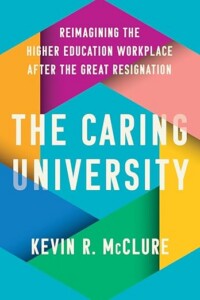
The Caring University: Reimagining the Higher Education Workplace After the Great Resignation
Three recent events at three Christian colleges within 200 miles of one another offer a glimpse into the muddled reality of higher education. A midwestern Christian college announced it was closing at the end of the current school year. A neighboring school announced the completion of a quarter-billion-dollar campaign only two years after making significant budget cuts. Finally, a third school, which is a partner for the first school and a competitor to the second, announced major budget revisions resulting in the elimination of several positions and programs as it seeks to right-size the institution for the future. If ever there was a time for care, it is now. Each story is significant to the hundreds of employees who work at these institutions and face the ebb and flow of the workplace.
Higher education is facing a perfect storm: market pressures, political shifts, post-pandemic effects, demographic changes, and workforce disengagement threaten to unravel the creative power of colleges and universities (henceforth, universities). Kevin McClure’s book, The Caring University, is an important volume that names the reality of disillusionment with the higher education workplace. Much of the perfect storm is related to higher education’s adjustment to academic capitalism, where schools try to become masters of the budgetary destiny. This is an important critique throughout the book. Despite the storm and the adjustment, McClure argues that this is the moment to generate creativity. The book invites institutional leaders to invest heavily in the culture of the workplace to recruit, grow, and retain talented employees.
The premise of the book is appreciative of the university. Most leaders would agree with the author’s basic assumption: “at the heart of the Caring University is the premise that all employees have talent, all employees should be treated as whole people, and all employees deserve to be cared for as essential contributors to organizational success” (26). However, most university structures are designed in contradiction to this belief, tending to undermine research-backed efforts for attracting, growing, and retaining talent. Ironically, universities have invested significant effort to understand the student experience; however, questions about workplace culture and employee well-being remain not only unanswered but not yet asked.
McClure asks and explores these questions. He conducts his research on the heels of the COVID-19 pandemic amidst the workplace trend called The Great Resignation. He explores timely quantitative and qualitative data on workplace well-being and demonstrates how widespread disillusionment with the university results in demoralization, disengagement, and burnout. Workplace shifts have continued since his initial research (Quiet Quitting, The Great Stay, The Great Detachment, and The Great Retrenchment), yet his question remains valid: how do university leaders attend to workplace culture to ensure an excellent organizational environment for employees, as well as for students?
McClure features the voices of faculty and staff, including graduate students, postdocs, and contingent faculty. He listens to understand what contributes to and detracts from a workplace culture of engagement and employee well-being. He captures voices to offer a descriptive perspective; yet he also listens toward action: for example, a professor of veterinary science offers an anecdote to leaders, “you can’t get performance out of an animal without considering how you take care of its physical and social needs” (239).
He makes many voices known, yet his audience is not primarily his subjects. His audience is university leaders, namely, deans, provosts, and presidents: “by virtue of supervising employees, managing resources, and shaping practices and policies, leaders are in the best position to bring the Caring University to fruition. Instead of calling out or shaming leaders, my goal is to invite them in. As co-constructors of the Caring University, leaders can and should be beneficiaries of it” (15).
McClure’s argument outlines six changes needed for cultivating well-being and engagement in the higher education workplace. His approach is informed by the integrated talent management model from the University of California and mirrored to the 2022 United States Surgeon General’s report on workplace mental health and well-being. He describes the Caring University as a place where:
1. employee experience is a strategic priority,
2. workplace conditions are created for real not ideal workers,
3. professional growth and compensation are regularly evaluated,
4. equity and belonging are actualized through user responses,
5. shared governance is also collective action, and
6. administrators lead through care and compassion for others and for themselves.
Universities are pejoratively known as organized anarchies and appreciatively known as professional bureaucracies. McClure adopts the latter description and argues that they evidence several beneficial characteristics, namely deliberative decision-making (key to democratic practice), pride of ownership (shared governance), deep affiliation and attachment by employees, and places of deep personal meaning, identity, and belonging (43). He appreciates this institutional culture as a key asset of the university. These are places with strong ties; yet this asset makes change a difficult challenge.
McClure continues his optimism by highlighting the opportunities within the bureaucratic designs of universities. He discovers places of engagement and well-being within universities, believing that universities have pockets of success that deserve amplification (the book is rich with anecdotes from interviews). Additionally, he prescribes open organizational behaviors stemming from recent organizational science literature. He argues for broad information sharing, stakeholder participation, acknowledgment of differing values and interests, and fairness-based outcomes (53). He seeks organizational justice that benefits everyone. He is arguing for trust and connection across the university, and he believes it is possible to achieve within the structures of the current university.
The strength of the book is in Chapter 3, where he describes the experience of real employees (faculty and staff) who create and sustain the culture of a university. He suggests that universities create rules and policies that work for real rather than ideal workers. The real worker is someone who seeks to contribute, albeit no longer confined within the 5-day, 40-hour work week. It is amazing we ever make it to work, given the complexity that exists in our homes and families, not to mention the complexity that lives within ourselves. McClure acknowledges the complexities of the adult-at-work, including disillusionment with the traditional workday, personal suffering, responsibilities of caregiving, and disabilities (visible and invisible). He offers several approaches that echo the Surgeon General’s report: “Safety over fear. Flexibility over rigidity. Wholeness over separation. Dignity over deficits” (112). He finalizes the chapter with appreciation for Offices of Student Affairs, proposing that the culture and practice of the student affairs office ought to lead and guide the culture and practice of the human resources office.
The Caring University is a well-researched book. It is thorough in identifying the issues that complicate higher education across the public and private sectors. It is appreciative in an uncompromising belief in potential for structural improvements. The book is practical in its insights as it invites leaders to be co-creators of the Caring University through the practices of holding pain and practicing compassion.
The tone of the book, at times, seems oriented toward administrators taking the first step. McClure can be heard as saying, “If administrators would begin caring first, then The Caring University would begin to unfold.” Administrators may read the middle chapters (employee rights, benefits and pay) and begin to feel defensive. McClure is trying to do the opposite, yet the method of the book (highlighting the voices of employees while framing the audience as administrators) lends itself toward such a reading. Even so, the call for the Caring University is a call for mutuality and trust.
McClure’s invitation is clear: caring leadership is now a necessity for all of us in higher education. He is not asking the university to remake itself. He is not blaming any one group. This is not some radical, innovative proposal. He is asking for a renewed posture amidst existing systems. He longs for an organizational workplace that puts its people first by ensuring that educational leaders are formed and equipped to care. Chapter 7 outlines the difficult task of leading in higher education. He identifies the need to care for administrators as much as administrators need to care for the broader university. His resolution to the leadership conundrum is a list of ten actions for caring leaders: compassion, self-awareness, listening, intellectual humility, vulnerability, trust-building, critical hope, responsibility-taking, equity-mindedness, and organizational thinking (250). We need leadership development that puts these “soft skills” front and center for academic leaders.
The book is particularly helpful for leaders in small, private, Christian universities. Christian colleges face additional internal and external factors: culture wars, LGBTQIA debates, denominational fragmentation, small endowments and tuition-based models, and conflicts between cultural movements and confessional commitments.[1] This is not an easy environment for Christian institutions. Even so, the Christian university seems apt to answer the question, “How do we care?” The words of Jesus (and Paul) invite the necessary posture for The Caring University. Paul’s Christ hymn (Philippians 2) invites participation in Christ through open-handedness (kenosis). We have the spiritual resources to remember, lament, and repair. These are not practices of ease, yet together, as administrators, individuals, teams, and departments, we can begin to release our grip on the recent past, including our capitulation to academic capitalism. We can lean into the practices that create a caring university because of our spiritual inheritance. The “soft skills” of the gospel echo McClure’s own list. My guess is that many already live in such a way. How do we ensure that these open-handed, compassionate actions are noticed, amplified, and rewarded? This is the beginning of a cultural shift toward remaking a caring university.
[1]. See Helen Huiskes, “In the Fight Over ‘Wokeness,’ Christian Colleges Feel Pressed to Pick a Side,” Chronicle of Higher Education, August 31, 2023, https://www.chronicle.com/article/in-the-fight-over-wokeness-christian-colleges-feel-pressed-to-pick-a-side.