


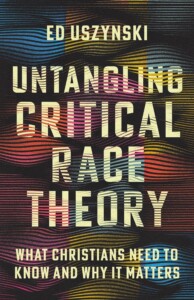
Untangling Critical Race Theory: What Christians Need to Know and Why It Matters
Over the past five years, Christians have had much to say about Critical Race Theory (CRT). Unfortunately, the most widely heard voices have tended to favor demonizing over perspective-taking. Thankfully, there is now an accessible book on CRT that corrects this error. Author Ed Uszynski not only has the academic credentials to write on this subject, but he also brings decades of Christian ministry experience to the table. Because he approaches secular theories with humble confidence in the gospel (rather than political ideology, whether conservative or progressive), Uszynski can respond to their ideas without resorting to either false caricatures or uncritical embrace. As stated in the book’s introduction, his threefold purpose is to provide “a primer on CRT, a short history of the Marxism and Critical Theory from which it grew, and a practical investigation of what CRT’s concepts mean for the church” (14). Across 15 chapters, Uszynski demonstrates a good-faith effort to fully understand and fairly represent differing ideological and racial perspectives in relation to one another and to Scripture.
Uszynski’s perspective-taking approach sheds vital light where polemical approaches generate mostly heat. For instance, he sees Marx not only as a “Christ-less villain” in his revolutionary philosophy (48), but also a brutally honest observer of sinful humanity’s greed and exploitive practices. As such, Uszynski concludes: “The world doesn’t need more Marxists. It needs more Christians who see what Marx and his followers see, and who will courageously bring the gospel to bear on matters they’d rather ignore” (36). Similarly, while Marxism’s 20th-century offspring, Critical Theory, lacks moral norms anchored in the Creator’s design, it does recognize the pervasive corruption of power in human culture and the self-interest often undergirding moral pretensions. Critical Theory lifts up the marginalized perspectives of minority groups, which understandably makes it attractive to Black, Indigenous, and People of Color (BIPOC)—hence the emergence of Critical Race Theory.
After a brief account of CRT’s origins, Uszynski outlines its central argument about race in America, helpfully clarified through a series of hypothetical quotes contrasting CRT’s perspective with commonly held assumptions about race. In chapter 6, Uszynski presents core tenets of Critical Race Theory and identifies four aspects of each tenet: what it means, what it counters (in society), why it’s important, and how it can be misused. If the first three aspects involve seeing through the eyes of CRT scholars, the fourth entails stepping back to take in a larger perspective, placing truth above ideology. For instance, Uszynski affirms CRT’s claim that racism is “ordinary”—i.e., its legacy in our culture is pervasive—yet he also recognizes that assuming the omnipresence of racism can lead to “finding it in some places it doesn’t really exist” (97–98). Similarly, although it is important to recognize the legitimacy of long-marginalized minority perspectives, this shouldn’t be taken to mean that “‘black is always right and white is always wrong’” (100). Uszynski takes pains to explain CRT’s tenets and clarify where they differ from distortions. For example, CRT’s skepticism toward legal or institutional objectivity “stems not from a post-modern disdain for truth,” as some may suppose, “but from a history of intentionally suppressing nonwhite voices” (104).
The fact that one can identify both valid ideas and errors within CRT’s orbit helps explain why people wearing ideological or political blinders are so divided on the subject. Chapter 7 surveys this problem across the cultural spectrum. Chapter 8 homes in on Christians who have been “discipled by our political climate to see enemies wherever there’s initial disagreement,” and who thus resort to caricatures and slander in the name of winning a culture war or fighting heresy,1 rather than pursuing mutual understanding and fuller unity in Christ.
The second half of Untangling Critical Race Theory focuses on shaping a better Christian response to CRT. Uszynski models an approach that is beholden neither to the metanarrative of progressivism nor the mythology of conservatism, but rather to biblical justice and Christ’s redeeming work. Within this frame, CRT becomes “an analytical tool” for diagnosing problems (111), rather than a worldview or quasi-religion, as some critics have claimed it to be.2 When Christians focus on defeating CRT as a false religion rather than measuring the church’s record against biblical justice, or hunt for heretics rather than listening to the voice of the marginalized, we miss the opportunity to learn, grow, and practice the love of Christ. Obsessing over the stick in our brother’s eye, we miss the log in our own. Chapter 9 identifies five such blinders, including cross-cultural shallowness, theological myopia, and selective reading of Scripture.
Chapters 11 and 12 address the litany of concerns many Christians have about CRT. I appreciate Uszynski’s ability to affirm these and then deftly flip the script. For instance, when Christians complain that CRT over-focuses on race, he says: “Of course it does. . . .CRT exists as a reaction to those who conveniently now never consider the racial implications of living in a country that for centuries made everything a racial implication” (170). To those who claim that learning from CRT constitutes a devaluation of Scripture, he responds: “We shouldn’t need CRT, but for too long the white American church hasn’t paid careful attention to what the Bible says about racial or ethnic division, our responsibility regarding various social injustices, or how we protect marginalized and vulnerable populations. What do we do when the Bible could be enough but hasn’t been for many cultural and political reasons?” (158, emphasis added). By affirming Christians’ zeal for Scripture and challenging their lack of faithfulness to God’s Word, Uszynski opens up space for conviction and fuller perspective.
If the deeper problem is not Critical Race Theory, but rather the western/white church’s “uncritical race theory” (131)—i.e., our subconscious or even willful blindness toward the legacy of racism—what are Christians to do? Uszynski addresses this question in terms of two main goals: “Redeeming ‘Social Justice’ from Injustice” (chapter 13) and “Healing from the Persistence of White Supremacy” (chapter 14). Regarding the former, he unpacks conceptions of justice in the Hebrew Bible that frequently appear in connection with social groups God identifies as needing special care and protection from the powerful. When Christians understand and promote such justice, they can redeem modern-day distortions of the concept; but when they reject it, Uszynski contends, they end up fueling those distortions—from the social gospel and liberation theology to secular social justice efforts, which put too much faith in political programs and the presumed goodness of the marginalized.
Chapter 14 focuses on exposing the insidious ideology of whiteness baked into the dominant American culture over centuries. While white supremacy has not always taken the form of racial hatred, it has necessarily fostered whiteness as the norm, arranged society as a racial hierarchy, and fueled the concentration of political, economic, and cultural power in the hands of white people at the expense of BIPOC. Until we face this historical reality and its effects on the present, white people in the church will still tend to view themselves (often subconsciously) as the cultural norm and will disproportionately control power and material resources in their congregations, denominations, and ministry organizations. Conversely, if we listen deeply and patiently to the experiences and perspectives of racial minorities, we can begin to see what we’ve failed to notice and better love our fellow Christians.
Chapter 15 concludes the book with a positive vision of how the church, at its best, approaches racial disparity and disunity. Uszynski commends the example of Christian leaders who hold a high view of biblical truth, avoid false binaries, and make justice a core element of their discipleship. These leaders focus neither on attacking the bogeyman of CRT nor “trying to figure out who the racists are in the room,” but rather on “addressing cultural patterns and ways of operating that work against being the people of God” and “practicing how to be in relationship with people different from themselves” (236–37).
The authors of a related book, Critical Dilemma: The Rise of Critical Theories and Social Justice Ideology—Implications for the Church and Society, would largely agree with what Uszynski commends here.3 In it, Neil Shenvi and Pat Sawyer offer a thorough, thoughtful, and fair-minded representation of Critical Theory, including CRT, and they devote a chapter to positive insights that Christians can and should affirm. Shenvi and Sawyer sound a lot like Uszynski when they write, “Christians cannot be so opposed to contemporary critical theory that they deny true claims simply because they sound woke. . . . Moreover, critical theory is not the only danger. Racism (including its concentrated expression in white power and white nationalist groups), sexism, and violence toward LGBTQ+ people are all real and soul-destroying.”4
Nonetheless, Shenvi and Sawyer ultimately argue that CRT is incompatible with Christian faith. Whereas Uszynski approaches CRT as a potentially useful analytic tool (while acknowledging that critical theory functions as a worldview for many progressives), Shenvi and Sawyer suggest that “[i]ts ideological presuppositions, claims, and commitments are much too broad, much too foundational and totalizing for that.”5 Although Uszynski acknowledges distortions within CRT’s orbit here and there, Shenvi and Sawyer regard them more as a feature than a bug, devoting a chapter to such problems as overemphasizing racial identity, exaggerating the ubiquity of racism, treating all racial disparities as racism, and reducing American law and norms to whiteness. If Uszynski’s take on CRT is more charitable and flexible, theirs is arguably more rigorous—and, at times, more rigid.6
Yet Shenvi and Sawyer reveal a chink in their position’s armor—and implicitly acknowledge another possibility—when they state that critical theories “often function as a worldview/metanarrative” (emphasis added) and clarify that “we are not saying that they must function as a worldview/metanarrative.”7 They also outline rigorous studies revealing that race is still a prejudicial factor in several areas—job interview callbacks, police use of non-lethal force, traffic stops, and hate crimes—thus supporting CRT’s claim that we do not live in a post-racial society,8 and implicitly making room for an approach like Uszynski’s.
In sum, while their perspectives differ, both books represent CRT and justice-sensitive Christians in good faith, rather than caricature. Doing biblical justice to contemporary racial disparities may well be found in the dialogic interface between them. Uszynski’s Untangling Critical Race Theory offers a welcome entrée into such conversations.
Cite this article
Footnotes
- A prominent example in this regard is Voddie T. Baucham, Jr., author of the best-seller Fault Lines: The Social Justice Movement and Evangelicalism’s Looming Catastrophe (Salem, 2021). For a careful analysis of the book’s merits and corrosive errors, see John Hatch, “From Fault Lines to Bridges of Understanding,” Christianity & Communication Studies Network, January 2024, https://www.theccsn.com/new-column-entry-from-fault-lines-to-bridges-of-understanding-part-4-in-a-series-by-john-hatch/. (This is the final installment in a four-part series. Links to the previous three parts are found under the column description.)
- Again, see Baucham, Fault Lines; also, John McWhorter, Woke Racism: How a New Religion Has Betrayed Black America (Penguin, 2021).
- Neil Shenvi and Pat Sawyer, Critical Dilemma: The Rise of Critical Theories and Social Justice Ideology—Implications for the Church and Society (Harvest House, 2023).
- Shenvi and Sawyer, Critical Dilemma, 241–42.
- Shenvi and Sawyer, Critical Dilemma, 277.
- For example, chapter 13 of Critical Dilemma presents ideas that could prove divisive or misleading, if untempered by spiritual wisdom and the whole counsel of Scripture, yet frames them in alarmist terms as “Ideas That Will Devastate Your Church” (Shenvi and Sawyer, Critical Dilemma, 409, italics added).
- Shenvi and Sawyer, Critical Dilemma, 277.
- Shenvi and Sawyer, Critical Dilemma, 216–20.















One Comment