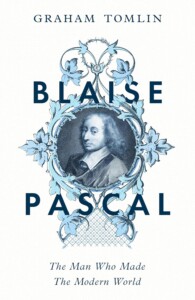
Blaise Pascal: The Man Who Made the Modern World
The French polymath, Blaise Pascal (1623–1662), has rightly been called a masterful writer who shaped French prose, a brilliant mathematician, a pathbreaking experimental scientist, an inventor, a witty polemicist (The Provincial Letters), an apt and original Christian apologist (Pensées), and an acute philosopher, both in the disciplines of philosophy of science and philosophy of religion.1 I have commended him as such for decades and have argued that he is undervalued or even ignored especially as a philosopher and apologist.2 According to this wide-ranging, well-researched, gracefully written, and compelling volume by Graham Tomlin, Blaise Pascal was no less than “the maker of the modern world.” Hyperbole is out of order in an academic volume such as this. But is this hyperbole?
A particular philosopher or thinker may be hailed as founder of a particular school of thought or as a revolutionary in some area. Thus, Soren Kierkegaard might be “the father of existentialism.” But what would be required to be a maker of the modern world? In 1955, Louis Untermeyer released a large and ambitious biographical volume called, Makers of the Modern World, with entries on ninety-two people (philosophers, composers, novelists, scientists, politicians, artists, dancers, and others) who were “makers of the modern world.”3 In every case, the question was what a particular person contributed to some feature of the modern world (for good or ill). Most of the makers sketched by Untermeyer made decisive contributions in but one discipline or endeavor, such as politics (Churchill), science (Einstein), or psychology (Freud). The author limited his entries to figures influential in the late nineteen to twentieth centuries, so Pascal was not a candidate. But if we look further back, we find that Pascal was indeed a “maker” of the modern world in several respects.
Pascal made lasting contributions to several fields, and his largely invisible fingerprints are everywhere. However, few possess the knowledge to dust the fingerprints to identify his influence. Let us revisit his achievements related to our lives. If you use a computer, you should know that Pascal designed a forerunner to the computer, the first working calculating machine (the Pascaline). An early computer language was called Pascal. His pioneering work on probability theory—a concept we take for granted, but unknown in Pascal’s day—has shaped the modern world. Business, politics, defense, science, engineering, medicine, insurance, and dozens of other areas require probability calculations that stem from Pascal’s discoveries. His experiments led to the invention of the syringe, to the concept of a hydraulic pump, and to the basic principles of hydrostatics. Next time you use a syringe or get an injection, thank Monsieur Pascal. When you use public transit, remember that Pascal invented the idea of the omnibus, which stemmed from his concern that the poor in Paris had no good way to make it across the city for their needs.
Thus, in his scientific and mathematical work, Pascal provided seminal theoretical concepts and practical devices (or their precursors) that make up our daily living. In the world of ideas, he is popularly known mostly through two basic ideas: the wager on God and “reasons of the heart.” Unfortunately, his brilliant insights in both areas are often distorted or hollowed out through ignorance, caricature, and oversimplification. (His idea that everyone has a “God shaped vacuum” that only God can fill is also well known, but less distorted.) This new book, however, commits no such intellectual offenses but is filled with insightful exposition and analysis.
Graham Tomlin is director of the Centre for Cultural Witness, based in Lambeth Palace, president of St. Mellitus College, and author of books on theology and the philosophy of religion. He has graced us with a thorough and sympathetic work on Pascal. It is an intellectually rigorous account of both the life and thought of Pascal, yet it is not uncritical or hagiographic. After dedicating much of my long academic career to the study and defense of Blaise Pascal, I found little with which I disagreed. Nor did I detect any omissions of significant ideas or events in Pascal’s life. Instead, Professor Tomlin not only establishes that Pascal was in fact “the man who made the modern world” (as the subtitle claims) but argues convincingly that Pascal’s mark was beneficial to posterity; his genius was not wasted; nor was it limited to his momentous scientific achievements and discoveries.
Moreover, aspects of Pascal’s character, especially his faith, his courage amidst theological controversy, his concern to win unbelievers to the Christian faith, and his kindness towards the poor (especially at the end of his life), are worthy of emulation and respect. Tomlin narrates Pascal’s life from birth to death with nuance and appreciation. Although Pascal did not write much about himself—unlike the self-obsessed Montaigne, about whom Pascal wrote, he was more fascinated with nature, God, and culture than with himself—we learn that Pascal’s genius sometimes gave him a superior attitude expressed through arrogance. This, however, was softened after his “second conversion” experience or “night of fire” in 1654 when the reality of God in Christ overwhelmed and humbled him.
This study’s sixteen chapters address all the significant ideas of Pascal in relation to the events of his life. Tomlin displays a rich understanding of the history and culture of seventeenth century France and the thinkers with which Pascal interacted, from the Jansenist and Jesuit theologians to Descartes and Montaigne. Thus, the reader is given a meaty historical and intellectual context for Pascal’s contributions and controversies. Tomlin brings Pascal’s ideas into dialogue with his interlocuters. Let us briefly consider Pascal’s work in the philosophy of science, his involvement in theological controversy, and his perspective on faith and reason.
We have mentioned Pascal’s scientific achievements, but these are tied to his philosophy of science, which, while taken for granted today, was innovative in his day. Philosophical and theological reasons had been given and were dominant that “nature abhors” a vacuum. However, Pascal devised an ingenious empirical experiment to put this to the test. Tomlin describes this in exquisite detail in the chapter, “The Weighing of the Air.” Here Pascal brilliantly challenged the traditional notions about air pressure and the vacuum by conceiving of and designing a careful experiment that contravened received wisdom. Tomlin notes that this was one of the first modern scientific experiments and perhaps the first because it was “carefully thought out, planned, repeated, tested, and the results were published for all to examine” (61). Whatever authority the writings of Plato or Aristotle or the schoolmen might have when we address the contingencies of nature, empirical experimentation is required. Pascal explains this in his essay, “new experiments concerning the vacuum.”
Pascal’s approach contributed not only to the emerging philosophy of science and experimental protocols, but to the relationship of science and theology. One should not look to theology for what can only be found in science or vice versa. For Pascal, these were two complementary sources of knowledge. Although he did not use this metaphor, others in the scientific revolution spoke of “the two books of nature,” both authored by God and which could not contradict each other. Of course, it is a vexed and involved matter just how this is cashed out concerning the biblical claims about the cosmos and the domain of scientific discovery. Nevertheless, Pascal’s essential approach gives us guidance for navigating the terrain.
I do take issue, though, with how Tomlin applies this insight. He seems to think that science provides little evidence for God, given that Darwin defeated the teleological argument, although he is sympathetic toward Pascal’s overall apologetic for Christianity, which draws no support from traditional arguments from natural theology. Tomlin shows no awareness of the great strides made in natural theology—which often draw on discoveries in physics and biology—in the past fifty years given by philosophers such as Richard Swinburne, J. P. Moreland, William Lane Craig, and the Intelligent Design movement or the substantial scientific critique made of Darwinism by members of the Intelligent Design movement, such as William Dembski, Michael Behe, and Stephen C. Meyer. This case against Darwinism and for design is best summed up by Meyer’s superb work, Return of the God Hypothesis.4 But, of course, Tomlin’s work is not a survey or critique of natural theology; nevertheless, some mention of this philosophically consequential development should have been made. Pascal’s apologetic could be pointedly strengthened through natural theology, although he himself avoided it and even argued against it.
Although it is less well-known than other aspects of his thought, Pascal was embroiled in a theological controversy between the Jansenists and the Jesuits. Jansenism was an Augustinian reform movement within Catholicism that was brought into conflict with the Jesuits over soteriology and the nature of the Christian life. Tomlin covers this carefully and with theological aplomb. While Pascal was likely never a Jansenist per se, his sister, Jacqueline, joined the movement as a nun. He wrote a series of brilliant letters exposing, refuting, and even mocking the moral compromises of the Jesuit approach to sin and confession and advocating Jansenist theology. The issues are complex theologically, but center on the sovereignty of God and the depth of human sin in relation to salvation. Tomlin limns the controversy astutely. The Jesuits took up a latitudinarian if not antinomian approach to Christian ethics that exonerated sin and justified immoral behavior. They left little sin worthy to be confessed to a priest. Pascal’s approach was a combination of journalism, satire, and theological critique—a combination of forms perhaps never before attempted. We have it as The Provincial Letters. In Praise of Folly (1511) by Erasmus might be an analogue, although neither Tomlin nor Pascal mentions it.
Pascal wrote under a pseudonym, since he was in danger because of his criticism of the powerful Jesuits. Reformed Protestant readers such as I may find themselves resonating with many of the theological and moral themes that Pascal defends, but Tomlin wisely warns against deeming Pascal a crypto or nascent Calvinist. He remained loyal to the church until the end, even though the Jansenist movement was crushed by the church. To my mind, the Catholic response was a shame.
I mentioned above that Pascal’s presentation of the wager and his statement that the heart has reasons of which reason knows nothing are often misunderstood. Let us explicate this. Tomlin patiently expounds both the wager and Pascal’s broader epistemology of religious belief and thus helps recover and defend Pascal’s real insights on these matters.
The wager argument is one of the longer fragments of Pascal’s Pensées but was written out in a way that makes its proper sequence of ideas challenging. However, the basic structure is discernible, and it is set up as a dialogue between a believer and an unbeliever. Although I cannot canvass his total treatment, Tomlin expertly explains the wager and answers all the major objections to it in “A Spinning Coin at the Edge of the Universe.” The wager can be summarized in a statement from Pensées, which Tomlin quotes, “I should be much more afraid of being mistaken and then finding out that Christianity is true than to have been mistaken in believing it to be true” (353).
Tomlin notes that it is not an argument for God’s existence, but rather a prod for a hardened skeptic to seriously consider Christianity in light of the potential gains or losses relative to belief or unbelief. Even if the unbeliever cannot decide through reason if Christianity is true, it makes sense to wager on God by involving himself in religious activities in the hopes that he may indeed believe.
Tomlin makes clear that Pascal thought that there are sufficient reasons to be a Christian, but that these are not rationally overwhelming. They can be refused, even though he gives a cumulative argument in Pensées based on prophecy, the Christian explanation of human nature, and other arguments. But Christianity is not irrational. Yet when considering (1) the possibility of an infinite gain of believing in Christianity if Christianity is true and (2) the finite loss of worldly enjoyment, the rational person should choose Christianity. Tomlin brings out an essential element of the wager often overlooked. The purpose of the wager “is to expose what Pascal sees as the moral hostility that exists within the stubborn unbeliever to truth. It exists to reveal his self-deception” (330). If the skeptic cannot believe, it is a matter of his passions restraining him, not his reason. Thus, Pascal advises the skeptic to act religiously in the hope that he will end up believing. One should simply numb his reason until he has faith.
Some have taken this advice as anti-intellectual: simply numb your reason until you have faith. But that interpretation sells Pascal short. A basic principle for interpreting and critiquing Pascal is to remember that “Pascal is smarter than you are.”5 If one of the greatest minds of all time seems to be claiming something patently false or irrational, it is likely that you haven’t understood his claim. To consider this piece of advice, Tomlin explains Pascal’s epistemology, which is a sophisticated account of how rational inference, intuitive knowledge, and bodily actions and habits (the machine) all contribute to knowledge. Since the interlocuter sees the benefit of believing and has no scruples that Christianity is irrational, he needs to engage in actions that might help him believe.
This brings us to Pascal’s well-known statement from Pensées, which is so often misconstrued: “The heart has reasons of which reason knows nothing.” Although Tomlin does not dedicate a chapter to this principle, he investigates it throughout the book, placing it in the context of Pascal’s sophisticated epistemology (see 321–325). Pascal is often misinterpreted to mean that the heart is merely the emotional center which gains religious knowledge apart from and even in opposition to reason. In other words, Pascal was a fideist. Space forbids a thorough accounting of how wrong this is but suffice to say that Tomlin explains that Pascal claimed that “the heart” was an organ of intuitive or a priori knowing. It does not oppose what can be known through reason (taken as rational inference from evidence). Rather, it provides a foundation for it and a means to transcend it.
Tomlin observes that Pascal gave a cumulative case for the rationality of Christianity, although he understates the force of his argument in some ways. I take Pascal’s account of human nature as “deposed kings” to be one of his strongest arguments for Christianity. Only the biblical view accounts for our greatness (through the divine image) and our wretchedness (through the fall) and offers hope of redemption (through the work of Christ). Tomlin refers to this several times, but does not, to my mind, adequately plumb its apologetic power.
Space forbids discussion of all the topics Tomlin addresses. He seems to have omitted nothing of significance and handles every Pascalian topic with a learned and good-natured eloquence that I admire (even when I disagree). Yes, Pascal was “the man who made the modern world”—or at least one of them—and, if we rightly attend to his genius, we and the world will be the better for it.
Footnotes
- Blaise Pascal, Les Provinciales (Cologne, 1657); Blaise Pascal, Pensées (1670).
- See Douglas Groothuis, Beyond the Wager: The Christian Brilliance of Blaise Pascal (IVP Academic, 2024).
- Louis Untermeyer, Makers of the Modern World (Simon and Schuster, 1955), https://archive.org/details/dli.ernet.53906.
- Stephen C. Meyer, Return of the God Hypothesis (HarperOne, 2021).
- I picked this up as a general principle for doing philosophy from Professor Ed Miller years ago.