In the first post, I shared a story about Mike Mulligan [link] that shaped me. In this one, I want to share the story that shaped my current approach to engineering education. It’s the story of how the t-shaped engineer came to be, and how a quiet theological correction helped me see its deeper truth.
The t-shaped Engineer
For over a decade, I had championed an approach to engineering education focused on producing T-shaped engineers—those with technical depth and strong professional skills: ethics, grit, motivation, communication.1 It was a model that made sense. It worked. And I believed in it.
Then, I got a call that would change the direction of my entire professional life. LeTourneau University was looking for a Dean of Engineering. I wasn’t looking – I had worked a great deal on personal contentment as a life skill, and was reasonably happy in my current role at another University. But the call intrigued me, and as I learned more about LeTourneau, I became more excited.
Then, I read Steve Mason’s white paper – it defined LeTourneau as The Christian Polytechnic University, laying out a saga for the institution and a vision for who they were and what they could be. I was hooked. I saw also how the T-shaped engineer that I had been working with could and should evolve based on my faith. How Jesus’s greatest commandment – To Love God and Love people, translated seamlessly into a better, fuller model – a lower cased t.
The lower vertical represents a technical foundation. The horizontal cross piece recasts professional or soft skills into relational ones that help us connect with other people. And the upper vertical points toward God, centering Him as our ultimate purpose.
It is my belief that this model answers the two most critical questions of the age for engineers: (1) Why? Why does my vocational work matter? And (2) How do we solve the current crisis of connection? It does this by explicitly answering Whose we are and Whose image we were made in.
I developed this in preparation for the job interview. I got the job. Soon after, I visited with my new boss and Provost, excited to begin the work of focusing the engineering group around the t-shaped engineer concept. They were already doing this work – but naming it in such a simple and powerful way could help intentionalize our pursuits, giving them vision, power and resonance. Or so I thought then – and still do today.
My boss, a wise man, said, “Sounds wonderful Mike, but why don’t you run it by the Theology Department before we get too excited – make sure it’s Biblical.” I was a little puzzled, and perhaps my enthusiasm was a bit dampened, but off I went to visit with one of the theology professors.
I sat in his office, still excited, and told him about this thing called the t-shaped engineer. He listened, thought for a moment, and then said, “I’m sorry, no, that doesn’t work. We can’t do that.”
What?
I was confused, a little miffed, perhaps also a bit nervous. This was one of the centerpieces of the vision I was casting in my new role.
He paused, then continued. He said, “God is in all good things. All of them. You can’t push Him ‘up there,’ or ‘over there.’ You can’t separate Him out. He isn’t bolted on or extra. If there are good things in your technical depth, He’s there. If there are good things in the relational aspects of your model, He’s there too. If it is good, it starts with Him.”
I was floored, and my wonderful Theology colleague was right.
This is in fact one potential ‘failure mode’ for the t-shaped engineer as a concept. But I did push back a little with something that I think my Theology friend really appreciated.
“Don’t you think that the overall shape gives it away?” I asked. The model is intentionally cross shaped, and that shape leads us to the point that God is central in all of it. He’s in every part. The shape itself points to Him directly.
My colleague paused, thought and said “You’re absolutely right, how about I add this to my theology class this fall?”
That’s the story of how the t-shaped engineer came to be accepted at my institution. Initially through a quiet conversation, and a humble Theology professor who invited me in to a learning moment. That conversation didn’t just affirm the model—it deepened it. It reminded me that the shape itself is a theological claim. In an age shaped by AI and digital acceleration, this model offers a way to form engineers who are not only competent, but wise—who know how to build, relate, and discern.
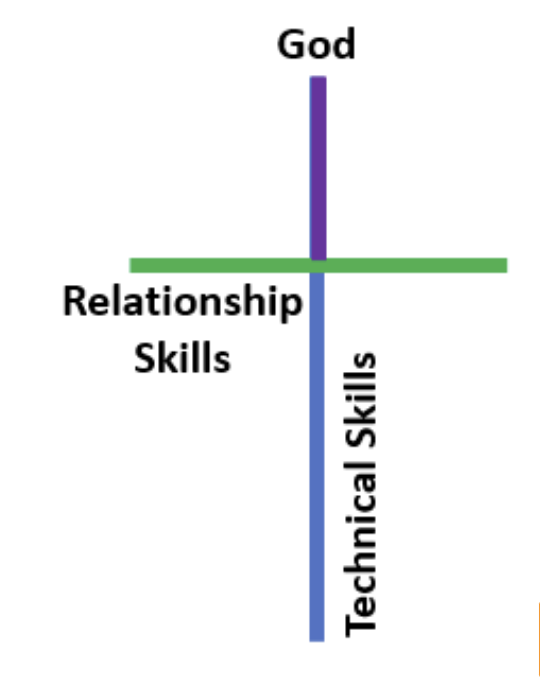
Figure: t-shaped model
The t-shaped model is not perfect. Like any framework, it can be misunderstood or misapplied. One of its greatest risks is the temptation to compartmentalize God—to treat Him as an add-on rather than the source of all good things. It is important for us to look for this tendency in our lives – that posture of trying to separate God from our work, our thinking and our passions.
This is the deeper challenge of the digital age. It is not simply that AI might replace engineers, or that smartphones are eroding attention spans, though both are true. It is that the accelerating pace of modern life makes compartmentalization feel like wisdom — keeping God tidy, separate, manageable, while we get on with the real work. The t-shaped model is a protest against that impulse. The shape itself will not allow it.
At its best, this vision invites us to see engineering not merely as problem-solving, but as a vocation shaped by love—love of God and love of neighbor—infusing technical work with deeper purpose and hope.
Formation has always been slow, communal, and resistant to shortcuts. The hearth requires tending. The circle requires showing up. The cross requires everything. These are not obstacles to the work — they are the work.
1 The T-shaped engineer concept has a rich genealogy. David Guest coined the term in 1991; Leonard-Barton developed its pictorial representation in 1995. The more contemporary meaning — technical depth combined with professional and communication skills — is captured well by Dean James Plummer of Stanford, who described Stanford engineering graduates as ‘capital Ts — vertically supported by strong math and science training but stretching laterally with extensive business and communication skills’ (2011).